Subscribe to Marlin magazine and get a year of highly collectible, keepsake editions – plus access to the digital edition and archives. Sign up for the free Marlin email newsletter.
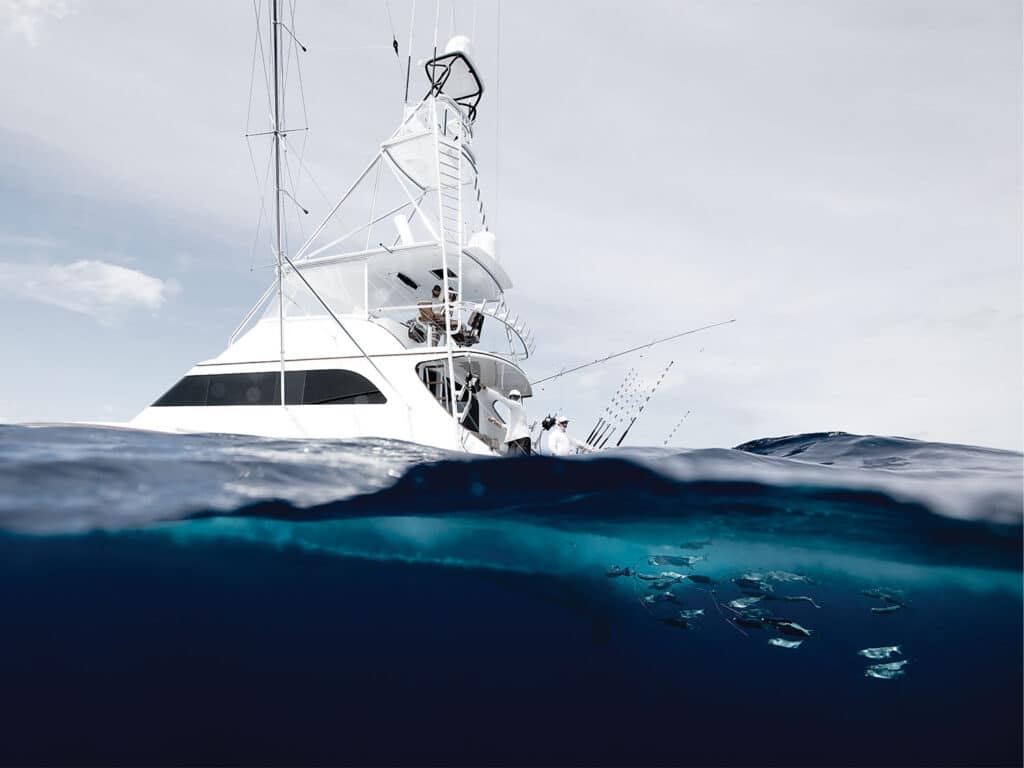
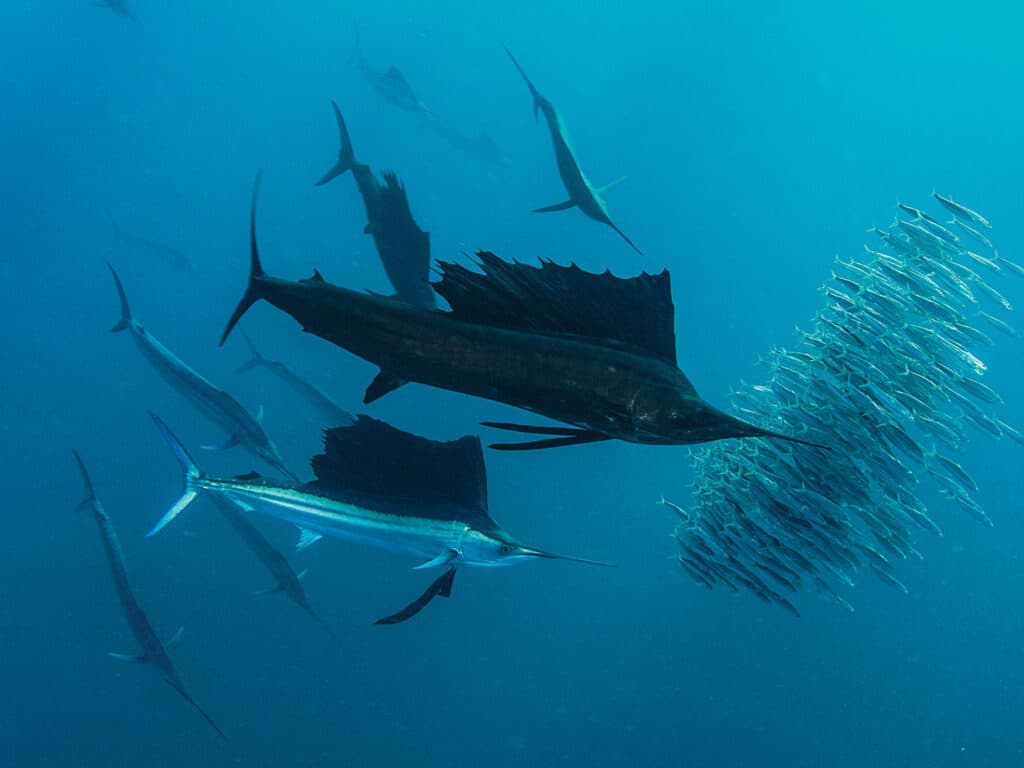
Tournament crews today pull dredges for one reason: to make a billfish believe there’s a real bait school behind the boat. But within that simple goal is a highly technical game of depth, motion, profile, scent and constant adjustment.
How captains create that illusion varies widely by region, target species, boat setup and personal philosophy, and the smallest details can make the difference between a fish fading off or converting to a release. What follows are tips, tricks and hard-earned approaches from three top captains who have spent years refining the art of building the perfect baitball.
Dredging Deep
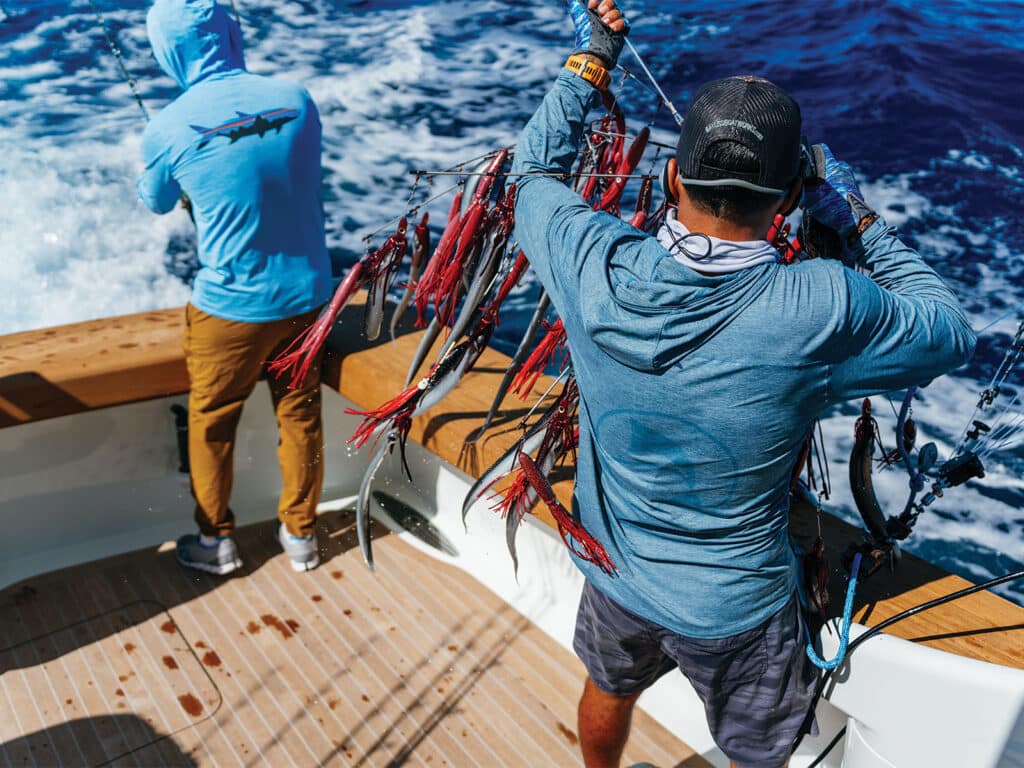
For Capt. Mark Pagano aboard the 61 Blackwell Big Booty, an operation that splits time between the DR and Costa Rica, dredges are all about adjusting depth to draw fish up into the spread. Fishing in these two locations specifically, Pagano prefers heavier dredges and natural bait whenever he can get it. “In Costa Rica, a lot of times you just can’t get enough quality bait, so you end up fishing more plastics,” Pagano says. “But where I can get meat, I want meat.”
Pagano likes black-and-purple color schemes and heavily weighted mullet dredges with 3- to 4-ounce chin weights on individual baits. Combined with heavier leads—often in the 8- to 10-pound range, depending on conditions and speed—he wants his dredges fishing deep. “The deeper, the better,” he says. “We’re trying to create a stepping stone to bring fish up into the spread.”
In places like Costa Rica, where crews often troll faster for mixed species, Pagano says dredges might run 30 feet or deeper. When fish show around deep bait schools, crews can slowly raise the dredge in the water column and often pull the fish right up behind the boat.
However, he stresses that dredges are not passive teasers. “You can’t just put a dredge out and forget it,” he says.
Pagano relies heavily on LP 24-volt teaser reels with alarm systems. Experienced crews quickly learn the difference between a dredge slowly loading up with grass and the sharp surge of a billfish crashing the teaser.
That attention to detail matters because once a fish fully eats a teaser bait, it has “permission to leave,” as Pagano puts it. “The whole idea is to hold that fish there just long enough to get a pitch bait to him,” he says.
Staying Shallow
Capt. Scott Fawcett is a veteran tournament captain who runs Off the Chain fishing charters in Stuart, Florida, as well as boats in prominent tournament hotspots. In his home waters off Stuart, while fishing from his Contender, Fawcett runs his dredges much higher in the water column. He prefers lighter dredges that stay visible from the tower, allowing crews to watch fish track and react to the teaser. “As much as I like getting the bite, I really like seeing the bite,” Fawcett adds.
However, one of the more interesting concepts we discussed was that of dredge “breathing”—the opening and compressing action of a bait school reacting naturally to wave motion and boat speed. He intentionally uses lighter leads toward the back of the dredge so trailing baits lift naturally in the wash. “When you watch real bait getting chased, the back of the school starts getting pushed up,” he says. “You want the dredge doing the same thing.”
But that constant flexing action comes at a cost. Fawcett says traditional stainless and titanium dredges eventually lose their spring and stop fishing correctly. “For years, I’d get maybe two to five days out of a dredge before it lost its shape,” he says. Recently, Fawcett began experimenting with tapered fiberglass-composite dredge bars that retain their flex far longer than traditional metal frames.
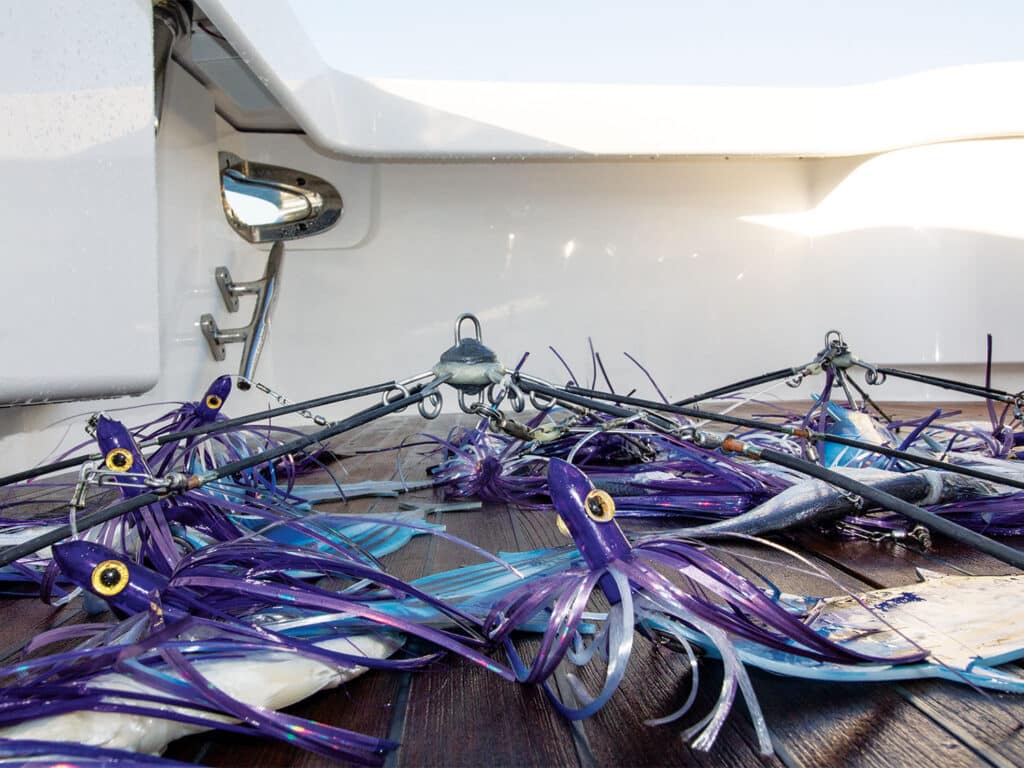
The region he fishes also heavily influences his setup. In Stuart, Fawcett still prefers natural mullet dredges, sometimes mixing in rubber fish to help balance, lift, and keep the tails from sagging. In the Northeast, however, pink squid dredges are his go-to because they remain deadly for white marlin. In Central America, Costa Rica’s bait shortages continue to push many crews toward artificials.
Fawcett also pays close attention to the slick produced by fresh mullet dredges. During tournaments, crews may refresh or lightly crush mullet heads midday to increase scent and oil in the water. “You’ll fish around that slick because it absolutely gets attention,” he says.
His teaser systems have evolved as well. On larger sport-fishers, Fawcett runs LPs or upgraded Miya Epoch teaser reels, while his Stuart center-console program uses Cannon downriggers fitted with custom fiberglass booms built from repurposed Rupp outriggers. The Cannon systems allow crews to remotely cycle dredges through the water column from the tower.
Attention to Detail
Capt. Randy Yates, who runs the 54 custom Mallard out of Palm Beach, Florida, harps on how modern dredge fishing continues to evolve rapidly, especially on the artificial side. But he still believes there are times when natural bait simply outfishes everything else. “There’s a time and place for both,” Yates says. “But there’s still something about real bait.”
Like the others, Yates largely favors six-arm dredges, though he warns bigger isn’t always better. “I’ve been outfished plenty of times by smaller, cleaner dredges,” he adds.
Yates says many crews now fish combinations of natural bait and artificials, especially when traveling internationally where bait supplies become limited. He points to increasingly realistic mullet-style plastics already seeing success in Bahamas tournaments.
Still, Yates believes proper rigging remains one of the most overlooked parts of modern dredge fishing. “Just because you have a bait out there doesn’t mean it’s attracting anything,” he says. “It’s got to swim right.”