Subscribe to Marlin magazine and get a year of highly collectible, keepsake editions – plus access to the digital edition and archives. Sign up for the free Marlin email newsletter.
Spend enough time around billfish anglers, and you’ll likely hear it repeated in some way or another: If the goal is simply to catch one, there are much easier ways do so than with a fly rod. But ease was never the point. And what was once dismissed as a novelty and laughed off has matured into one of the sport’s most compelling pursuits—one that continues to draw increased interest.
The first documented fly-caught billfish was a Pacific sailfish in 1962. Since then, fly-fishing for billfish has developed significantly. Not only have tactics and gear improved immensely, but fly-fishing destinations and sport-fishing operations now specialize in targeting specific billfish species: Guatemala for Pacific sailfish, Cozumel for Atlantic sailfish, Morocco for white marlin, Mag Bay for striped marlin, the Dominican Republic for Atlantic blues, FADs off the coast of Costa Rica for Pacific blues, Australia for blacks, and Majorca for spearfish and swordfish, to name just a few.
What follows is a brief history, with the high points and development, of how fly-fishing for billfish has evolved into a global obsession.
The Beginning to the Golden Years
Fly-fishing for billfish can trace its roots to the early 1960s when Lefty Reagan, a Key West guide who often fished with Dr. Webster Robinson, developed a teasing technique that brought cobia and amberjack to the surface. Reagan and Robinson, a pioneer in bluewater fly-fishing, discussed adapting the technique for billfish, but early attempts to catch an Atlantic sailfish on fly failed.
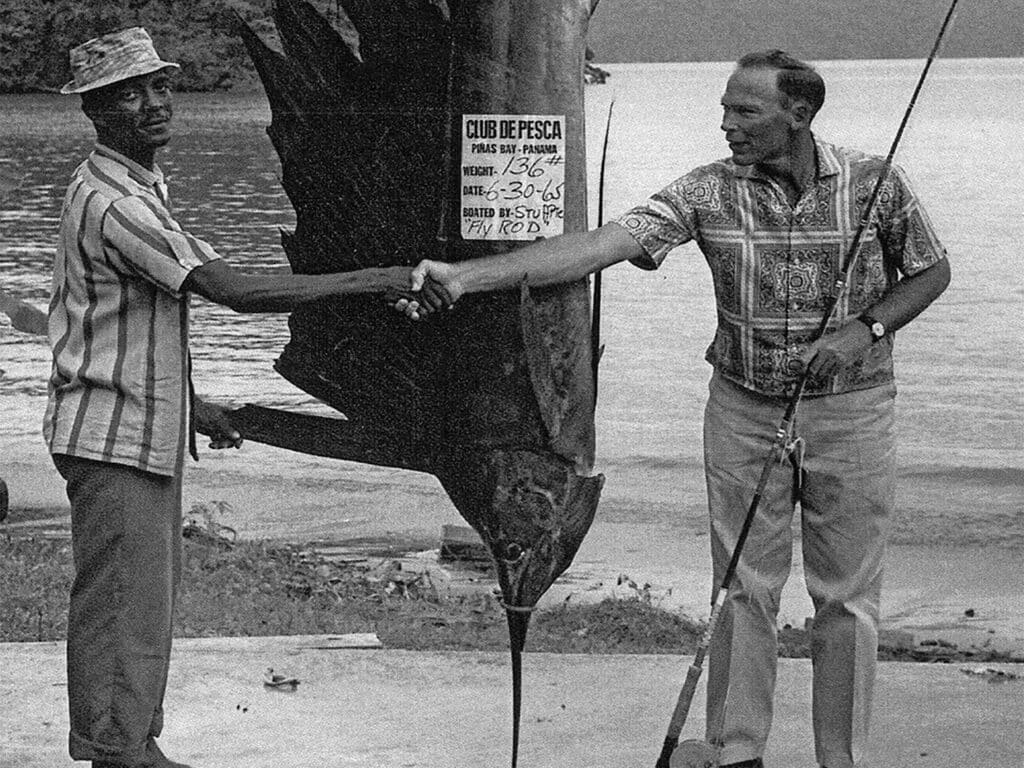
Robinson brought this technique to Piñas Bay, Panama, in 1962, where he used it to successfully land a 74.5-pound Pacific sailfish. Fishing aboard Capt. Louis Schmidt’s Caiman, Robinson’s sailfish is recognized as the first billfish caught on fly. And the fish was no fluke; rather, it was the result of a considerable amount of effort, experimentation and expense.
Following Robinson’s success, other early billfish fly pioneers used the “Robinson System” of teasing fish to capture more billfish on fly. J. Lee Cuddy of Miami, a close friend of Robinson’s, captured the first fly-caught Atlantic sailfish—a 47-pounder—off Florida in June 1964. With the new sport gathering momentum, notable anglers of the day, including Stu Apte, Lee Wulff, Mark Sosin and Billy Pate, all set about catching their first billfish on fly. At that time, there was no governing body to record and maintain fly-caught records on saltwater fish, so the Saltwater Fly Rodders of America was formed, with the legendary Mark Sosin as its head. From that seat, Sosin went about setting the foundation by which saltwater fly-rod world records and catches were measured and validated. The organization existed in that capacity until 1979, when the IGFA assumed responsibility for this record category.
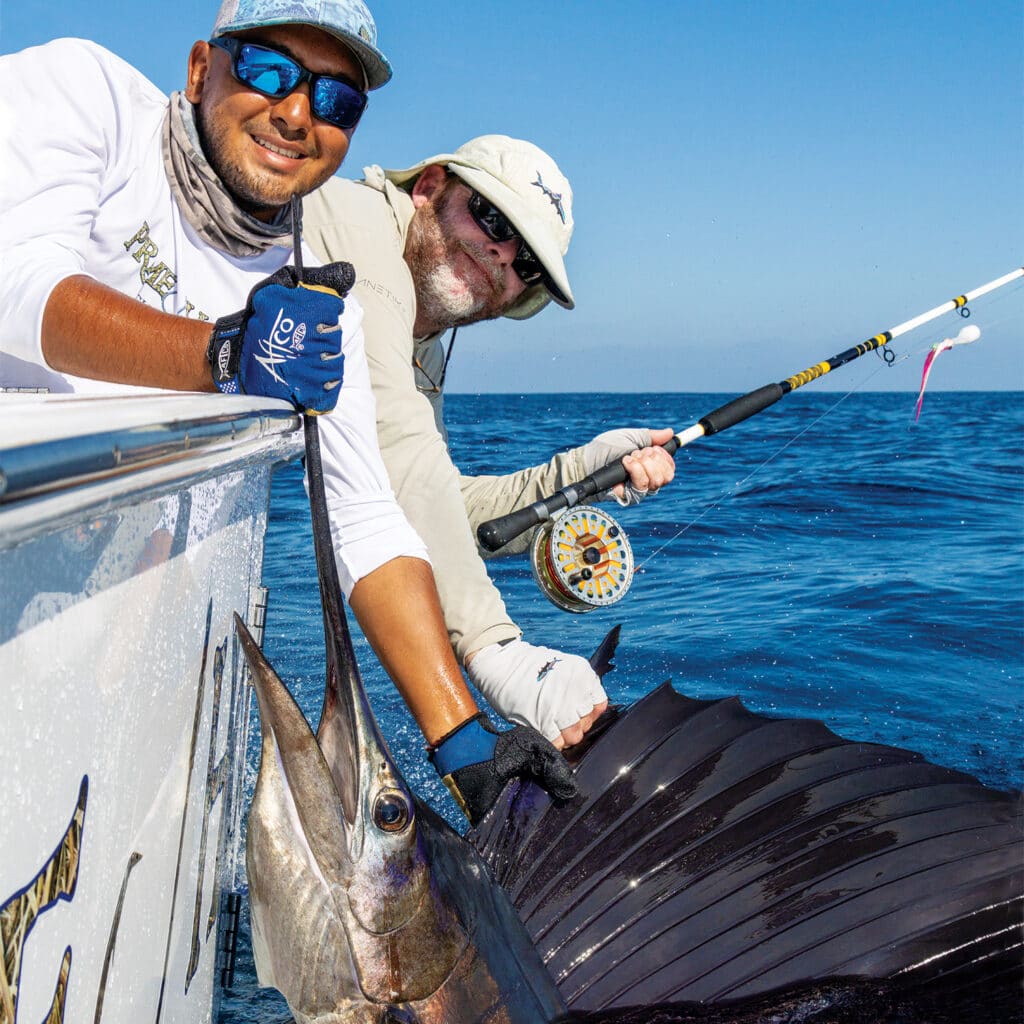
Moving into the 1970s, the pursuit of billfish on the fly expanded globally. Fishing in Australia between February and March 1973, Billy Pate, who had already caught a striped marlin on fly in Ecuador, caught the world’s first black marlin on fly. In doing so, Pate became the first angler in history to catch two different species of marlin on fly. On the same trip, Pate’s then wife, Laura, also caught a small 38-pound black marlin on 10-pound tippet, becoming the first woman to catch any species of billfish on a fly. Though the Pates’ blacks were small, Billy Pate’s 46-pounder on 6-pound tippet still stands to this day. Billy Pate is also credited with being the first angler to catch a white marlin on fly, with an 80-pound fish caught off Venezuela on 16-pound tippet in 1975. After this initial push, the pursuit of billfish on fly would soon enter what many consider to be the sport’s “golden era.”
The late 1990s into the 2010s is when fly-fishing for billfish ceased being a niche sideshow and started carrying real weight, thanks to a handful of anglers and crews who forced the rest of the world to take notice. Thomas Evans Jr. was right in the middle of that charge, and his body of work with the legendary Aussie Dean Butler includes several masterpieces, including a 183-pound black marlin on 12-pound tippet at Port Stephens in 2005, a 272-pound Pacific blue marlin on 16-pound tippet in Vanuatu in 2006, and a 240-pound striped marlin on 20-pound tippet in New Zealand in 2013.
Around the same time, Moroccan angler Fouad Sahiaoui brought the same edge on a global scale, from black marlin in Australia to blue marlin in Cape Verde and white marlin off Morocco. Kenyan angler Jeremy Block kept pushing the frontier with Atlantic sailfish records in Angola and fly-caught swordfish in Kenya.

Enrico Capozzi and Stacey Parkerson, meanwhile, gave the era star power and serious credibility aboard their Spirit of Pilar with Capt. Scott Jones. Their team posted standout records that helped turn heads well beyond the hardcore fly crowd, including Capozzi’s 82-pound Atlantic blue marlin on 8-pound tippet in the Dominican Republic in 2011 and Parkerson’s Pacific blue marlin marks in Costa Rica, including a 187-pounder on 16-pound tippet in 2007. These were the kinds of catches that made people stop and look twice.
But the expansion of fly-fishing for billfish during this period wasn’t limited to record-chasers. Big-game legend Tim Choate recognized a growing interest among anglers eager to target billfish on fly and began accommodating them at his Fins and Feathers operation in Guatemala in the late 1990s. A true visionary, Choate’s early embrace of the discipline helped establish Guatemala as a proving ground for big-game fly-fishing. In the years that followed, renowned captains, including Ron Hamlin, Bud Gramer, Chris and Mike Sheeder, John LaGrone, Erik Lorentzen and Brad Philipps, pushed the boundaries of what was possible, refining tactics and evolving tackle in a fishery that offered anglers, mates and captains an unparalleled volume of opportunities to hone their craft. Those formative years cemented Guatemala’s reputation—one it still holds today for many—as the epicenter of billfish on fly.
These were the formative years of chasing billfish on fly—bold, technical, a little cocky and massively influential. The catches not only filled the record books, but also exposed the limits of existing gear and methods, setting the stage for the next leap forward in fly tackle, boatmanship and billfish-specific techniques.
Changes in Tackle, Changes in Techniques
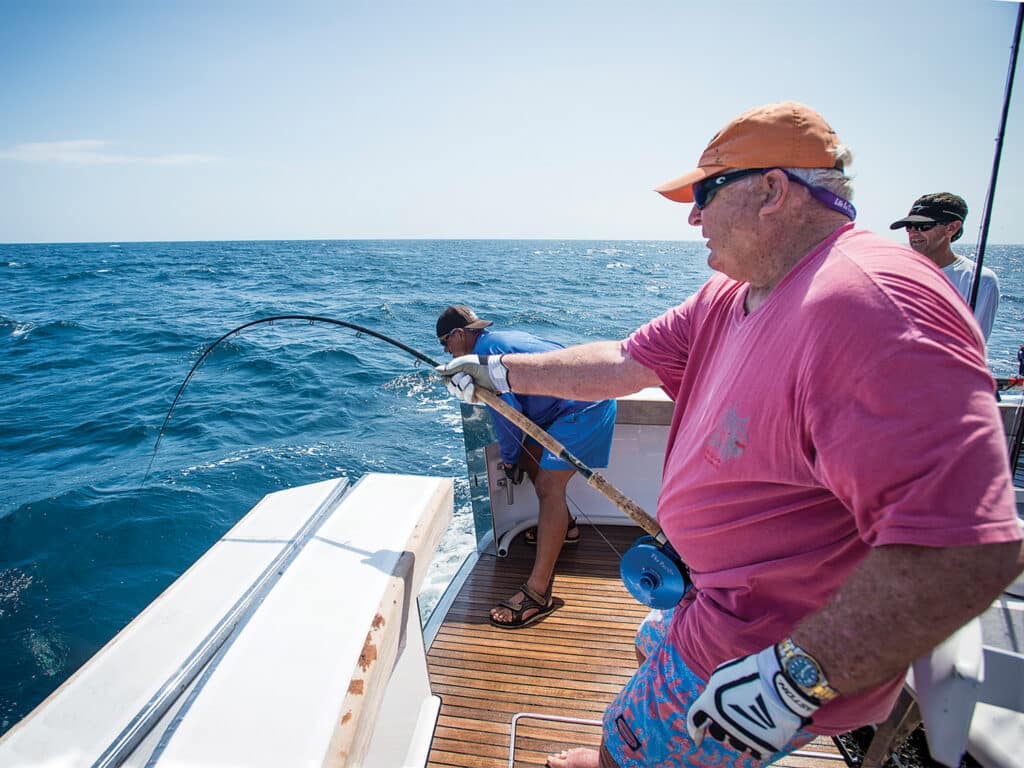
By today’s standards, the tackle Doc Robinson and those earliest pioneers used was crude at best. Most early billfish fly anglers fished using tackle designed for tarpon. While their gear was the best available at the time, it’s safe to say that it is not likely to have stood up to the demands of modern billfish fly anglers. No where is this more apparent than with fly reels.
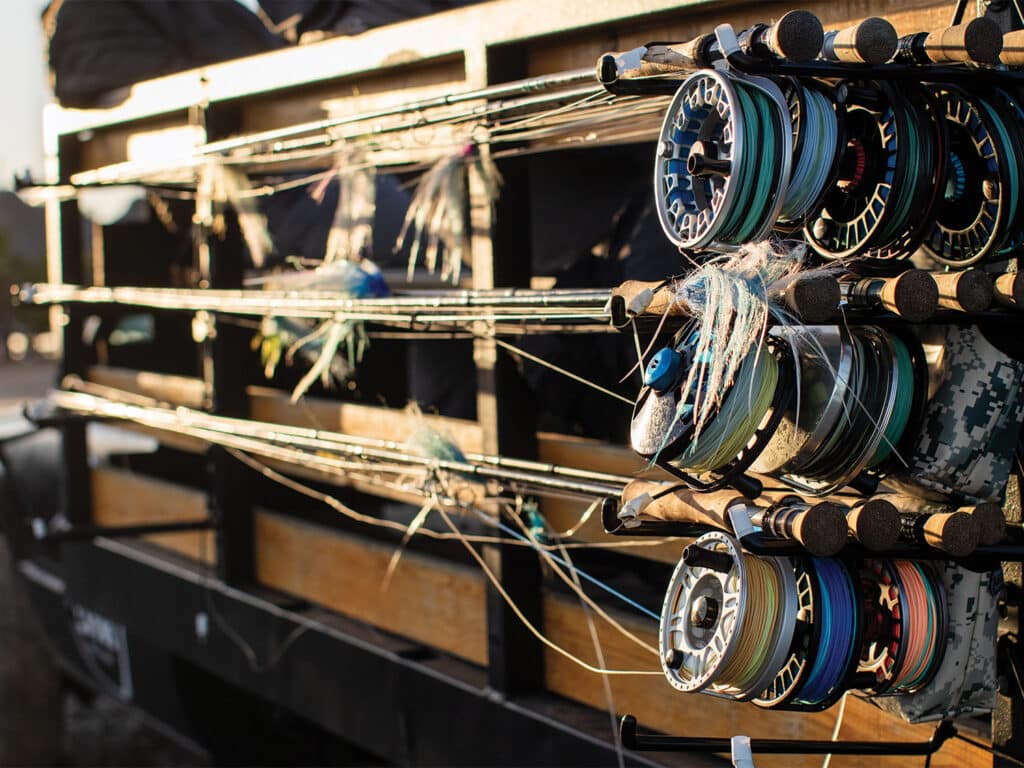
When fly-fishing in fresh water for trout or salmon, the reel’s sole purpose is pretty much to hold the line. This is certainly not the case when chasing billfish, where the reel is an essential tool in allowing the angler to fight and successfully subdue a fish. Anglers looking to catch billfish on fly today benefit from purpose-built reels, beautifully engineered products that have been manufactured with incredibly strong frames and gearing, along with super-smooth, ultra-reliable drag systems.
Capt. Jake Jordan has personally caught over 4,000 billfish on fly, and 2026 will be Jordan’s 33rd year of operating sailfish schools in Guatemala. To date, his students have caught over 15,000 sailfish on fly. Jordan has been involved in the design and development of several brands of fly reels.
“Vom Hoff [fly reels] were the earliest used for billfish, but as the sport increased in popularity, more manufacturers started producing reels specifically for use in bluewater fishing,” Jordan says. “Companies such as Fin-Nor, Seamaster, Tibor and the Argentinian company STH were the main ones. In the 1990s, Penn International fly reels were great big-game fly reels, solidly built with a strong and efficient drag.
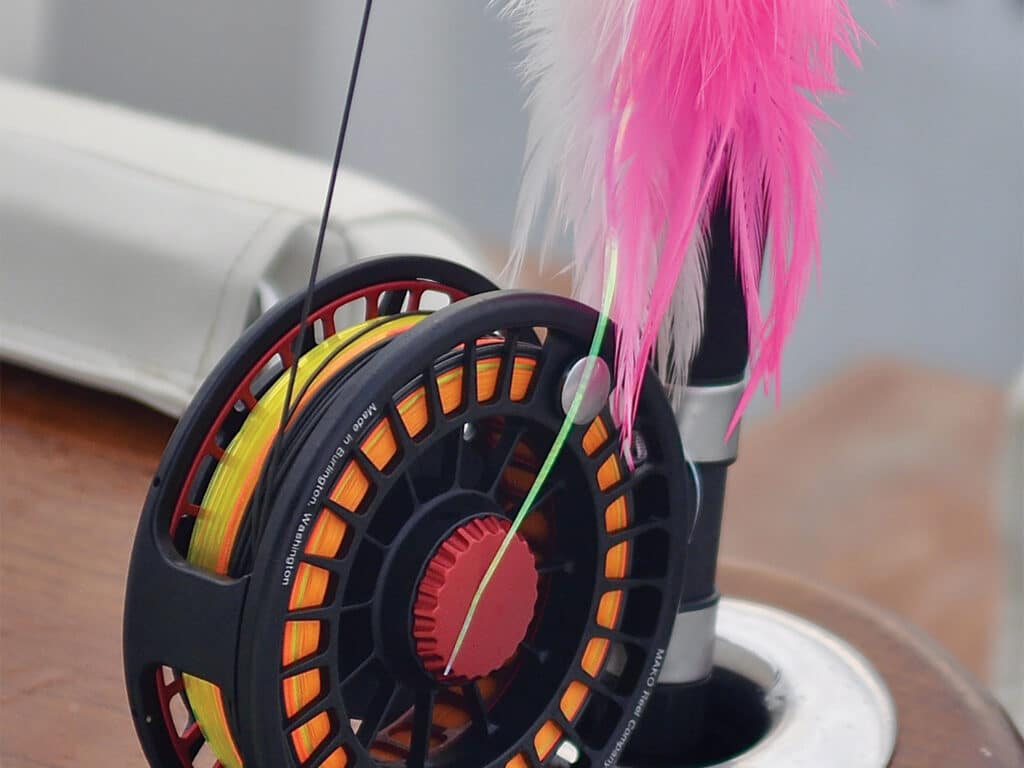
“In more recent years, the Charlton reels have set the standard. They have by far the best drag system,” Jordan says. He adds, “Jack Charlton’s Mako fly reels became the first to feature a drag system with exact drag-pressure settings, settings which never change and remain smooth and constant throughout the entire battle.”
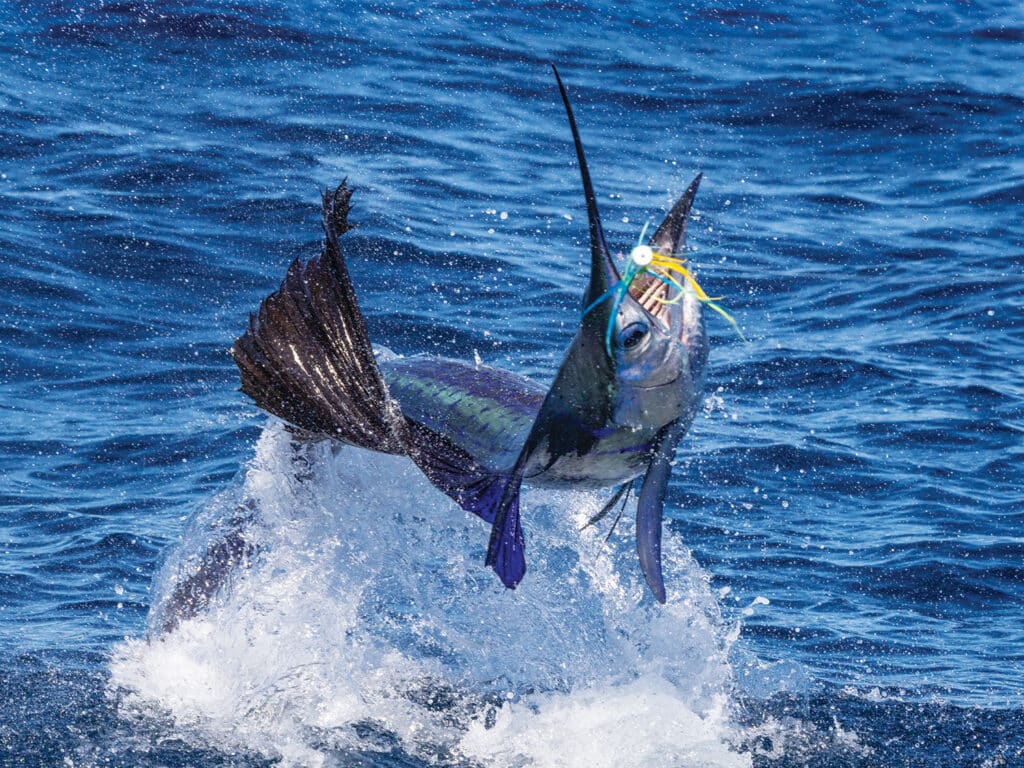
Renowned captain Brad Philipps was on the forefront of fly-fishing for billfish from his base in Guatemala, and echoes Jordan’s thoughts on the evolution of fly reels and how that has impacted technique as well. “Another big difference today is the way we set the hook. Modern bluewater fly reels are vastly superior to the earlier reels. They have a much smoother clutch system, which allows the drag to set the hook rather than the angler.”
Early fly anglers relied on standard 90-foot floating or sinking lines, but their bulk created excessive drag and often snapped fragile tippets. To adapt, many cut lines down to 25 to 30 feet as shooting heads, reducing resistance and improving castability. Some added 100 feet of 30- to 45-pound monofilament between the backing and head for cushioning and control. Today’s purpose-built billfish fly lines and ultra-thin backing maximize capacity and dramatically reduce drag during long high-speed runs.
Rufus Wakeman, another pioneer in big-game fly-fishing, notes that fly-line choice also influences how a fish is fought. “Using a heavy fly line can actually be beneficial because when you’re hooked up, the weight of that fly line in the water will put downward pressure on the fish, often forcing it to the surface to jump, and therefore tiring itself out sooner.” Today, that approach is widely adopted in billfish fly-fishing.
When it comes to billfish flies, the earliest examples were primarily large, feathered surface poppers rigged with stiff double-hooked rigs. However, modern designs have expanded to include large streamers with both single and twin hooks, often rigged for flexibility. Synthetic materials have also gained traction, though not without debate, as renowned Kenyan angler Jeremy Block mentions. “I have also moved away from synthetic hair in the fly, because I find this often gets tangled up by the billfish around the hooks and prevents a good hookup. So, I almost exclusively use feathers in the fly, just like when I first started.”
Hook design has evolved just as dramatically. For most, the oversize, heavy-duty hooks have given way to smaller, chemically sharpened models that improve hookup ratios. “Tandem hook flies used to be the standard when targeting billfish,” Wakeman mentions. “But years ago, when fishing with captains Chris and Mike Sheeder in Guatemala, they turned me on to single-hook flies, and I haven’t gone back. It’s a win-win. Improved hookup ratio and better for the fish.”
Beyond tackle, the biggest shift has come in how fish are hunted. Raising and teasing billfish with hookless baits is now essential, allowing crews to bring fish into range and trigger an aggressive switch to the fly—an art form that has become a defining measure of skill in the cockpit.
And when it all comes together, few moments carry more weight and reverence than the gaff shot. This is especially true when it comes to fly-fishing, as the crews are handicapped in more ways than one. First, due to the fly leaders having a maximum “weakest link” of 20 pounds in the class tippet, there is no such thing as taking wraps on a fly leader to pull on and subdue the fish. Secondly, IGFA rules limit crews to using only fixed gaffs under 8 feet. This often creates a high-stakes, close-quarters challenge that has produced its share of dockside legends—and remains one of the ultimate proving grounds in big-game fly-fishing.
The Next Horizon
The next horizon of big-game fly-fishing isn’t theoretical; it’s unfolding in real time. So, what’s coming up? In recent years, the next generation has continued to push the boundaries of what’s possible offshore with a long rod.
IGFA Chairman Roy W. Cronacher Jr. has amassed an incredible seven IGFA Billfish Royal Slams on fly in his lifetime and is only four fish away from bringing that total to 10. For reference, only three other people—Dr. Martin Arostegui, Jeremy Block and Fouad Sahiaoui—have achieved this slam once.
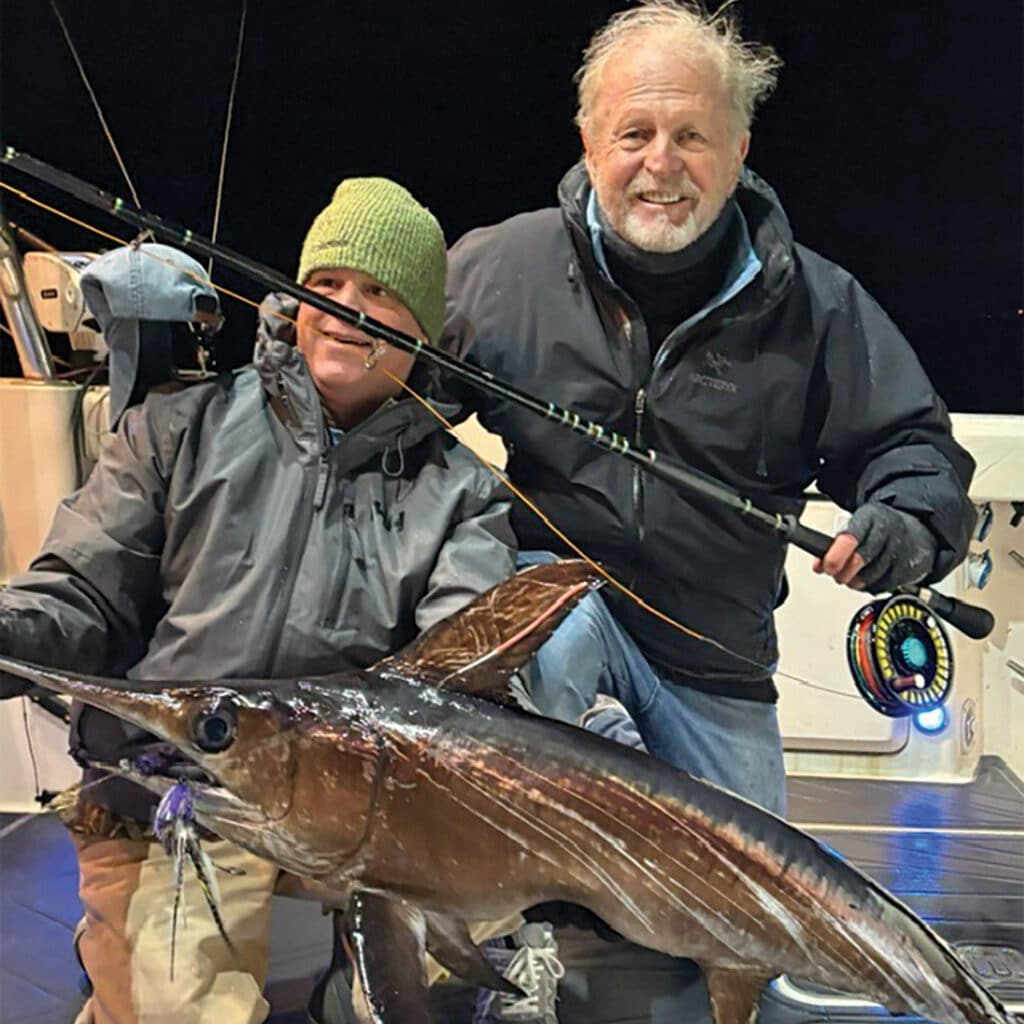
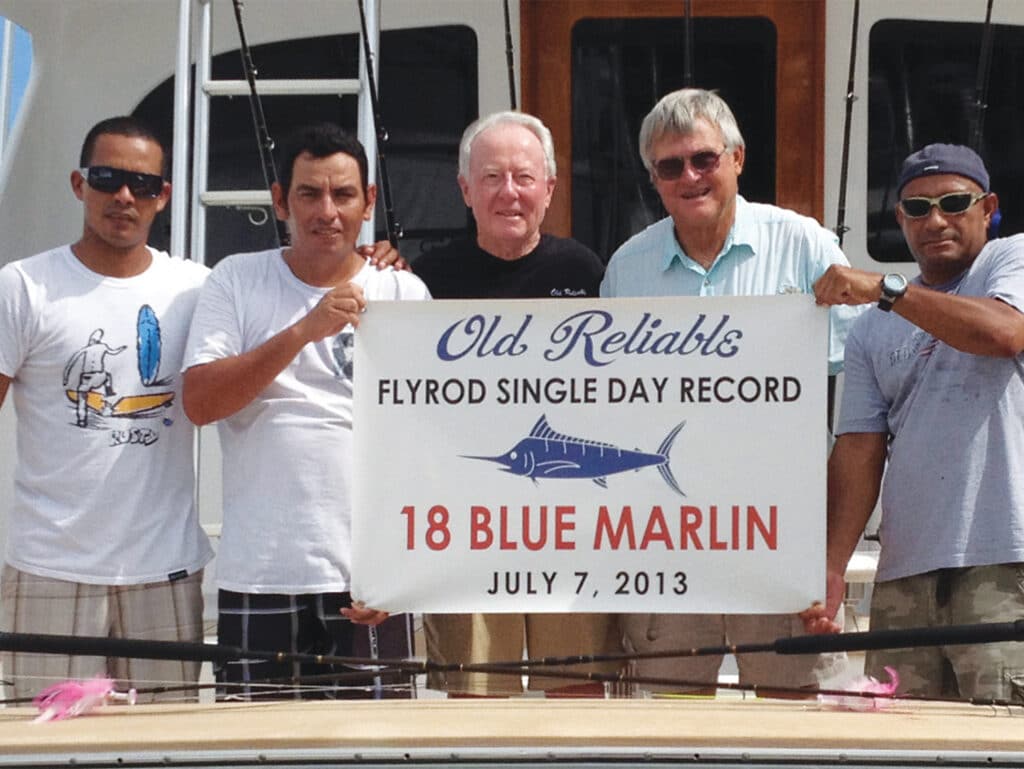
Few angler-captain pairings in the history of the sport can rival what Nick Smith and Capt. Chip Shafer have accomplished in the realm of billfishing on fly aboard Old Reliable. Defined by an obsessive attention to detail and a relentless pursuit of efficiency, the duo has rewritten what’s possible with a long rod in billfishing. With more than 6,000 billfish released on fly and over 500 blue marlin to their credit (and still adding), Smith and Shafer have cemented their status as perhaps the most prolific billfish-on-fly duo the sport has ever seen when it comes to sheer numbers of fish released.
But perhaps most exciting is the new wave of younger anglers drawn in, from Los Locos’ youthful lodge scene to new record pursuits—like Ian Keinath and Jarad Boshammer’s 106.8-pound blue on 12-pound caught in 2024—signaling a new generation rising to carry the torch.
Records will continue to fall, and fish that once seemed out of reach on fly will keep getting closer to reality as the ceiling edges higher. But more than the numbers, it’s about the statement being made: Fly-fishing for billfish isn’t trying to prove itself anymore. It has arrived, and it’s defining a new standard for doing things the hard way.
Fly-Fishing Rules and Record Governance
Tippet Classes
Today the IGFA accepts record claims for billfish in 2-, 4-, 6-, 12-, 16- and 20-pound classes, the latter becoming effective April 1, 1991. Some anglers, including Billy Pate, advocated for the introduction of a heavier 30-pound-class tippet category, which has been declined so far, with the IGFA standing firm on a maximum of 20 pounds for the tippet.
The Game Fishing Association of Australia, the longest established national fishing association in the world, does permit a heavier 15 kg, 30-pound-class tippet, but only when fishing for sharks and billfish. When fishing this class, the GFAA also allows the use of much longer shock tippets, up to a maximum of 1 meter (39.37 inches). Further, whereas the IGFA only permits the use of a fixed gaff with a maximum length of 8 feet and does not allow the use of a flying gaff, the GFAA permits the use of a flying gaff.
Shock Tippets
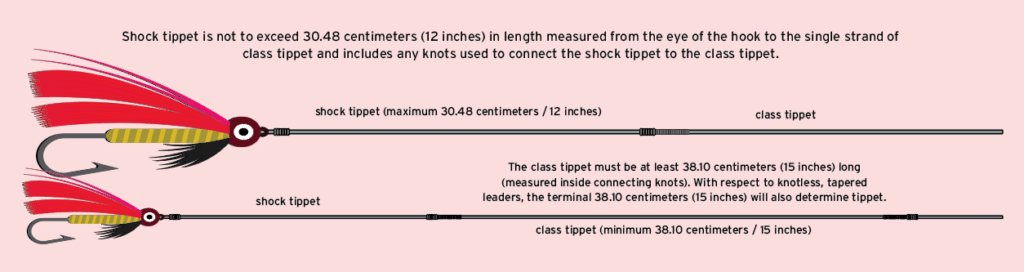
A shock tippet immediately follows the fly and cannot exceed 12 inches in length. It can be made of any material. Shock tippets are not required but are common practice when fishing for billfish or other pelagics.
Class Tippets
A class tippet immediately follows the shock tippet (if used) and must be at least 15 inches in length. The breaking strength of the class tippet is where the catch is classified. The highest recognized tippet class in fly-fishing by the IGFA is 20 pounds.
Hooks and Hook Placement
Anglers are permitted to use up to two single hooks, which must be at least one hook length apart (not overlapping), with the eyes no more than 6 inches apart. Contrary to the ruling on hook placement on skirted lures, the entire hook(s) must be contained within the fly material. No part of the hook arrangement can extend beyond the fly material.
Gaffs
When boating a fly-caught fish, the IGFA permits the use of fixed gaffs up to 8 feet in length. The use of flying gaffs when fly-fishing is prohibited, one of the major differences between conventional and fly-fishing tackle requirements.
No Trolling
The IGFA requirements for saltwater fly-fishing demand that the boat must be in neutral when the angler makes the cast.
Capturing the Evolution
While much of billfish fly-fishing’s progression can be traced through advances in tackle and technique, its growth into the mainstream owes much to those who helped tell the story. Pat Ford, a lawyer by trade and obsessive fly angler by nature, stood at the forefront—his iconic images of airborne marlin and sailfish inspiring generations to take up the challenge.
Equally impactful was Jack Samson, whose prolific work in print brought both clarity and credibility to the pursuit. Through decades of articles and editorial leadership, including as Marlin’s fly-fishing editor for nearly 20 years, Samson not only chronicled the sport’s evolution but also helped educate anglers on its nuances, cementing fly-fishing for billfish as both an art and a discipline.