Subscribe to Marlin magazine and get a year of highly collectible, keepsake editions – plus access to the digital edition and archives. Sign up for the free Marlin email newsletter.
There are certain expectations you are perfectly justified in having when you travel to Panama to fish. You expect heat, jungle, and something large enough to hurt you at the end of the line. You hope for violent surface feeds, screaming drags and the sort of fishing that justifies hauling several bags of tackle through airports in foreign countries. At Sport Fish Panama Island Lodge, I got all of that and then some.
We spent three days running and gunning across the Pacific, chasing tuna and landing the biggest of my life. We explored the legendary Hannibal Bank looking for a black marlin. Threw top-waters for roosterfish and cubera snapper against rugged shoreline. Ate like minor royalty, drank well, smoked cigars and had a private island to ourselves in one of the rawest places I have ever fished.
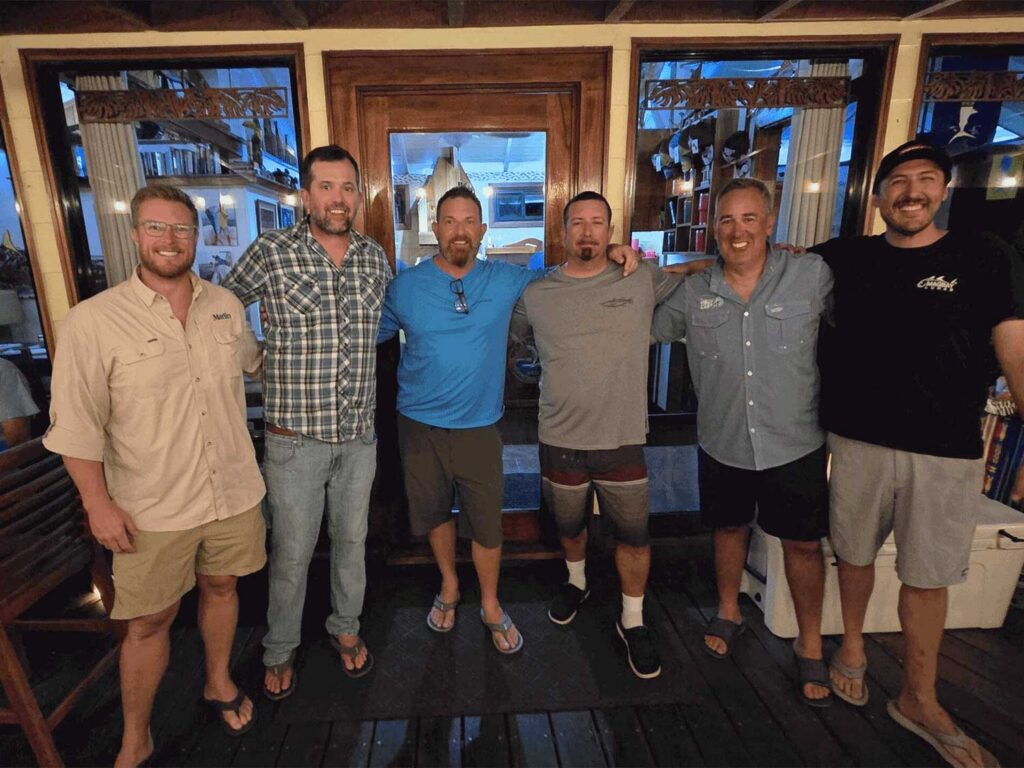
By any reasonable measurement, the fishing trip was a home run. Yet when I look back on Panama, some of the things I remember most clearly are not fish at all. They are characters I shared the experience with. Strangers, mostly, who arrived from different corners of the world with different stories and found themselves thrown together on a remote Pacific island because we all shared the same incurable interest in catching things with fins. That was the welcomed bycatch.
Into Panama
I had been to Panama twice before. The first visit came when I was 10 on a family cruise, during which I received the proper tourist introduction to the canal and jungle but no fishing. I returned in May 2023 while working for the IGFA, when a trip to Tropic Star Lodge included sailfish, some inshore fishing and just enough exposure to Panama’s Pacific side to make me want considerably more of it.
So, when Capt. Shane Jarvis invited me to Sport Fish Panama Island Lodge as an “ambassador” during a VIP experience, there was very little convincing required. The description involved serious offshore fishing, a private island and a collection of anglers and industry partners descending on the lodge for several days. I was slightly uncomfortable with the “celebrity guest” designation, but I decided this was a burden I was willing to bear.
Five weeks later, I landed in Panama City, where the JW Marriott served as our hotel for the transfer evening before the final push west. I met the rest of the group over cocktails. It was an eclectic bunch from different places and with wildly different fishing backgrounds, and quite frankly I was apprehensive about how the week would go. But never judge a book by its cover.
From there, we headed to Huey Magoo’s for a casual welcome dinner, where fish tacos, ceviche and enough tequila helped accelerate the normal social process. Formal introductions faded quickly. By the time we returned to the JW, some elected to investigate the attached casino while I made the less adventurous decision to go to bed. Their choices were readily apparent when the group reassembled at 5:30 the next morning for our flight to David. I have long heard that fishing is better when you are hungover. I have tested the theory extensively, and I was proud to see several members of our party appeared committed to advancing the science as well.
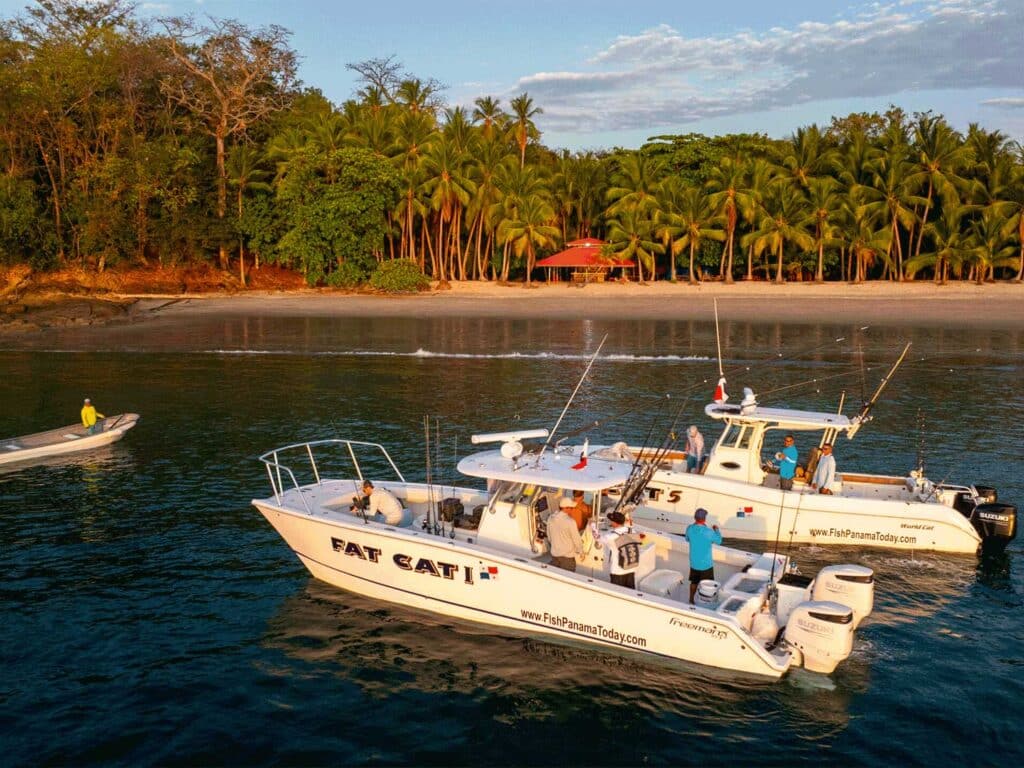
From David, we loaded into boats for the final run toward Isla Parida, winding first through the mangroves and skirting along empty beaches, before entering the open Pacific. This was the Panama I remembered. The landscape is dramatic and clearly not manicured for tourism. Jungle-covered islands rise abruptly from dark blue-green water. Black rock cuts into the sea. Frigatebirds hang overhead. Mountains disappear into distant haze. Even before you fish, there is a sense that something large and prehistoric ought to be swimming nearby.
As we approached the lodge, the travel fatigue disappeared. People pocketed their phones and started asking Shane when we could start fishing.
Shane’s Island
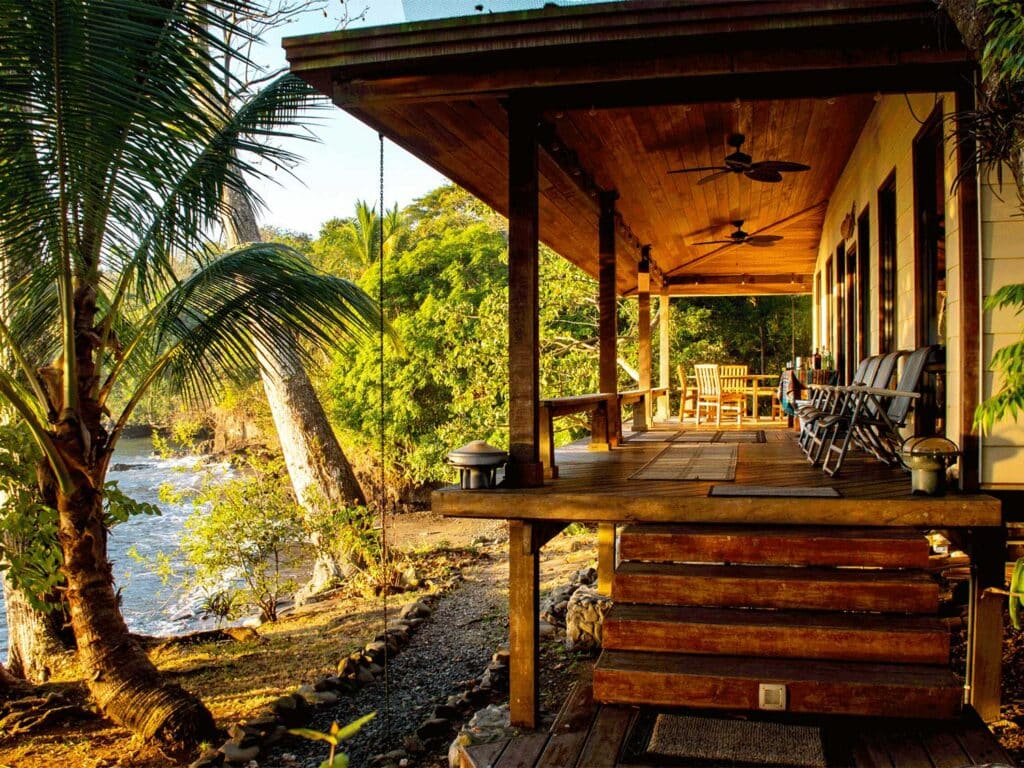
Sport Fish Panama Island Lodge sits on Isla Parida, roughly 12 miles offshore from Boca Chica. Today it is a polished, highly comfortable operation, but its location makes that comfort all the more impressive. The lodge is genuinely remote. Guests arrive by boat, and virtually everything necessary to maintain the place has to make the same trip.
Food, fuel, equipment, tackle, replacement parts and building supplies do not simply show up at the loading dock. Water and power require planning. Boats need to run. Staff need to be housed and supplied. When something breaks on a private island in the Pacific, there is no quick drive to Home Depot.
That reality made me appreciate Shane Jarvis and the operation he has built even more. His story is one many fishermen have fantasized about but few have actually had the cajones to live it. Shane is a gringo who came to Panama, became consumed by the fishing and eventually chose not merely to visit the place but to build a life around it. What began with his family acquiring property on Isla Parida, a boat and a relatively simple setup grew over the years into a sophisticated fishing lodge with a fleet, guest accommodations, professional staff and an operation capable of making a remote island feel remarkably easy.
Most fishermen have, at some point, threatened to quit their jobs and move somewhere tropical. Usually the conversation takes place after several drinks and perhaps 20 minutes browsing waterfront real estate on a phone. Then Monday arrives and everyone returns to their 9-to-5. Shane actually did it.
I admired that more with each day I spent there. There is an appealing recklessness to looking at a jungle-covered island in Panama and deciding that this is where you are going to build your dream. The finished lodge may be comfortable, but the leap required to create it was anything but. And Shane still comes across first and foremost as a fisherman. He watches the weather, talks fishing, studies what is happening offshore and clearly still gets satisfaction from seeing guests come back to the island exhausted and smiling. I had the pleasure of fishing with Shane for one of the days and it just so happened to be our most productive day offshore.
Run, Gun and Hang On
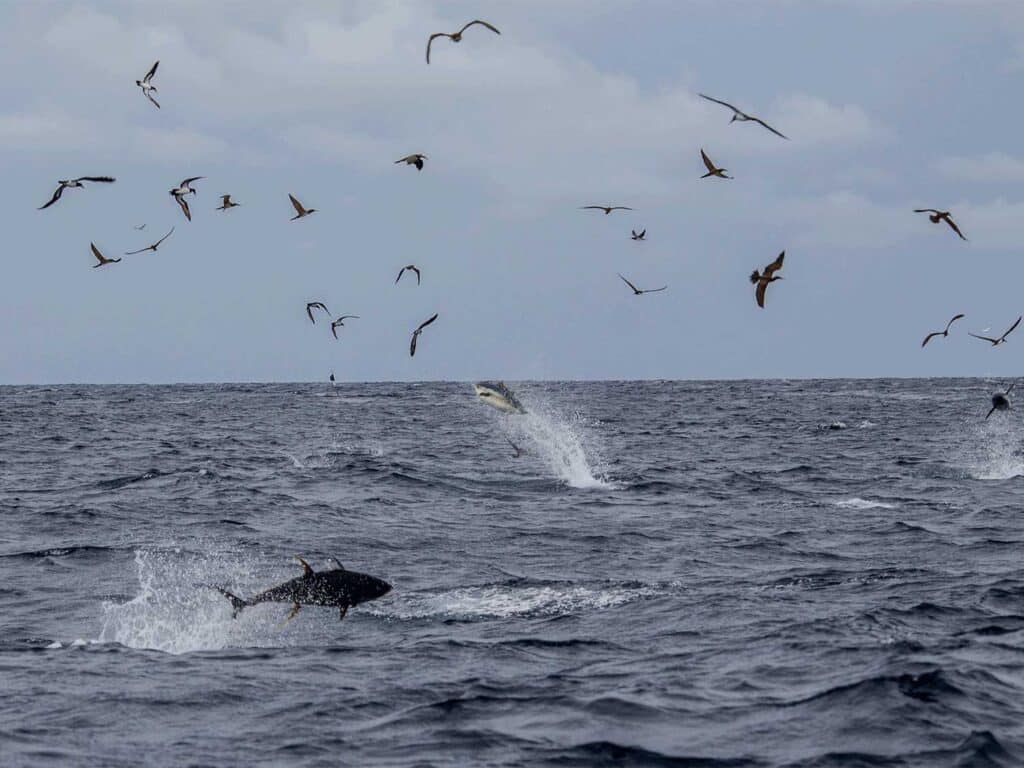
Our offshore fishing focused primarily on yellowfin tuna, and Panama’s tuna fishery is wonderfully visual. You are not sitting around waiting for something to happen. You are hunting.
Find the birds. Find the porpoises. Find the commercial boats puffing black smoke. Find a patch of ocean erupting with tuna, and get there before it disappears.
When the birds appeared on the horizon, the captains reacted immediately. The throttles went forward and the boats charged toward the commotion. On the rougher days, this involved spray flying sideways, tackle rattling and everyone aboard learning exactly how much flex remained in his knees. The captains handled the conditions beautifully, and the boats never felt unsafe, but the Pacific certainly made us earn our opportunities.
Then you would arrive amidst the chaos unfolding in front of you and forget the discomfort entirely.
Yellowfin crashing through bait on the surface, birds diving around them and porpoises cutting through the melee. Somebody would fire a popper into the chaos and begin working it back, waiting for the explosion. Astern, hooked blue runners are tossed out frantically before the action fades.
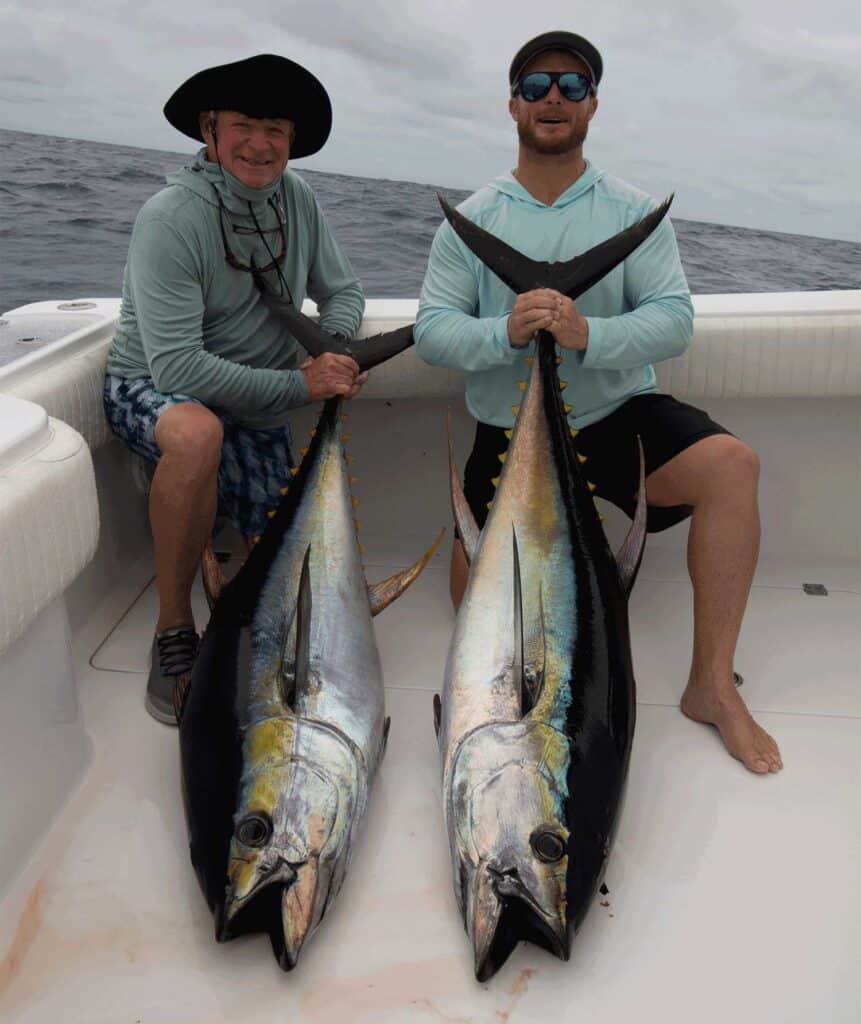
I was lucky enough to experience the version every angler hopes for. During my turn on the bow, a big tuna came up and crushed my plug, and what followed became one of the high points of the trip. On topwater gear, a serious yellowfin is a spectacularly efficient destroyer of confidence.
This one – weighing in at 126 pounds – became the biggest yellowfin tuna I had ever caught. It is also the only fish that made me involuntarily vomit immediately after catching it – no cerveza needed. There is no mystery to a topwater bite. You see the fish eat. You see the hole in the water where your lure used to be. Then you spend the next portion of your life regretting every workout you skipped, and admiring those who specialize in this masochistic-style of angling.
Big yellowfin are bullies with exceptional cardio. They do not care about your back, shoulders, age or self-esteem.
Some of the fights became communal out of necessity. Someone hooked up, somebody cleared the deck, the captain maneuvered the boat and the rest of the crew shouted advice ranging from genuinely useful to personally insulting. When a fish finally came alongside, everybody had participated somehow. Shared struggle accelerates friendships, and few things compress the normal getting-to-know-you process faster than spending a day getting bounced around in large seas while trying to stop a tuna.
One day we pushed farther offshore to explore Hannibal Bank, one of the great names in big-game fishing. Just hearing it has a certain weight. You run out there expecting something prehistoric to appear behind a bait at any moment.
We were looking for black marlin. They did not cooperate.
But there was something satisfying about the search itself. Running through big Pacific swells toward a place you have read about for years, staring at birds, current edges and every suspicious mark on the sounder is part of what makes destination fishing so addictive. The black marlin never arrived, but the experience of hunting that water still felt worthwhile.
Living Well
Sport Fish Panama Island Lodge also makes it very difficult to pretend you are suffering too greatly for your sport.
After each day offshore, we climbed from the beach through the jungle and were greeted with appetizers and drinks. One afternoon brought fresh sushi. Another featured ceviche, tostones and chicharrones. Another somehow included ribs, wings and mozzarella sticks. After hours of casting, fighting fish and hanging on through rough water, that first plate and first cold drink bordered on spiritual.
Then came a shower, where the ocean continued to move even though the boat had stopped hours earlier. Anyone who has spent a rough day offshore knows the sensation. Close your eyes under the water and the room rolls. Your body remains at sea while your feet insist they are standing on tile.
Dinner followed, and the food was consistently excellent: tuna, steaks, pork, paella, pasta and enough other options to defeat whatever restraint remained after cocktails and appetizers. Shane and his staff treated us like kings, but the best part of dinner was rarely what was on the plate.
It was the gathering itself.
Cigars appeared after dinner. Glasses were refilled. The day’s fishing was reconstructed, with missed tuna becoming larger as the evening progressed. Lenny took the group back to Grateful Dead concerts and backstage parties. Captains told stories. Shane talked about Panama and years spent building the lodge. Someone inevitably became the target of a joke that survived for the remainder of the trip.
One of my roommates, Alejandro from Simrad Latin America, slept in the lower bunk beneath me. I spent several nights hugging the wall, mildly concerned that rolling out of bed and landing on a senior marine-electronics executive might create an unfortunate industry-relations problem. We both survived.
Morning offered its own social hour. Coffee was ready at 5 a.m., giving everyone plenty of time for caffeine to perform its most critical biological functions before boarding a boat. Baileys and Kahlúa sat nearby for those who preferred a more aggressive startup sequence. Guests wandered in slowly, forecasts came out, yesterday’s mistakes were revisited and someone inevitably declared that today was going to be epic.
I stand by my belief that fishermen remain perhaps the world’s most durable optimists.
Characters Welcome
That became the real rhythm of the trip. Fish hard all day, return to the island sore and salty, get pampered, and then learn a little more about the people you had been fishing beside.
Lenny was impossible to miss. With long curly hair and the air of a man who had wandered through some interesting corners of American history, he had come to Panama during something of a rebirth in his own life after recently overcoming cancer. He was there to fish, but it did not take long to discover that Lenny’s greatest contribution to the group may have been his inventory of stories.
He had previously worked band security along the West Coast and had toured with the Grateful Dead. One evening he told us about being “accidentally” dosed with LSD at a concert after someone sprayed him in the face with a bottle containing considerably more than water. Another story involved partying backstage with Eddie Van Halen. His stories had the group in tears.
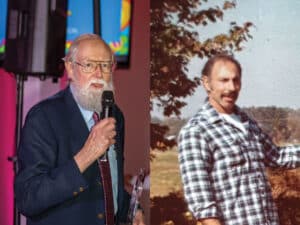
Then there were two guests who provided a different kind of entertainment and, ultimately, inspiration. Both were over 80. Both were recovering from recent surgeries. Both had flown to Panama alone.
That deserves some consideration. They traveled internationally by themselves, transferred to a remote island and signed up to pursue some of the hardest-fighting fish in the world at an age when plenty of people would consider a trip to the airport an ambitious outing.
They had every reasonable excuse not to come, but they came anyway.
Both caught giant tuna. Both caught cubera snapper on top water. On the rough days, they rode through the same heavy seas as everyone else. Big fish do not offer senior discounts, and these guys handled them like pros.
Watching them made a bigger impression on me than I expected. Getting older gives you an ever-expanding catalog of reasons not to do something. There are health concerns, logistics, fatigue, missed connections, weather and a thousand imagined ways the plan might go sideways. Staying home can always be justified. But staying home also guarantees that nothing remarkable will happen.
These two rolled the dice, and the payoff was a tremendous fishing trip. That is worth remembering. But so was something else.
Over the course of the week, I found myself sharing boats, meals and even rooms with people I barely knew before arriving, including other ambassadors from brands across the fishing industry. They came from different places, different companies and different walks of life, but by the end of the trip those distinctions seemed increasingly unimportant. We had fished together, gotten beat up by the same seas, laughed at the same stories and compared notes over dinner each night.
It reminded me of something I had not experienced much lately. Fishing on private boats with established teams has plenty of advantages, and I am fortunate to spend time doing it. But there is something different about a fishing lodge. You arrive with strangers and, almost by accident, become part of a temporary community.
That may be one of the most underrated parts of the whole experience. The fish are what get you there, but the shared meals, the stories, the inside jokes and the people you would never otherwise have met are what stay with you afterward. For all the emphasis we put on boats, destinations and trophies, fishing has always been as much about camaraderie and friendship as anything else.
Sometimes it takes a lodge full of random people to remind you of that.
The Welcomed Bycatch
By the end of the trip, I had everything I could reasonably have wanted from Panama. I had caught my biggest yellowfin tuna on a popper, watched enormous fish explode at the surface, chased birds across the Pacific, explored Hannibal Bank, caught roosterfish and seen the power of cubera snapper. We fished through weather that made the stories better once we were safely back at the bar.
The scenery alone was worth the trip. Panama’s Pacific coast is one of those places that continually reminds you how far you are from home. Jungle rolls down to the water, islands break the horizon in every direction and the ocean seems to contain life everywhere you look. Add a comfortable lodge, excellent food and a fishing program capable of putting you in front of world-class fish, and Shane has built something special.
But the unexpected part of the trip was how much I enjoyed the people assembled there. I think that is something fishing does better than almost anything else. It gives people who might otherwise never meet a compelling reason to share a boat, a meal and eventually pieces of their lives. A retired merchant marine captain, marine-industry executives, Canadians, an old rock ’n’ roll security guy with a spectacular archive of stories, a couple of octogenarians unwilling to stop living adventurously and a magazine editor can all end up at the same table because somewhere offshore there are tuna eating bait.
You get bounced around together. You miss bites together. Somebody catches the fish of his life and everybody celebrates it. You sit around afterward with a cigar and laugh until someone can barely finish a story. You hear about where people have been, what they have survived and why they are still willing to travel halfway across the world to pull on something that can hurt them.
Those relationships are rarely the reason you book the flight, but they often become part of what makes the trip matter.
I went to Panama expecting great fishing, and I got it. I caught the biggest yellowfin of my life, ate and drank exceptionally well, explored an outrageously beautiful piece of the Pacific and was treated like a king.
I also came home thinking about Shane chasing an improbable dream on an island, Lenny getting another crack at life and making everybody laugh, and two men over 80 who refused to let age, surgery or common sense keep them from going fishing.
That was the part I did not plan for. In fishing terms, I suppose you would call it bycatch. And it was every bit as welcome as the target species.