Subscribe to Marlin magazine and get a year of highly collectible, keepsake editions – plus access to the digital edition and archives. Sign up for the free Marlin email newsletter.
The IGFA Great Marlin Race is, on the surface, a fairly simple competition: Catch a billfish, attach a satellite tag, release it and see whose fish travels the farthest. But the real significance of the race extends well beyond the distance traveled. It’s about recognizing the anglers, captains, scientists and supporters who have dedicated their time, resources and expertise to understanding these remarkable fish and helping ensure their future.
That makes the outcome of the 2025-26 IGFA Great Marlin Race particularly fitting. Bob and Sally Kurz, two of the program’s founding supporters and longtime champions, have claimed the annual title with a blue marlin tagged off Kona, Hawaii. For a couple who have spent nearly two decades helping turn recreational fishing into meaningful scientific research, the victory represents a full-circle moment.

From Kona to Global Research
If you’ve followed the IGFA Great Marlin Race over the years, you’ve likely heard its origin story. But this year, that history is particularly relevant, considering the people who helped launch the program are now celebrating a victory of their own.
The concept dates to 2009, when Bob Kurz joined renowned Stanford University marine scientist Dr. Barbara Block and Hawaiian International Billfish Tournament founder Peter Fithian to create a competition combining big-game fishing with scientific research. In fact, the Kurz family sponsored the winning fish in that inaugural race, a 140-pound blue marlin that traveled 2,225 nautical miles from Kona. In 2011, the IGFA partnered with Stanford to expand the initiative internationally, transforming a Hawaiian competition into a global research program.
The premise remains simple: Anglers sponsor satellite tags that are attached to billfish before they’re released. The tags record information about the fish’s movements, depths and water temperatures, eventually transmitting that data to scientists studying migration patterns, habitat preferences and population connectivity. These findings can help shape fisheries management and conservation decisions.
Since 2011, the Great Marlin Race has grown into the world’s largest citizen-science billfish satellite-tagging initiative, with more than 720 tags deployed worldwide. And throughout that evolution, Bob and Sally Kurz have remained among its most dedicated supporters, making this year’s result especially meaningful.
A Fitting Victory for the Kurz Family
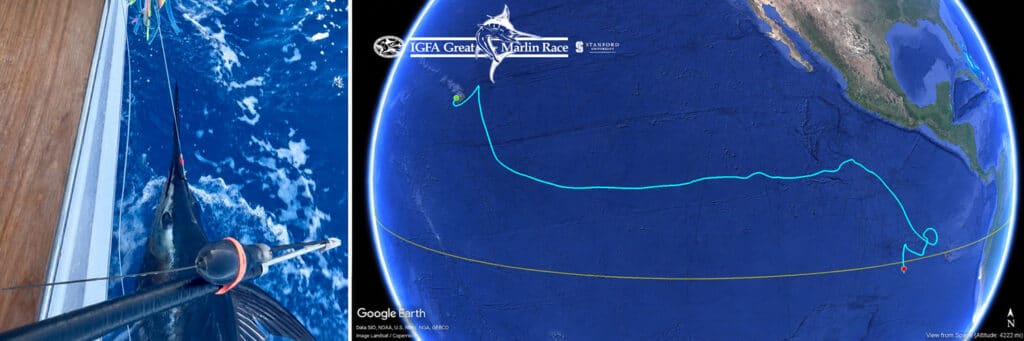
The winning fish in this year’s competition was a blue marlin estimated at 200 pounds, caught by angler Dave Free aboard 2nd Offense, captained by Kevin Hibbard, during the 2025 Kona Pacific Blue Marlin Tournament. Hibbard successfully deployed the satellite tag, sponsored by Bob and Sally Kurz, before releasing the fish.
What followed was an extraordinary six-month journey. After circling southeast of Hawaii, the blue marlin headed south, eventually turning east and traveling across the tropical Pacific for more than two months. It later changed course again, heading toward the Galápagos Islands before crossing the equator. When the tag finally surfaced after 180 days, it was 3,575 nautical miles from where the fish had been released.
The fish’s estimated total journey was considerably longer, at 5,424 nautical miles. That distinction matters because the Great Marlin Race determines its winners by the straight-line distance between the tagging location and where the tag surfaces, rather than the estimated route traveled in between. This provides a more consistent measurement, since the reconstructed movements of the fish are not always precise.
The tag also revealed some interesting details about the marlin’s behavior. It spent approximately 55% of its time within 33 feet of the surface, generally in warm water between 77 and 84 degrees. It also made occasional deep dives, including one to 1,223 feet, where the temperature dropped to 50 degrees.
For the Kurz family, however, the significance goes beyond one remarkable fish. Bob, an IGFA trustee, and Sally, an IGFA representative, have remained among the program’s most dedicated advocates, supporting tag purchases, matching-fund campaigns and annual tagging events in Kona and Southern California. Their involvement has helped bring new participants into the program and generate valuable research data year after year.
Although the family sponsored the winning fish in the original 2009 competition, this marks the first time one of their tags has won the annual worldwide race since the IGFA expanded the program in 2011.
More Than Just a Race
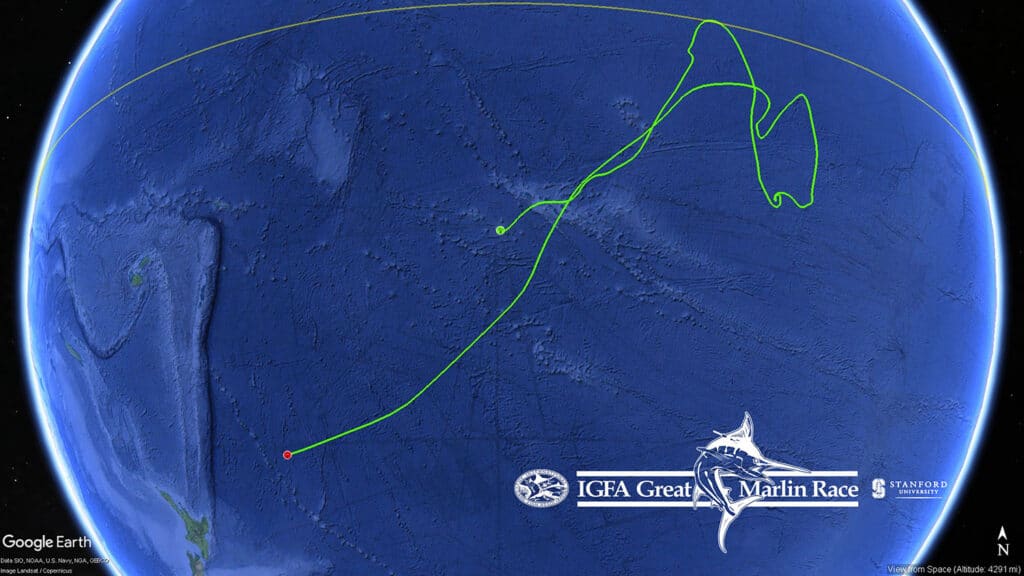
The remaining podium finishers offered equally valuable insights into billfish movements. Second place went to a 150-pound striped marlin tagged aboard Sea Weez in French Polynesia. Capt. Ross Finlayson’s team, with angler Bob Edmonds and tagger Hannah Drake, recorded a straight-line distance of 1,400 nautical miles. But the fish’s estimated total journey was an astonishing 7,022 nautical miles, eventually bringing it northeast of New Zealand.
That migration has particular scientific importance, providing further evidence that striped marlin populations may be more interconnected than current international management practices assume. The findings have helped prompt the IGFA to develop additional research into Pacific striped marlin populations. Finlayson and the Sea Weez program have also become significant contributors to the research effort, deploying 19 satellite tags in recent years, with more planned.
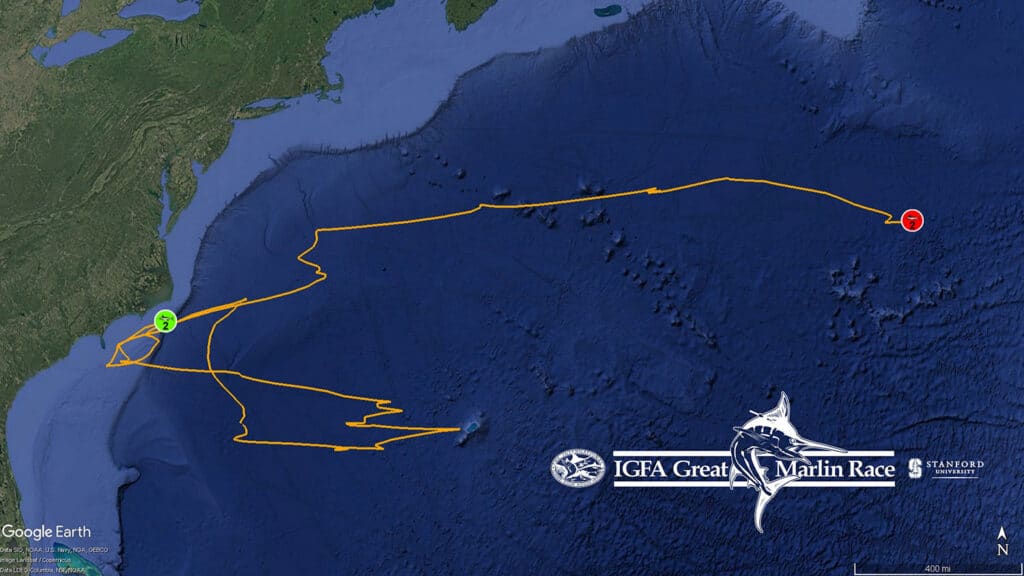
Finishing third was a 250-pound blue marlin caught by Dave Pfeiffer and tagged by Adrian Holler aboard Sea Striker, captained by Pete Zook, off North Carolina. Sponsored by the Big Rock Foundation, the fish traveled an estimated 3,895 nautical miles before its tag surfaced 1,304 nautical miles from the deployment location. The result highlights another valuable partnership, with the Big Rock Foundation supporting the deployment of five satellite tags annually through its collaboration with the IGFA.
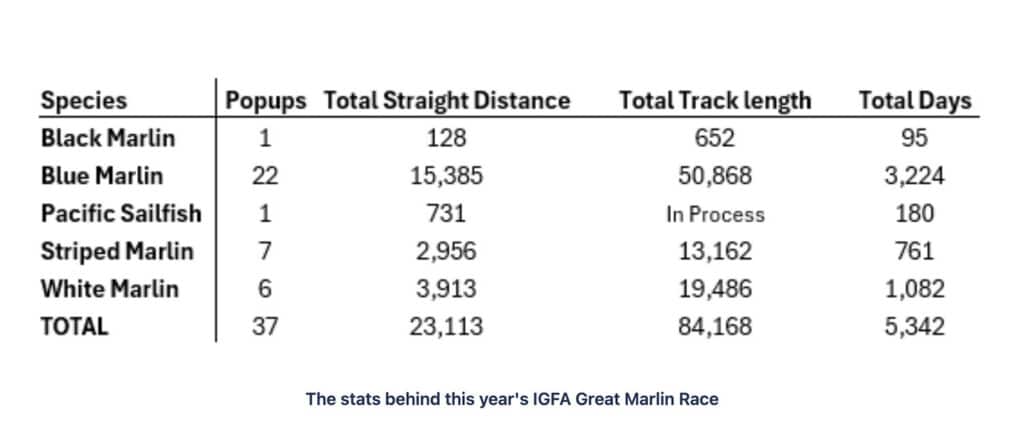
Collectively, the numbers tell an even bigger story. During the 2025-26 race, 37 satellite tags reported data, providing researchers with 5,342 days of tracking information across five billfish species. Those fish covered an estimated combined 84,168 nautical miles, nearly enough to circle the globe four times. During the year, sponsors funded 63 tags, with 45 deployed across eight countries. The program’s global reach now extends to 27 countries, with additional tags awaiting deployment during the 2026-27 competition.
“The IGFA Great Marlin Race highlights the extraordinary impact anglers can have beyond the catch,” said IGFA President Jason Schratwieser. “Each year’s participants contribute critical data that supports billfish research and conservation, and our winners exemplify that spirit. Their achievement reflects not only an incredible fish, but also a meaningful contribution to billfish science and conservation.”
For Bob and Sally Kurz, this year’s victory is certainly worth celebrating. But perhaps the greater achievement is the program they helped create and continue to support. What started as a novel competition at a Hawaiian fishing tournament has become a worldwide collaboration between anglers and scientists, proving that the value of a released billfish can extend far beyond the moment it swims away.
Presented by Costa Sunglasses, the IGFA Great Marlin Race is supported by AFTCO, the Bass Pro Shops and Cabela’s Outdoor Fund, PENN, Yamaha Rightwaters and the Big Rock Foundation. For more information or to support the program, visit igfa.org/the-great-marlin-race.