Subscribe to Marlin magazine and get a year of highly collectible, keepsake editions – plus access to the digital edition and archives. Sign up for the free Marlin email newsletter.
One of the greatest things about the modern big-game landscape is the number and variety of billfish destinations. These days, we can catch them wherever they live, the Northern Hemisphere and the Southern, east or west. There are places where you might target slams, and others have volume days of double-digit releases. It is a wonderful time to be a traveling fisherman.
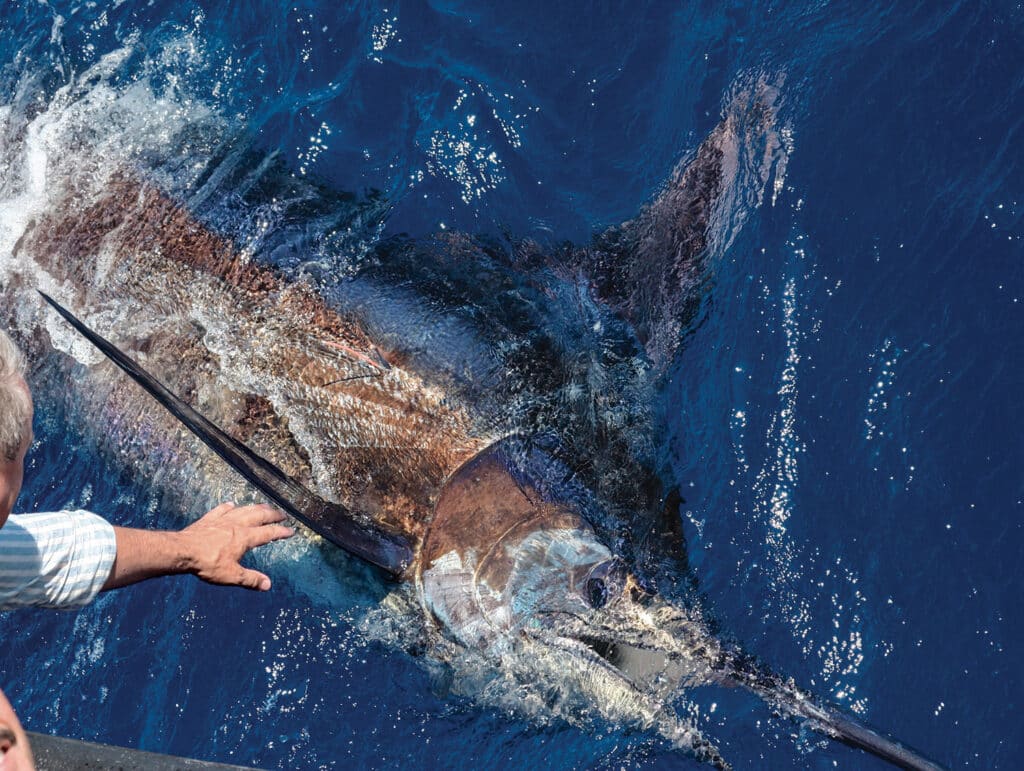
With apologies to all the other incredible places—with reverence and respect for 40 sailfish days or the trips of 60 striped marlin releases—there is perhaps nothing more iconic or universally resonant than the big blue marlin fisheries of the world. These are the places where you head in hopes of seeing the one—the biggest fish you’ll ever encounter.
There is something essential about the quest for giant fish—Capt. Ahab’s white whale. Ernest Hemingway devoted incredible time and resources to hunting the grander he would never catch. Most anyone who has ever picked up a fishing rod has dreamed of catching a blue marlin. Catch one or two, and the obsession soon evolves into catching a real one.
What follows is that list: a present-day breakdown of some of the best places in the world to target big blue marlin. Sure, catching a 1,000-plus-pound sea creature is never something you can plan on, but these are the places whose big-fish legacy and tradition most thoroughly inspire the hope of running across the blue marlin of a lifetime—the places to watch as we approach the annual Blue Marlin World Cup.
Each destination is provided with a bit of historical context about why it made the list and what you might expect if you fish there today.
The Pacific Ocean
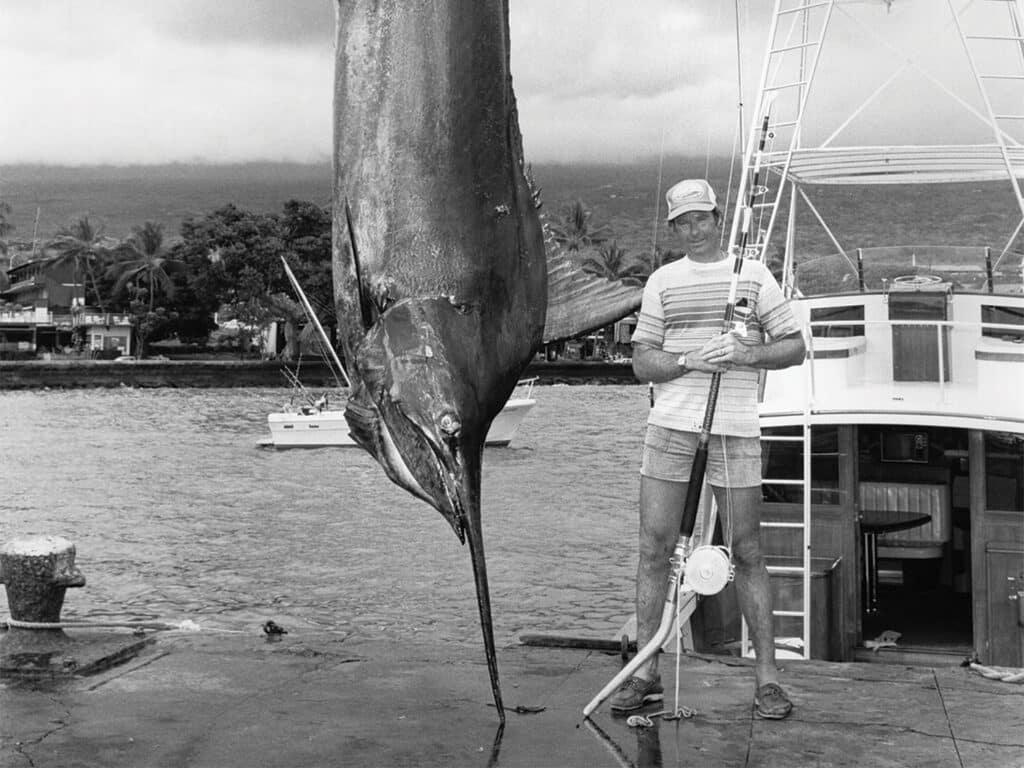
Kona, Hawaii
Historical Context
Just how much has Kona influenced the broader world of sport fishing? Just how storied is Kona’s legacy of giant blue marlin? Funny you should ask.
On May 31, 1982, Capt. Bobby Brown and the crew of No Problem landed the IGFA all-tackle world record Pacific blue marlin. The fish, caught out of Kona, weighed 1,376 pounds. Some 43 years later, it remains the largest Pacific blue marlin ever landed in accordance with IGFA rules. This fish is not, however, the largest blue marlin ever landed in Kona.
Capt. Bart Miller named his famous slant-faced plug after the 1,656-pound blue he caught in 1984. Choy’s Monster, the largest blue marlin ever caught on rod and reel, hit the docks in nearby Oahu (170 or so miles from Kona) on June 10, 1970. That fish, at 1,805 pounds, was a reasonable-size yellowfin away from being the mythical tonner. Kona’s first grander blue marlin, 1,002 pounds, was caught by Capt. George Parker in 1954. You can fish with George’s son, Capt. Marlin Parker, in Kona today.
The consistent presence of big blue marlin has been attracting sport-fishing talent to Kona for decades. Grander blues have been caught in every calendar month here. Kona has produced not simply an unmatched tally of giant blue marlin, but perhaps the most broadly influential legacy in big-game sport fishing. Many of the lures you troll trace their evolution to Kona. Not only that, but Kona was also an early hotbed of live-baiting for marlin. Captains who fished here brought the technique to Panama, before it spread to the U.S. Gulf Coast and beyond.
Kona Today
The Honokohau Small Boat Harbor remains a giant blue marlin mecca today. In fact, Kona has weighed four grander blues since late 2024—including three in an eight-month window. Kona’s consistently calm waters (it sits in the lee of Hawaii’s Big Island) and short runs are perfect for the fleet of classic sport-fishers available for charter here. The fleet is among the best, most accomplished and most storied of any place in the world.
The fishing talent in Kona is as deep and geographically diverse as ever. Kona is also home to the Hawaii Marlin Tournament Series, composed of some of the most famed events in the sport. As mentioned, granders have been caught here in every calendar month, but if you’re after big blue marlin specifically, you might consider coming in March, April or May, with a bit of the season spilling into the summer.
The South Pacific
Historical Context
When it comes to big blue marlin, the South Pacific casts about as long of a shadow as any place in the world. Zane Grey caught the first 1,000-pound marlin on rod and reel in 1930 off Mataiea, an island in Tahiti. At the time of its capture, Grey referred to the fish as a “silver marlin.” If caught today, they’d call it a blue.
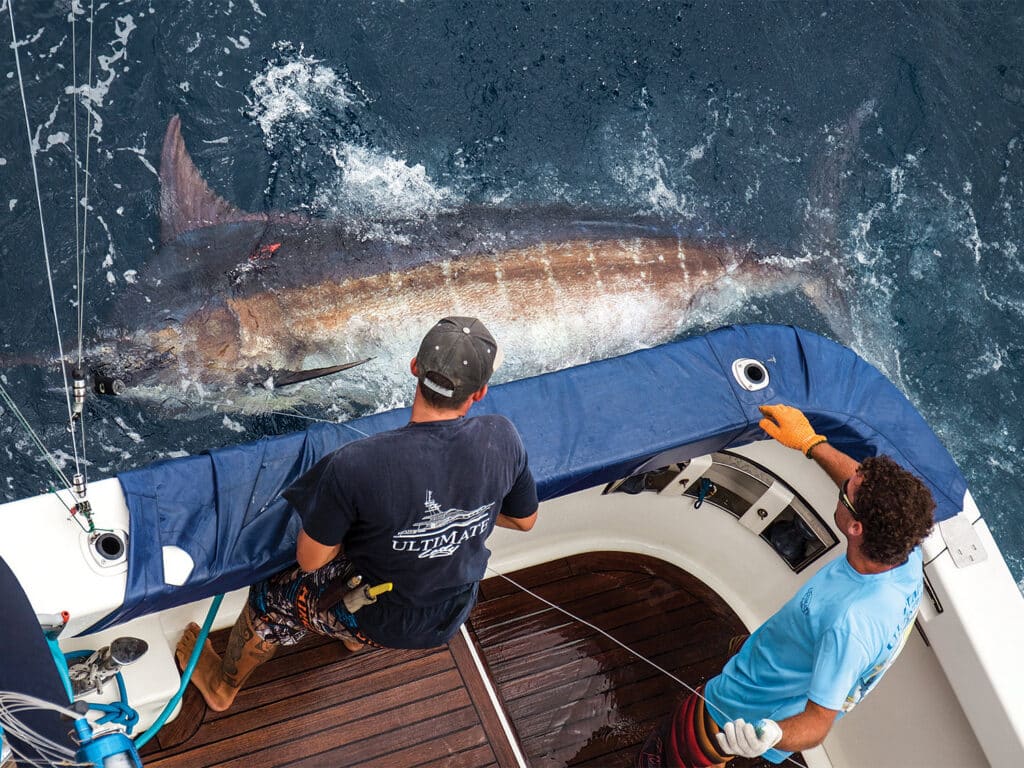
Fast-forward 95 years to the 2025 Blue Marlin World Cup, and the South Pacific once again reminded the world of its prominence as a big blue marlin destination. Tahiti-based Capt. Tom Francis and Ultimate Lady beat 167 teams from around the world with a 689-pound blue marlin. There has been a great deal of big blue marlin across the South Pacific in the years between these two events.
The size and scope of the South Pacific is large and grand enough to boggle the mind. Referring to it as a single region might be about like talking about the fishing in the United States. It’s a giant, largely empty expanse of open ocean populated by a spackling of small islands and archipelagoes.
Many of these remote specs of land are surrounded by water that produces giant blue marlin. Perhaps the least explored region on Earth, the fisheries here are remote, beautiful, and untapped from a sport-fishing perspective. The characteristics and infrastructure available vary tremendously.
Here is a list of some of the notable giant blue marlin that have come from the South Pacific:
In 2021, a commercial fisherman in French Polynesia caught a 1,106-pound blue on a Halco Laser Pro (a Rapala-style lipped plug). Tahiti produced a 1,474-pound behemoth in 2015 and a 1,301-pounder in 2011. Vanuatu had a 1,142-pounder in 2017, and the Cook Islands a 1,045-pounder. Capt. Chris Donato holds the Samoan record blue, a 1,025-pound fish.
The South Pacific Today
The specifics of how to get to each of these places and which are best suited for your adventure are beyond the purview of this article. What we can say for sure is that if you’re after the biggest blue marlin you might ever catch, don’t sleep on the South Pacific. If you’re serious about it, a good first step (the one I’d take) would be contacting Capt. Tom Francis.
The Atlantic Ocean
Much like its larger neighbor, if you’re after giant blue marlin haunts in the Atlantic Ocean, isolated islands that rise out of deep, open ocean are good places to start. The Atlantic has more than a few of them.
Bermuda
Historical Context
Few places in the world can match the big blue marlin culture of this self-governing British overseas territory. Sitting about 600 miles offshore of North Carolina, Bermuda’s giant blue marlin fishery is largely a summertime affair.
The big blue marlin are here consistently enough to have been attracting private boats for decades. These fish support an active, storied charter dock and are the foundation for the Bermuda Triple Crown, one of the longest-standing, most influential big-fish series in the sport.
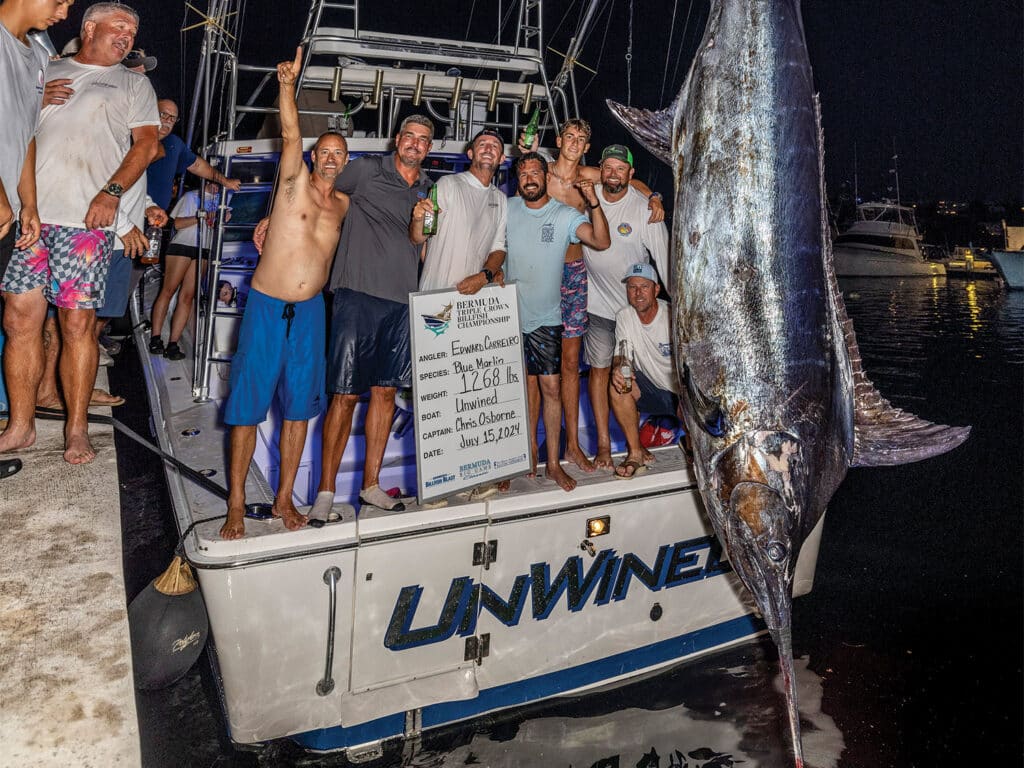
When it comes to big blue marlin track records, few places can match Bermuda. In 2024, UnWined won the Bermuda Big Game Classic with a 1,268-pounder. Capt. Alan Card, a treasure of the sport-fishing world and an IGFA Hall of Famer, has run his charter boat, Challenger, for some 50 years. Card himself has caught an incredible seven blue marlin north of 1,100 pounds, his biggest some 1,289. Capt. Allen DeSilva weighed Bermuda’s largest blue marlin in 1982. That fish was 1,352 pounds.
Bermuda Today
Bermuda is home to an incredible tourism and sport-fishing infrastructure. Come here in the summer, and you’ll see a parade of custom sport-fishers unlike many in the world. The Bermuda Triple Crown runs this time of year too. A visit to the island without a call to Capt. Alan Card and company, to at least inquire about a day or three of blue marlin fishing, might be classified as a questionable life decision.
The Eastern Atlantic
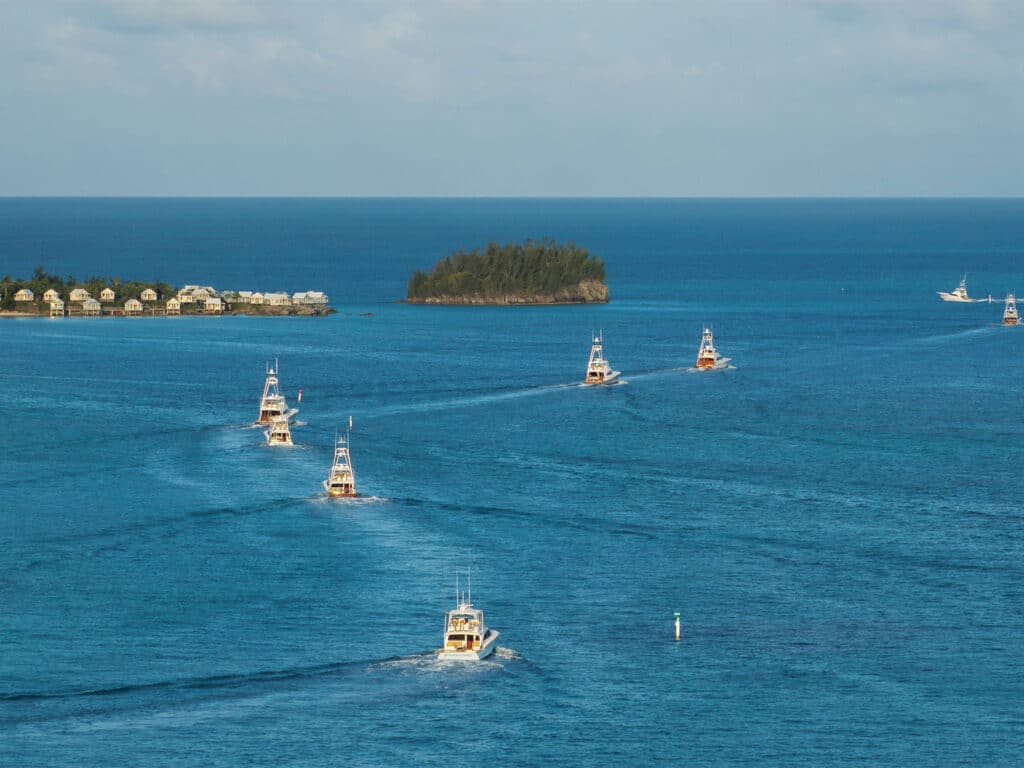
The Eastern Atlantic is home to its own incredible big blue marlin tradition. Perhaps three destinations headline what’s possible here: Madeira, the Azores and Cape Verde. These three fisheries each offer a unique combination of blue marlin fishing and tourism attributes. Which one is right for you depends on what you’re after, but here’s a starting point to dial in your bucket list.
Madeira
Of the three, Madeira probably has the largest degree of seasonal variability. Some years, the blue marlin bite is wide open. Others, it can be slow. But when the fish show up, it is among the best big blue marlin fisheries in the world.
In terms of big blue marlin lore, Madeira is in a class of its own. There have been at least 35 granders weighed in Madeira over the years, with a great deal more released. Capt. Jono Nicholas runs Allure II in Guatemala these days. He spent two seasons fishing Madeira in the early 1990s alongside Capt. Roddy Hays. In his best season, Nicholas released 74 blue marlin with an incredible average estimated weight of 650 pounds.
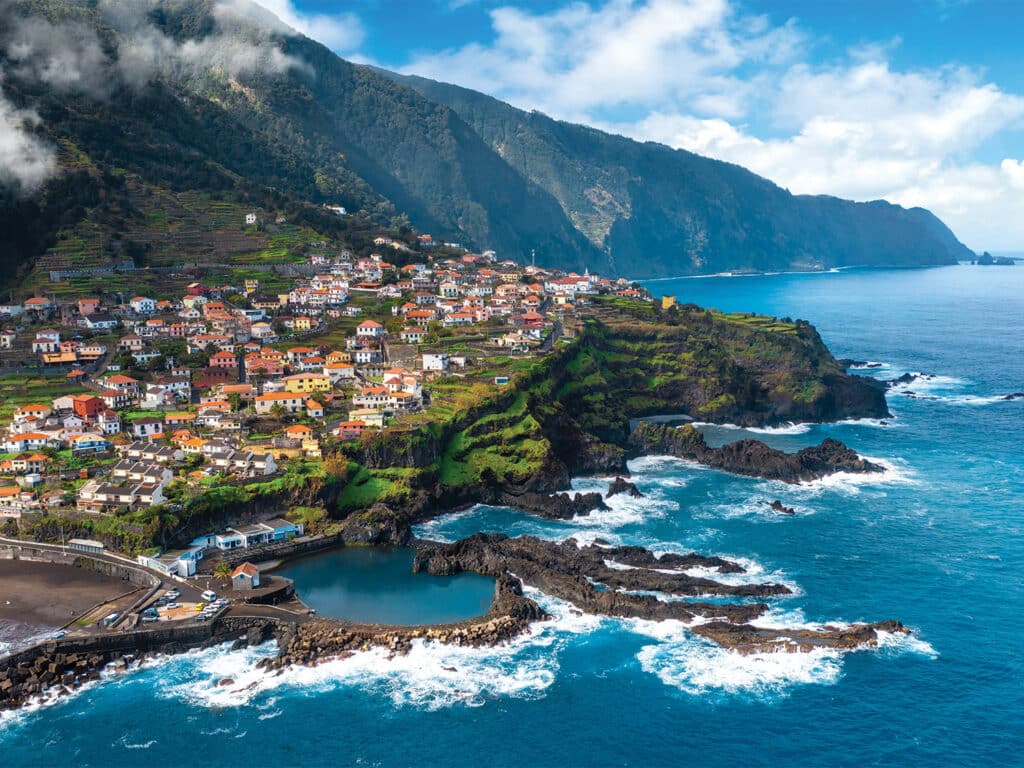
Madeira’s big blue marlin run in the early to mid-1990s was the stuff of legend. It attracted captains from around the world to the island. Madeira’s calm waters (like Kona, it sits in the lee) were home to much of Stewart Campbell and Chunda’s record fishing exploits as well. To scroll through a list of captains who have fished Madeira through the years is a who’s who of sport fishing.
Capt. Gerard “Frothy” De Silva operates his 30-foot Pesca Grossa out of Funchal, Madeira. In a typical year, the blue marlin here might average 500 pounds, though they come much larger. A day or three with De Silva is a wonderful way to experience Madeira’s world-class tourism offerings, renowned enough for the World Travel Awards to name it the “World’s Leading Island Destination” many times.
The Azores and Cape Verde
If your goal is to catch a 500-pound blue marlin, and to have a realistic shot at seeing a fish of 800 pounds (and the hopes of one that is bigger), Cape Verde and the Azores offer some of the best chances you’ll find. When it comes to the intersection of blue marlin numbers and size, these two Portuguese-speaking Atlantic archipelagoes are hard to beat. Though neither location is home to the grander traditions of Bermuda or Madeira, both the Azores and Cape Verde produce fish north of the mark regularly enough that it’s not surprising when it happens.
From a high-level perspective, the blue marlin fishing experiences in Cape Verde and the Azores are similar. The Azores offers a bit more tourist infrastructure. The fishing in Cape Verde has a more remote feel. That said, each is home to one of the most well-rounded blue marlin fisheries on Earth.
The blue marlin fishing in the Eastern Atlantic fluctuates yearly, depending on where the currents and water temperatures stack up. Some years, Cape Verde is better. In others, everything aligns for the Azores, like 2023’s “Bite of the Century.” While both places can offer more year-in, year-out consistency than Madeira, Cape Verde might be the safer bet in any given year.
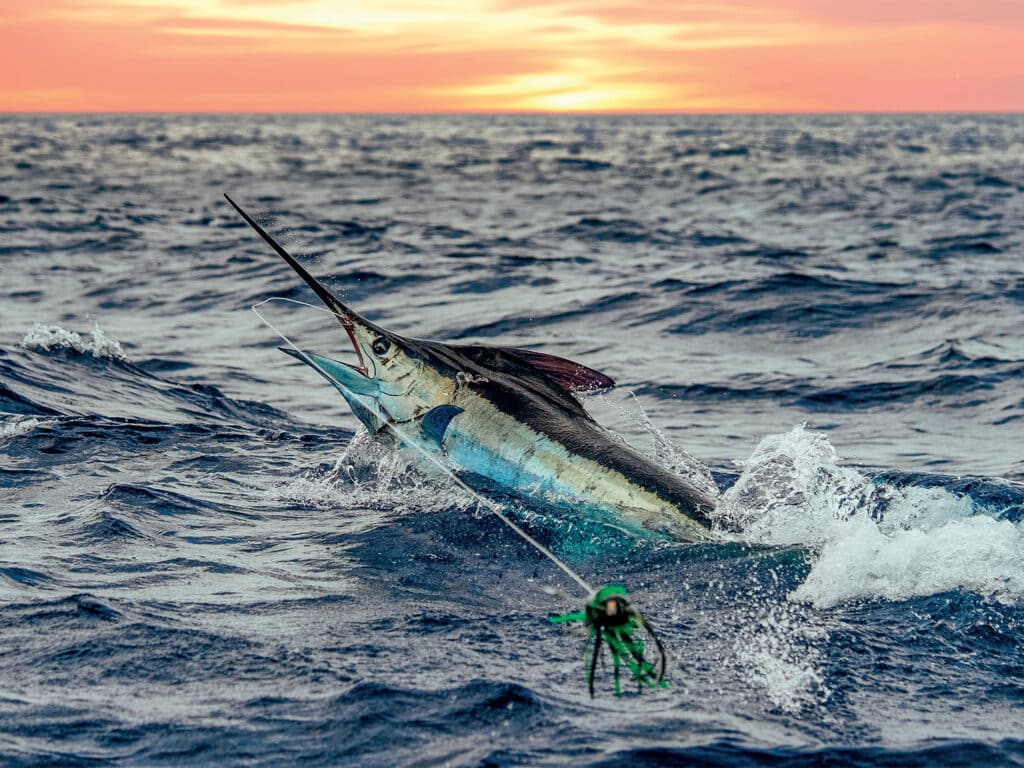
There have been plenty of granders caught in the Azores (a 1,307-pounder in 1997, a 1,254 in 2020, and a 1,189 in 1993) and Cape Verde (notably a 1,370 in 2022, a 1,290 in 2016, and a 1,046 that won the 2021 World Cup). If you’d like to fish Cape Verde, Capt. Mary Bates and the crew of Release Man is a great choice. There are excellent options in the Azores as well, Capt. Zak Conde chief among them.
Brazil
When it comes to gigantic Atlantic blue marlin, Brazil casts quite a legacy. The all-tackle world records for Atlantic blue marlin (1,402) and white marlin (181) were both set in Vitoria. If you’d like to chase big blue marlin in this general part of the world, head to the Royal Charlotte Bank near the town of Canavieiras. Capt. Shawn Wallace, a veteran captain who grew up on the Great Barrier Reef, runs Majestic Marlin. This is a wonderful, remote destination that offers some incredible big blue marlin fishing.
Head 1,400 miles east of Brazil, and you’ll find Ascension Island. The giant blue marlin fishing here is legendary. Were it more reliably accessible, it would be more prominently featured in this piece.
The Indian Ocean
Mauritius
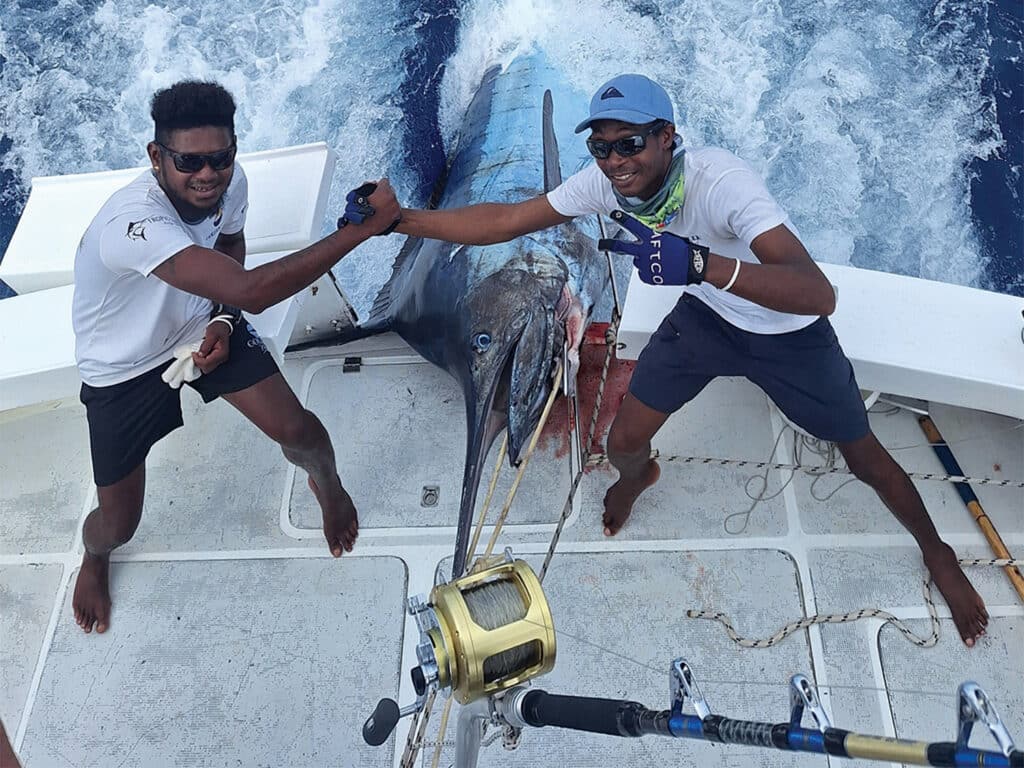
Quietly, and then all at once, Mauritius has emerged as one of the hottest big blue marlin fisheries on the planet. Four granders in the past five years—including a 1,212-pound fish in March 2026—have firmly planted it on the global radar, backing up a legacy that already includes multiple 1,300-plus-pound giants and an IGFA 80-pound-test world record. The season runs November through April, and while charter options remain limited, the quality is high. For anglers willing to make the trek, Mauritius offers a rare mix of modern momentum and old-school big-fish pedigree. It’s one of those places where every bite carries the real possibility of a lifetime fish.