Subscribe to Marlin magazine and get a year of highly collectible, keepsake editions – plus access to the digital edition and archives. Sign up for the free Marlin email newsletter.
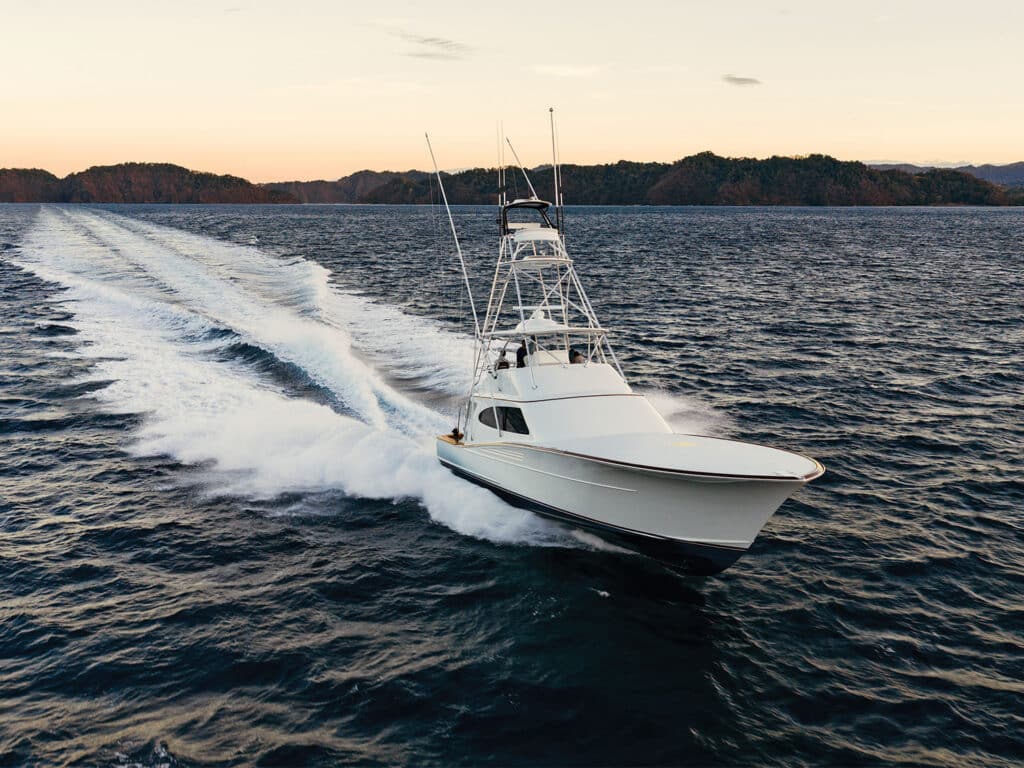
There are fishing trips—and then there are days that quietly redefine your understanding of excellence. My first time aboard the 64-foot Tarheel with Captain John Bayliss off the coast of Costa Rica was the latter.
Fishing alongside a legendary captain is memorable in its own right. But what stood out most was not the action offshore—it was the intent behind the boat itself. Tarheel is the second demo vessel commissioned as a working classroom for the Bayliss team, current owners, and those soon to join the fold. It exists not as a showroom piece, but as a proving ground.
Every mile run and every spread set become part of an ongoing refinement process. Performance is studied. Feedback is welcomed. Adjustments are made. It’s a disciplined, almost obsessive commitment to improvement—the belief that no matter how exceptional the current build, the next one must be better.
That mindset is what separates respected builders from world-class craftsmen. A day aboard Tarheel makes one thing clear: excellence isn’t declared at launch—it’s earned offshore.
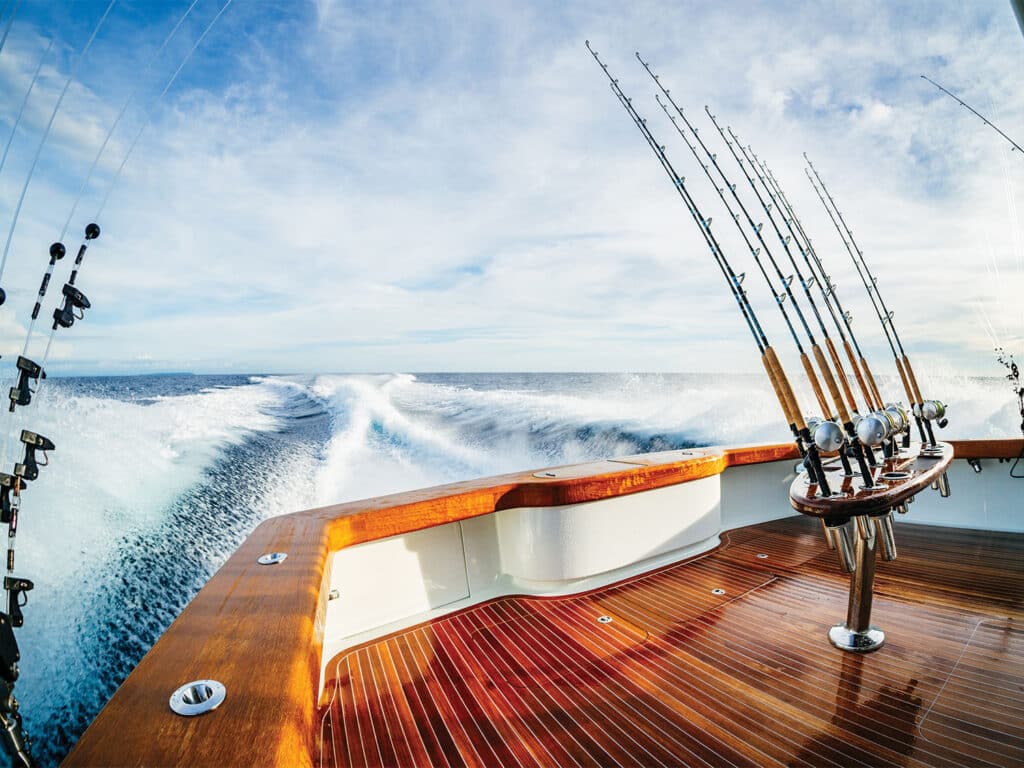
Cockpit/Mezzanine
With a focus on tournament fishing, the cockpit is laid out for efficiency and function. At the center of the action, a Release 10 rod rocket launcher hosts additional rods and pitch rods for the ready. A traditional Carolina transom fishbox adorns the transom. The center floor hatch is stainless lined dryer. Dredges with skirted lures are rinsed off after use and placed inside. Fans circulate heated engine room air through the area keeping your dredges dry, mold free, and ready for the next morning. To each side, two hatches allow lazarette access to reach your steering, rudders, and bilge pump access. Moving forward to the mezzanine steps, a combo of ice, chilled, and dry storage provides every option for bait, drinks, and cleaning tools. The port mezzanine seat provides additional storage, while to starboard, a filtered water dispenser allows you to keep the plastic bottles off the boat. In addition, tackle, gaff storage, and a grill are also in the starboard box.
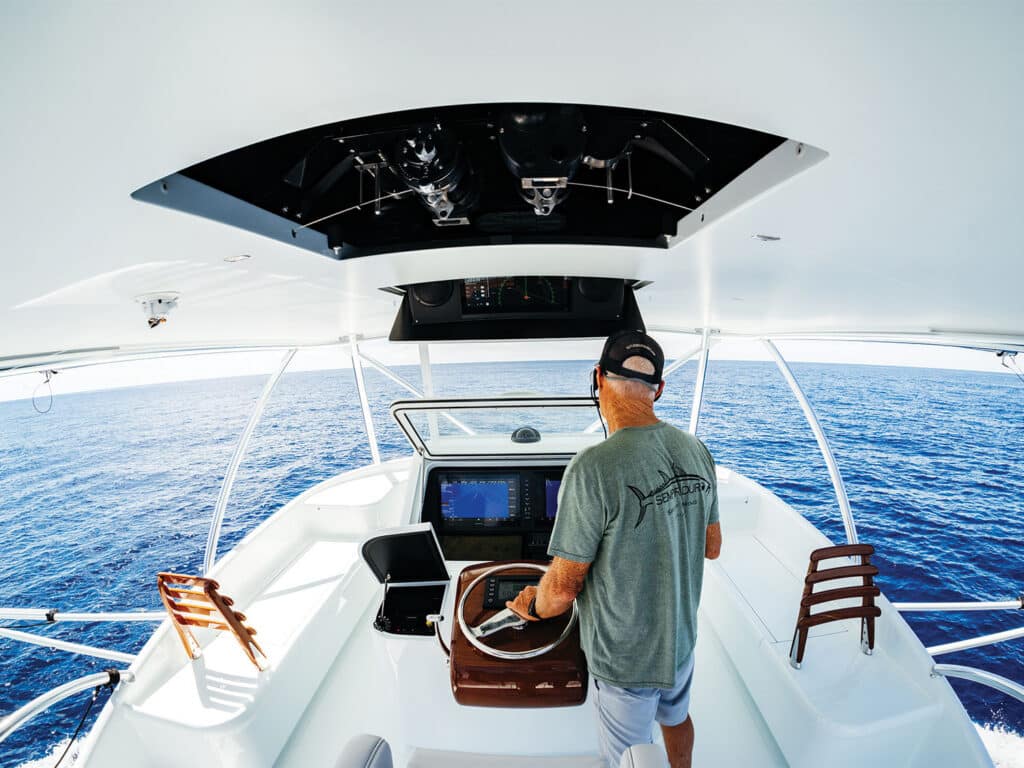
Bridge/Tower
Accessed via a starboard ladder, the bridge reveals a well-appointed center console helm highlighted by a single Release Trillion helm chair. The console is outfitted with a pair of 19-inch Garmin displays and a single 22-inch Furuno MFD, along with the Omni 10 control panel. An additional 16-inch Garmin display and VHF speakers are mounted above the console for enhanced visibility and communication.
Overhead, a pair of Hooker teaser reels are positioned for convenient access and easy adjustments. To port, a glove box houses the Simrad autopilot and two Standard VHF radios.
Comfort and versatility are abundant, with a forward-facing console seat and a pair of bridge wing benches equipped with fore and aft Release ladderbacks—ideal for relaxing during the ride out or turning aft to watch the spread. Ample storage is thoughtfully integrated throughout, including compartments at the forward ends of the bench seats, generous storage within the benches themselves, and a cavernous bridge brow capable of accommodating life vests and even a life raft.
A pair of Gemlux Gulfstream 45-foot carbon fiber outriggers, painted Tarheel blue and configured without spreaders, deliver a customized, ultra-sleek profile. According to Bayliss, they perform on par with traditional outriggers while eliminating the whistling and vibration often associated with spreader wires.
Their lightweight carbon fiber construction also allows for easy manual deployment, combining performance, simplicity, and refined aesthetics in one innovative package.
A Palm Beach hardtop and tower provide an excellent vantage point for the spotter, offering clear sightlines to help guide the captain and anglers the moment fish appear.
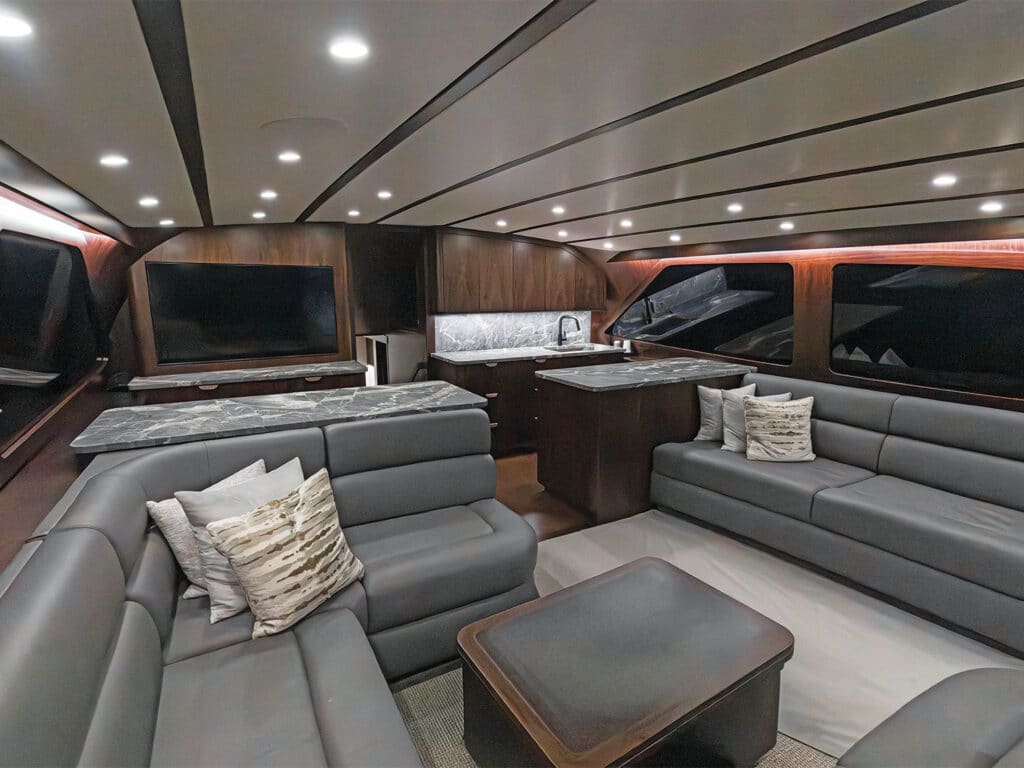
Interior Accommodations
Entering the salon to starboard, a dedicated console provides tank level monitoring, charging ports, Seakeeper controls, and additional storage. The salon is finished with striking vertical walnut veneers complemented by gray upholstery and coordinating countertops. Forgoing the typical dinette arrangement, Bayliss opted for a starboard sofa, a portside U-shaped sofa accommodating six to eight guests, and a custom walnut table. As expected, all seating areas offer abundant storage beneath.
The galley spans both sides of the salon and features three sets of refrigerated/freezer drawer units, all set atop comfortable cork flooring. To starboard, the galley includes a concealed cooktop and a Wolf Speed Oven, providing versatile meal preparation options. Customized storage solutions accommodate dinnerware, cookware, and flatware, while full slide-out upper cabinets function as a convenient pantry with space for daily provisions and a coffee maker.
On the port side, the upper cabinetry houses a television that rises to reveal additional storage for cups and glasses. The aft port galley area offers further storage, including dedicated space for Yeti tumblers. Just down the companionway steps, the electrical panel is located to port for easy access.
The portside day head features a beautiful carbon fiber toilet, vanity, and shower, with cork flooring continuing throughout. Opposite, a bunk stateroom provides a comfortable retreat complete with its own ensuite head and shower.
Forward on the starboard side, Bayliss incorporated a medical freezer with a custom lid that doubles as fiddled storage for gear, along with overhead cabinetry. Forward of that, customized rod storage with a glass door adds both function and style. Moving across to port is an additional bunk stateroom.
In the forward cabin—where one might expect a traditional master—Bayliss instead chose larger single bunks mounted along the hull sides to maximize space and practicality. Abundant storage is found below the bunks, in overhead cabinetry, within wall panels, and in a pair of cedar-lined lockers. The forward head features a well-designed U-shaped shower, vanity, and toilet.
Overall, the layout and design are driven by a singular purpose: maximizing crew comfort, efficiency, and performance in a competitive tournament setting.
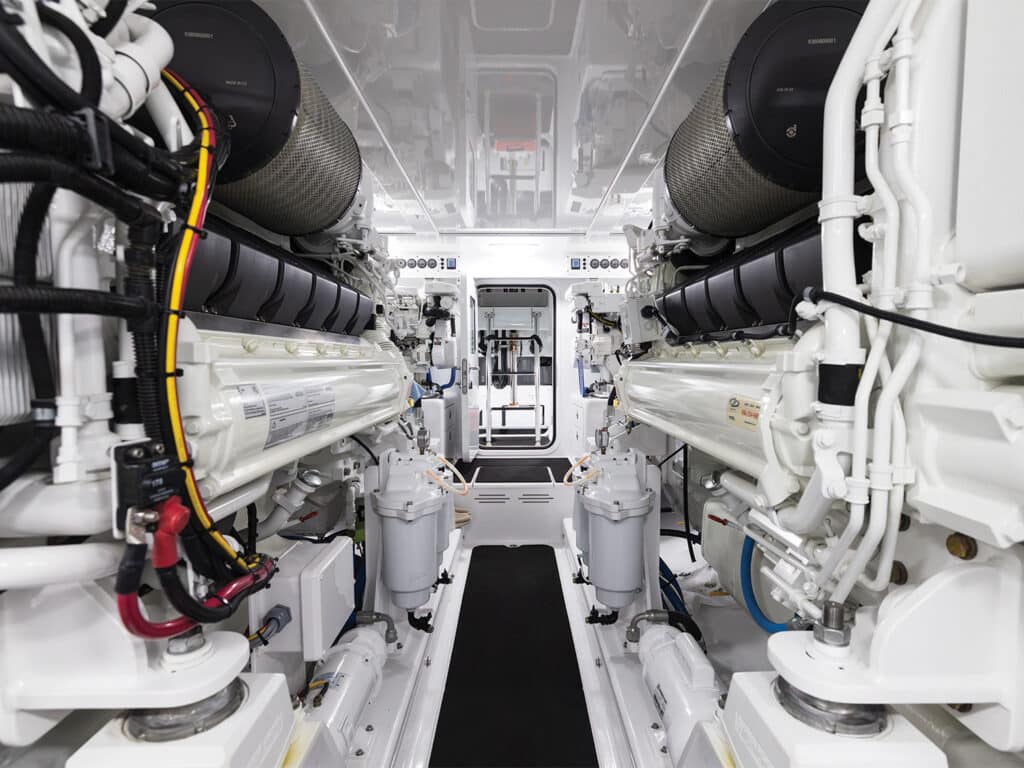
Engine Room
Engine access is centered through the mezzanine. As you step down, you’ll immediately spot one of the Seakeeper 10 units aft, along with additional storage space. Moving forward through the crash door, you enter the heart of the space, passing between the twin 12-cylinder engines from MTU.
As you would expect from Bayliss Boatworks, the engine room is thoughtfully arranged to provide easy access to motors, pumps, filters, and batteries outboard. All recirculating cooling pumps are supplied with freshwater, cooled through Bayliss’s proprietary heat exchanger system. With redundant systems and exceptional accessibility throughout, maintenance is simplified—so your time is spent on the water, not in the yard.
Performance
The fish had shifted from the previous day, forcing us to expand the search and visit a few of Bayliss’ favorite haunts. It proved to be the right call. By day’s end, we had 30 shots at Pacific sailfish spread across four separate areas-a testament not only to the fishery, but to the boat’s versatility.
What stood out was theability to run and gun with authority, then pivot instantly into precise maneuvering when the chaos of doubles—and even a triple hookup—erupted in the spread. The transition from high-speed hunt mode to cockpit choreography was seamless.
Power comes from MTU 12-cylinder engines, and it shows. Tarheel delivers an impressive range of performance—from a comfortable 30-knot slow cruise to a high cruise of 38 to 40 knots, depending on load. With a full crew aboard and tournament gear on deck, I personally watched her reach 44.5 knots at the top end. For a 64-footer built with this level of refinement and fishability, that number is more than impressive—it’s defining.
Crafted with uncompromising attention to detail and performance, Tarheel embodies the relentless pursuit of excellence that defines Bayliss Boatworks. From her precision-engineered systems to her refined Carolina lines, she stands as a testament to innovation, craftsmanship, and the passion for life offshore—built to run hard, fish harder, and represent the very best of custom sportfishing.
Bayliss 64 Specs
- LOA: 64’9”
- Beam: 18’4”
- Draft: 5’6”
- Dispel.: 105,000 lb.
- Fuel: 1,800 gal.
- Water: 300 gal.
- Power: MTU 12V2000M96X 2,000 hp
- Gears/Ratio: Twin Disc MGX6599A 2:1
- Propellers: VEEMS 5-blade with splined shaft
- Paint: Axalta Imron Tarheel Blue
- Climate Control: Dometic
About the Author
Capt. Tom Southward has been fishing the waters of North Carolina and Virginia for billfish and other pelagic species since 1984 and has been a contributing writer for Marlin since 2016. He currently resides in Ocean City, Maryland, where he heads offshore as frequently as his schedule allows.