
Subscribe to Marlin magazine and get a year of highly collectible, keepsake editions – plus access to the digital edition and archives. Sign up for the free Marlin email newsletter.
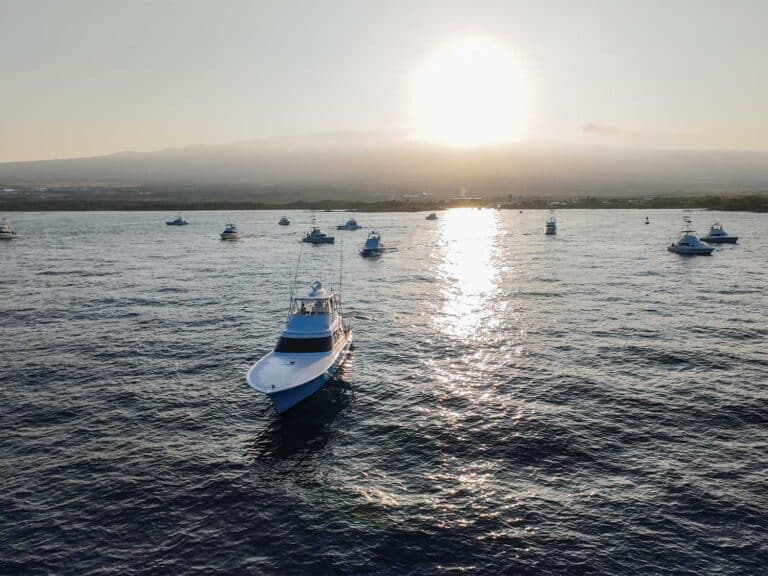
The Kona Gyre is a colloquial misnomer for one of the largest eddy systems in the world, created in the lee of the Big Island of Hawaii. Gyres are enormous systems of rotating ocean currents found in fixed positions around the globe. Eddies are much smaller, feature upwellings, can be wind-driven and wandering. The Big Island leeward eddy system is so big, some folks think of it as a gyre, but—not to split hairs—it’s an eddy system.
When the enormous North Equatorial Current collides with the Big Island at Cape Kumakahi, it splits into two forks. One fork of the stream squeezes through the Alenuihaha Channel separating Hawaii and Maui islands. The other fork wraps around South Point. To the west, in the lee of the Hualalai and Mauna Loa volcanoes, the two current forks meet back up. Here, those collision dynamics create the foundation of the giant eddy system, which then creates one of the most important spawning grounds in the Pacific for several pelagic species. But is it the most important? Wild Oceans wanted to quantify just how important this region is to billfish reproduction. Here’s why.
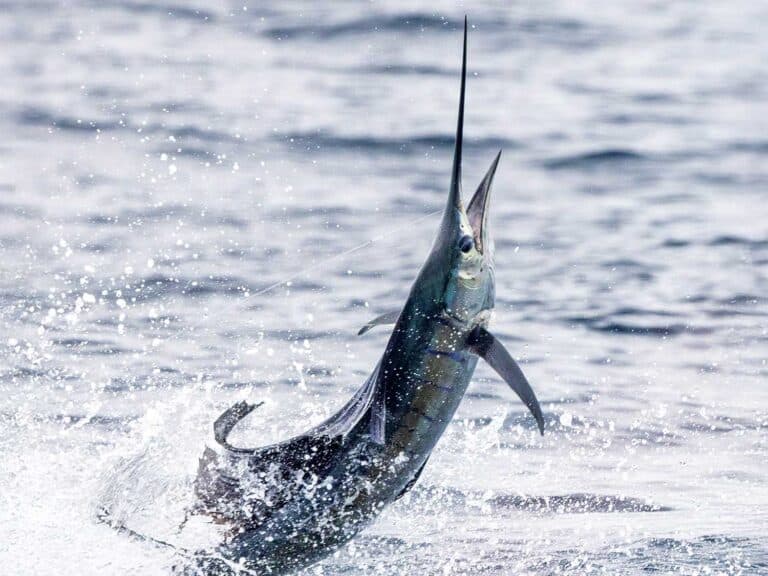
In the 1990s, while helping Dr. Mike Musyl depoly pop-up satellite archival tags (PSATs) on marlin, we’d troll the current slicks the eddies kick up. Oddly, we’d often see a guy swimming around in the slicks, swinging a hand net. Come to find out he was the Aussie Andrew West, working on his Ph.D. studying larval marlin. He had figured out that the slicks were honey holes for tiny marlin. This got us thinking: if baby marlin are so thick a guy swimming can catch them, wouldn’t an eddy-wide study be better?
Fast-forward to 2021 and a comprehensive study of the dynamics of billfish larvae in the Kona eddy system had still never been performed. One night that year, Musyl and I discussed how to approach a comprehensive study of the dynamics of the entire system. And so, the Kona Project was born.
Later, I briefed my fellow Wild Oceans board members on the research concept we had conjured up, and President Rob Kramer got it immediately. He called colleagues at the International Game Fish Association, asking them to partner with us on the Kona Project. The idea that new life cycle knowledge could contribute to better informed management might be a bonus. So the work began.

The Kona Project has three components: research, management and outreach. The initial research is comprised of two phases.
Phase 1: Search and summarize historical reports of billfish (Istiophoridae) larvae, habitat and incidence of spawning activity, synthesizing all the data into a meta-analysis.
Phase 2: Develop oceanographic circulation models based on Phase 1 data to determine likely dispersal routes and connectivity of Istiophoridae larvae from potential spawning locations.
The database created in Phase 1 from historical records is now the largest repository on the distribution of larval billfish in the Pacific. The data clearly shows the preeminent significance of the Hawaiian Islands as a nursery ground. The study uncovered some previously unknown “hot spots,” and also assembled critical habitat parameters such as prefered salinity and water temperature.
In Phase 2 of the project, Wild Oceans partnered with University of Hawaii oceanographer Dr. Yanli Jia. Using Phase 1 data and current modeling technology, a particle-tracking tool simulated the movements of billfish larvae carried by ocean currents. For each larval sample, tracking begins at the location of its capture, moves backward in time, and continues for a duration concordant with its estimated age. The end location is then considered to be its most likely area of spawnig origin.
Preliminary tracks by Jia provided some surprising and unforeseen results. Marlin larvae older than 14 days were tracked backward, and their probable area of origin was on the windward side of the Big Island, not in the eddy system of the leeward side.
Prior to this discovery, prevailing thought was that since larvae were caught in the lee, spawning only occurred in the leeward eddies. We needed more larvae samples from this area to prove this new theory though. Luckily, because Dr. Musyl had been a scientist on many NOAA larvae sampling trips, we deduced that some of those samples may not have been processed and therefore did not show up in the available research.
Old NOAA cruise reports indicated this might be the case, but where were they? Through public and private cooperation, some 1,800 larval billfish samples were located in storage at NOAA’s Pacific Island Fisheries Science Center (PIFSC). Kramer then worked with PIFSC and the University of Hawaii to hire a researcher, Andrea Schmidt, to analyze these samples, and add them to the inventory.
After a year, Schmidt delivered the first complete multispecies larval billfish dataset in the Pacific Islands region with catch information as well as notations of temperature, salinity, chlorophyll and more associated with each larval billfish specimen.
With the additional larval samples, Jia’s models may be able to help determine the percentage of larvae caught along the Kona Coast that were spawned on the windward or leeward sides.
Either way, the Kona Project helps show how important the Kona eddy is in creating ideal conditions for billfish spawning in the North Pacific. Learn more about the project at wildoceans.org.