Subscribe to Marlin magazine and get a year of highly collectible, keepsake editions – plus access to the digital edition and archives. Sign up for the free Marlin email newsletter.
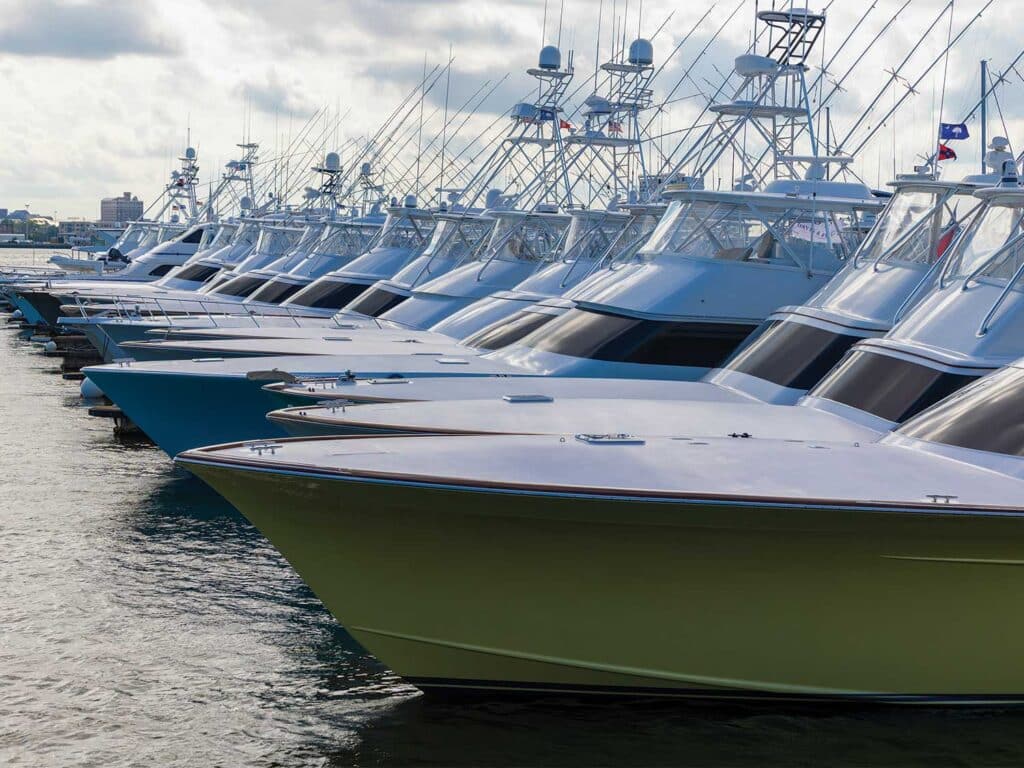
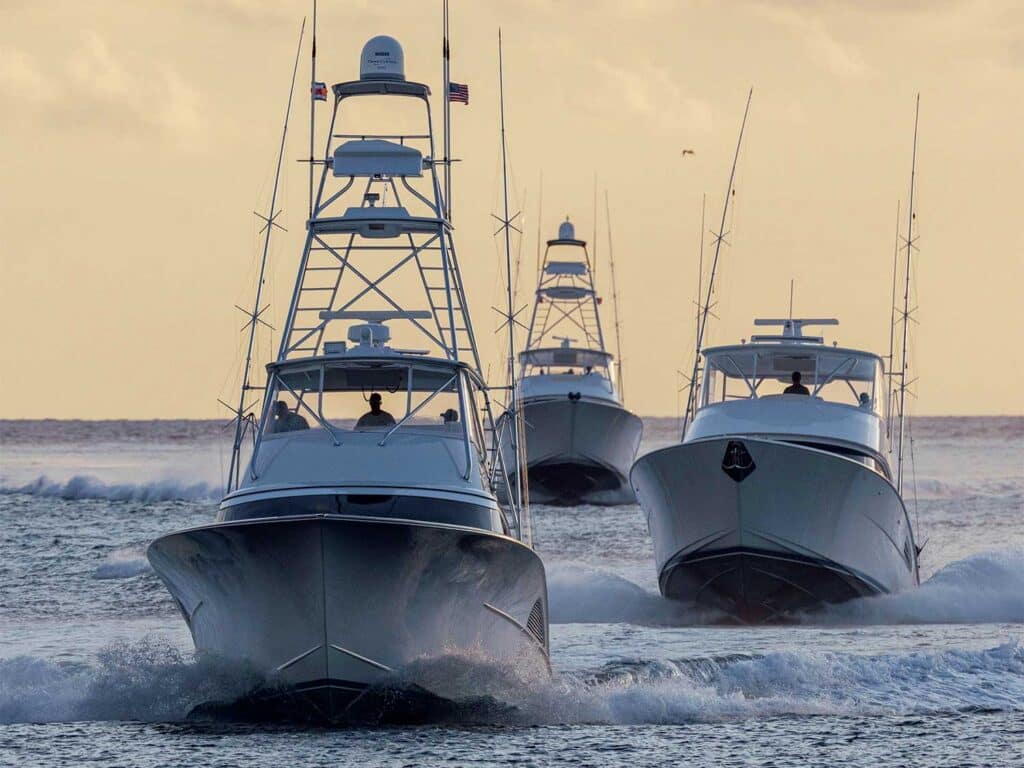
Beyond the capacity to dock boats with incredible deftness and the seemingly magical ability to conjure marlin bites no matter where in the world they fish, veteran sport-fishing captains can do something most people cannot: identify the make of a sport-fisher just by looking at it. If you’ve ever fished a tournament and found yourself in a helm chair next to a veteran captain navigating a scene where the fleet converges on a bite, you know just how magical that ability can seem.
For anyone who has ever wondered how to tell one boat from the next, this article is for you. With a bit of background, an introduction to the specialized vocabulary, and some context on what to look for, sport-fisher identification isn’t as complicated as it might first appear.
The Seven Defining Traits of Sport-Fisher Design
Sport-fishing boats come with a specialized vocabulary, and boat guys spout these words with ease, flowing with the smooth grace of a Carolina boat through a head sea. Without some preparation, though, that jargon can make learning to identify boats far more daunting.
Thankfully, we’ve enlisted the help of some knowledgeable boat guys, starting with David Wilson, Viking’s design manager. Wilson comes by his deep knowledge of sport-fishers—and his passion for designing them—naturally: His father was the first Viking designer, and Wilson shares that knowledge graciously.
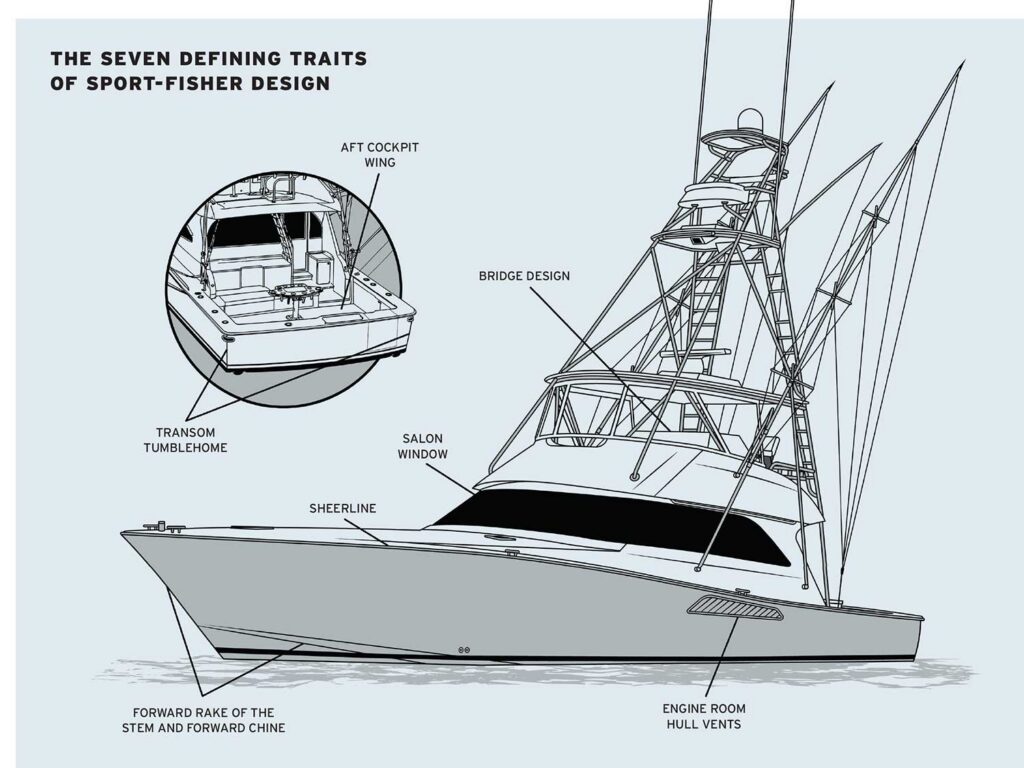
Wilson’s take on identification starts with an overview of defining traits: seven characteristics that form the foundation of a boat’s design. The framework below is his; in some cases, the language used to define the terms is mine.
Sheerline
When you talk about a boat’s “lines,” the sheerline is chief among them. Roughly speaking, if you drew a line from the bow of a boat to the stern, you’d have drawn its sheerline.
If you want to sound like a naval architect, describe the sheerline as the longitudinal curvature of the main deck. To speak more directly, you’d call it the curve along the top edge of the hull’s side.
Sheerlines are particularly helpful for identifying sport-fishers, and the most fundamental split is between boats with a broken sheerline and those with a continuous, or unbroken, sheer.
Florida boats and Vikings are known for unbroken sheerlines—with the notable exception of Michael Rybovich and Sons—meaning the curvature of the profile runs without interruption from bow to stern. It’s the classic S-curve you might see in vintage black-and-white photos of boats fishing tuna tournaments in Cat Cay.
Carolina boats, on the other hand, traditionally feature broken sheerlines. Viewed from the side, the gentle curve running from the bow stops—often where the cabin meets the cockpit—and a hard, straight line of covering boards runs the rest of the way.
The Salon Window
Many builders incorporate unique window treatments. Are the windows contiguous (often a Carolina trait), or are they and the cabin paneled (a South Florida feature)?
Bridge Design
Is the bridge of a sport-fisher overhanging or offset? Florida boats often feature more overhang, which creates shade and a place to escape the sun.
Aft Cockpit Wing
The aft cockpit wing, also called the haunch, is the sloping feature at the aft end of the deckhouse where the aft bulkhead meets the cockpit. The angle of the slope can help identify boats.
Engine Room Hull Vents
As David Wilson puts it: “I’ve never seen two sport-fishers with the same vents. The vents have three jobs: keep water out, get air in, and make it look stylish.” Pay attention to the number, style and placement of vents on the hull, and you’ll likely notice that builders keep them consistent across time.
The Forward Rake of the Stem and the Forward Chine Design
The forward rake of the stem describes the angle of entry from the tip of the bow to the waterline, best observed from the profile view. Builders often keep this angle consistent across builds, though in some cases—like Merritt, whose more modern builds feature an increased angle—it can offer a clue to when the boat was built.
The forward chine design is a related consideration. Picture standing on the dock as the boat comes straight at you and note the angles along the hull where it enters the water.
Some boats feature a single chine—one place where the angle breaks sharply—while others have a double chine. Note the number of chines, the sharpness of their angles, and where they’re placed on the hull; these can also indicate when the boat was made. “The latest Viking models have a double chine,” Wilson says.
The Transom Tumblehome
Were a boat designer to talk about how the Fightin’ Lady fills out a pair of jeans, he’d do so in terms of tumblehome: the amount of roll from the covering boards to the waterline. It’s best viewed from behind the boat, looking forward at the transom—as when docking or leaving the dock.

Schools of Boat Design
With a sense of where to look and how to describe what we see, we can turn to the two main schools of sport-fisher design. Understanding these broad categories makes identification much easier.
Capt. Karl Anderson is something of a sport-fishing ambassador. He knows boats every which way you can know them, and he’s fished them all over the world. If TED Talks ever did a segment on this, it would call Anderson. So did we.
Anderson divides sport-fishers broadly into two design schools: South Florida and Carolina. The rules aren’t as hard and fast as they once were—many builders now blend characteristics from both camps—but here are the trademarks of each.
South Florida Boats
Classic examples: Merritt, Rybovich, Jim Smith, Garlington, Mark Willis.
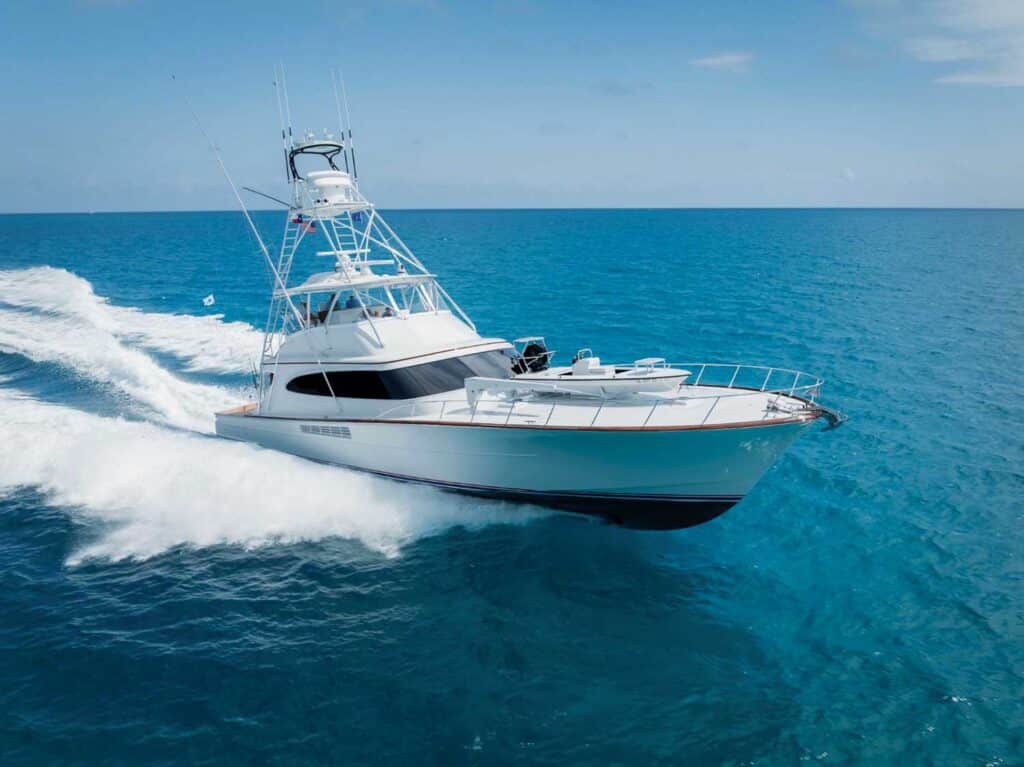
Design characteristics: South Florida boats carry less flare on the bow than their Carolina counterparts, and they tend to run beamier. “Florida boats tend to be beamier, particularly those built by Roy (Merritt), Michael (Rybovich) and Mark Willis. Carolina boats, rather, are skinnier, made to run through head seas and get into shallow inlets,” Anderson explains. South Florida sheerlines are sometimes unbroken, and the bridge and front of the house are typically three-paneled. The bridges tend to have more overhang than Carolina boats, creating shade and a place to escape the sun while fishing, and the front of the house features visible paneling rather than a rounded, seamless curve.
Building from these four characteristics, you can identify a South Florida boat. From there, pay attention to the design tendencies of individual builders to discern the make of a specific boat.
Carolina Boats
Classic examples: Omie Tillett, Buddy Davis, Paul Spencer, Bayliss, Scarborough, Ritchie Howell, Paul Mann, Jarrett Bay; Duffie is built in Ocean City, Maryland, but draws heavily on the Carolina school.
Design characteristics: Carolina boats are known for their exaggerated flare, perhaps the school’s most iconic design feature. The sheerline is broken, with the S-curve of the profile from the bow often stopping where it meets the flat line of the covering boards aft of the house. Up front, the hull’s foot is narrow where it meets the waterline, and the house is typically rounded, without any visible paneling or sections.
Building from these characteristics, you can identify a Carolina boat. From there, pay attention to the attributes used by individual builders to identify the make of a boat.
A Third Category: What About Viking?
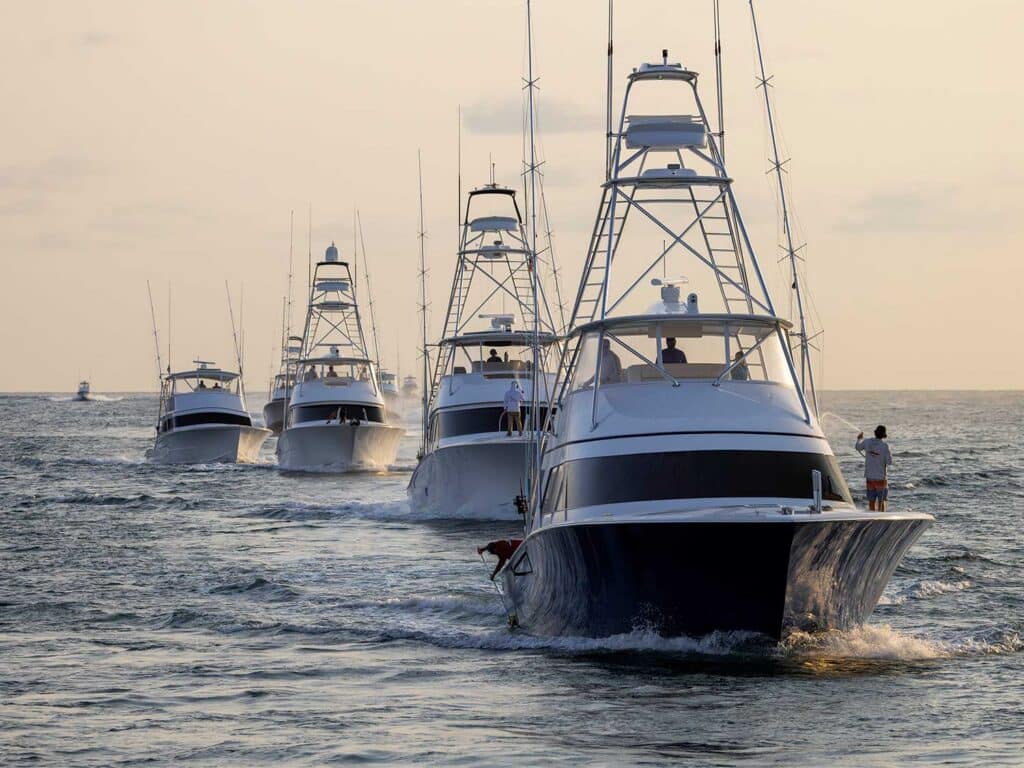
As New Gretna, New Jersey, lies beyond both the Carolina and South Florida schools, Viking deserves special consideration. Anderson provides context: “Viking has blended everything together and done a great job. From the ’80s, they had a boxier look. They’ve taken styling to an incredible level, especially in the past 15 years or so. They’ve taken elements of good-looking Carolina boats and aspects of South Florida boats and produced something all their own.”
Identification by Builder
There isn’t room here to profile every builder on the water, but the four that follow—Bayliss, Viking, Jarrett Bay and Merritt—represent a cross section of the boat design landscape. Each is representative of the schools and traits described above. Use them as a starting point for spotting what sets one make apart from the next.
Bayliss
Cheat code: A salon window profile inspired by the shape of a white marlin’s pectoral fin; enough flare to read as Carolina, though not as much as some builders use; a soft, gentle hint of a broken sheer; a rounded flybridge and cabin.
Inspiration: A modern take on the classic Carolina school, Bayliss boats are known for not only their performance but also the extreme, finely tuned detail of their fit-and-finish. Custom as custom can be, Bayliss is also protective of the lines and fundamental design elements that inform the brand’s aesthetic.
John Bayliss, designer, and Pete Buescher, naval architect, are the driving forces behind the look, feel and performance of Bayliss Boatworks. “When we were designing our first boats,” John Bayliss recalls, “we wanted people to look at them and say, ‘I don’t know where that was built.’ [The look] was very intentional.”
“We’re zeroing in on what we think is perfect,” Buescher adds. “Our design is something we’ve honed. There are things we don’t compromise on—we want a Bayliss to be a Bayliss.”
Design elements: The salon windows are a signature: “The window profile is something we came up with way back when. We wanted something different. The white marlin is one of my favorite fish, and the window looks like a white marlin’s pectoral fin is overlaid on it,” Bayliss explains. The sheerline carries a softer hint of a break—a gentle S-curve, not quite as gentle as a Viking’s but far gentler than a typical Carolina boat—and the flare reads as Carolina without being as pronounced as some other builders. The cabin curves continuously from side to front, with no distinct edge where the two meet, and the flybridge follows the same shape.
Viking
Cheat code: Silver VIKING lettering on the side of the deckhouse; an unbroken sheer; a characteristic sleek, low-profile design.
Inspiration: “From an aesthetic standpoint, it’s low-profile. Even an 82- or 90-foot boat can look sleek and low-profile,” says Viking design manager David Wilson. “It’s critical to get the right proportions. We still start all our designs with 2D black-and-white profiles on paper.
“For proportions, it comes down to the cockpit, deckhouse and foredeck. After the cockpit length is established, the deckhouse should account for no more than 50 percent of the remaining length forward of the cockpit. We generally prefer a slightly longer foredeck and a slightly smaller deckhouse.”
Design elements: The silver VIKING lettering has appeared on the side of the deckhouse in one form or another for about 60 years. Most Viking convertibles feature an offset flybridge, with the bridge deck extending beyond the deckhouse perimeter along the sides and forward edge. This increases the usable flybridge footprint while maintaining Viking’s clean, balanced lines. Viking Billfish models have an inset bridge, with the bridge deck within the deckhouse perimeter for a more classic look. Other signature elements include an unbroken sheerline, distinctive salon windows framed by a black mask, engine room hullside vents and a hullside feature line.
Jarrett Bay
Cheat code: Plenty of flare; lots of tumblehome, or a high degree of curvature from the covering boards to the waterline; a broken sheerline accented by a painted toe rail.
Inspiration: Peyton Lanier, a design engineer at Jarrett Bay for nine years, is an expert in imparting curves to beautiful sport-fishers. “Our sheerline is one of our signatures, with a painted toe rail where it turns down. We’ve held that line consistent in boats from 30 to 90 feet for the past 20 years. The sheerline is nice and calming; it’s smooth. It started with a pencil stroke. It’s not too sharp; for us, it’s just right.”
“Our tumblehome is another signature. We carry more tumblehome in our transom—more curvature in the back and the sides. This gives our girls wider hips than some other builders,” he adds. “I’m not sure how it came about—in the early days, in sketching or drawing, I imagine. That’s our shape. That’s what we like.”
Design elements: Jarrett Bay boats carry a broken sheerline accented by a painted toe rail, plenty of Carolina flare, and the builder’s characteristic tumblehome—a good deal of curvature in the transom. The cabin top is rounded too; there are plenty of curves in a Jarrett Bay.
Merritt
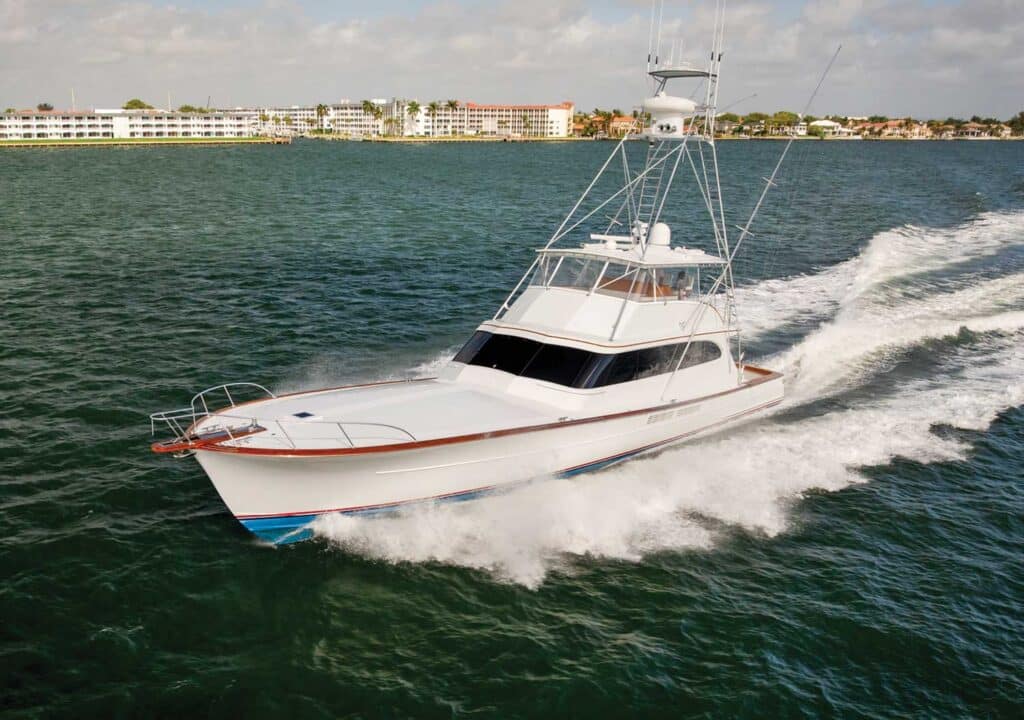
Cheat code: A classic South Florida hull with no flare; an overhanging bridge; engine vents in three simple, straight lines; an unbroken sheerline.
Inspiration: Anderson works closely with Merritt Boatworks, and few people understand and appreciate what this boat and its tradition mean as deeply as he does. To hear him describe these boats is to appreciate their evolution from the 1950s to today.
“Merritts have an unbroken sheer. The rake of the stem has changed a bit from the ’60s to the ’90s—today’s boats are raked more progressively forward. You can always tell a Merritt by the engine vents: three straight lines, very simple,” Anderson explains. “The window shape at the front of the house has become sleeker and modernized through time.” Comparing the rounded ease of modern boats with the paneled look of the past tells the story.
“Roy’s boats carry a lot of beam relative to length, providing more interior space and room for fuel. They’re usually a foot or two wider than boats of the same length,” Anderson adds. The ability to modernize while paying homage to the classic is no accident: “Roy is really careful about how it all looks.”
Design elements: Merritts feature an unbroken sheer, engine vents rendered in three clean, simple lines, plenty of beam, and the classic Florida hull.