Subscribe to Marlin magazine and get a year of highly collectible, keepsake editions – plus access to the digital edition and archives. Sign up for the free Marlin email newsletter.
The goal was simple: buy an older sport-fisher and refit the boat over six months. Once the refit was done, a lifetime of fishing and family fun awaited. That was eight years ago.
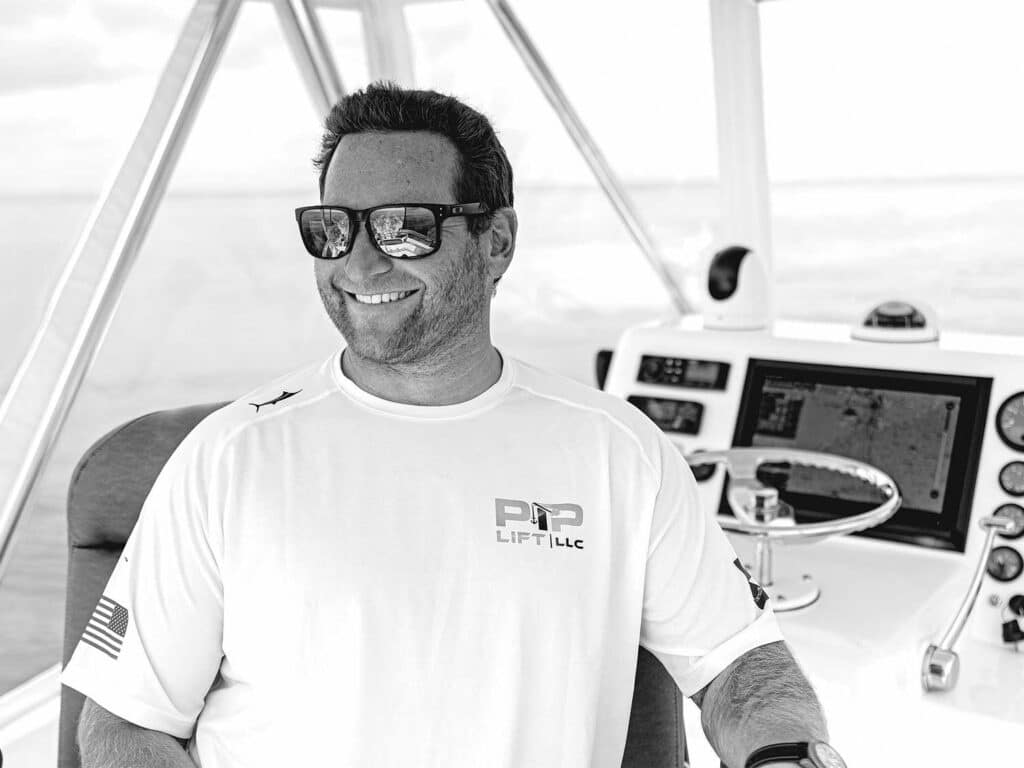
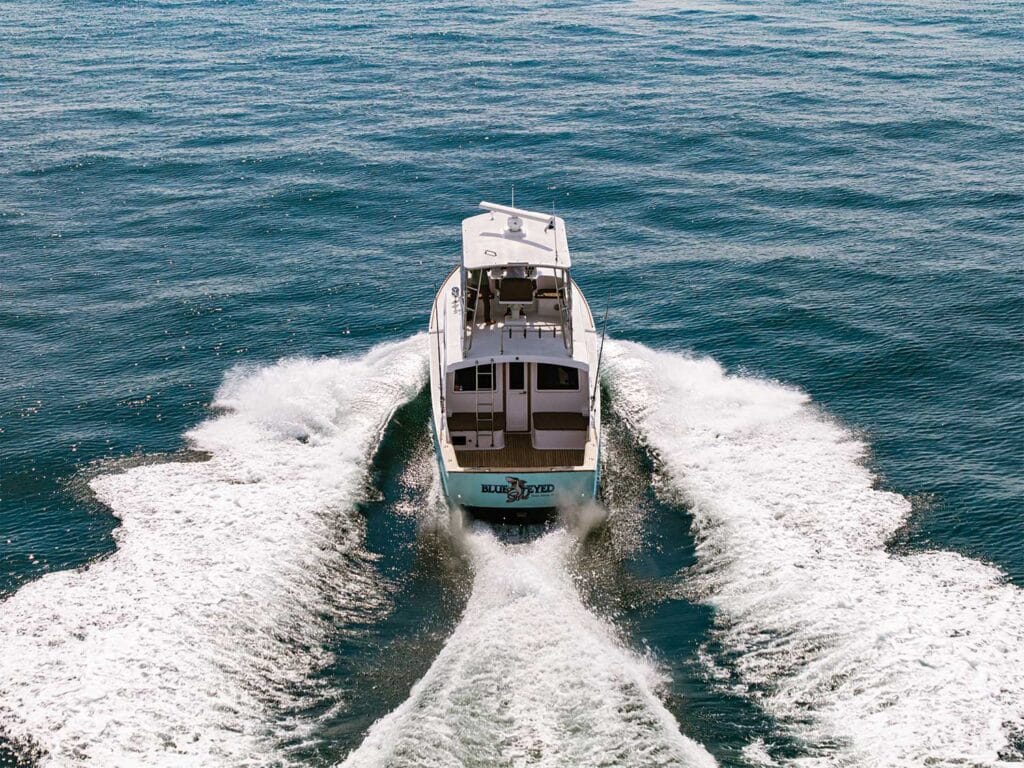
The boat, a 40-foot 1957 wooden Whiticar, is now complete, sort of. Are boats ever really finished? More than the story of a refit, this is the tale of how a challenging refit project led the boat’s owner and third-generation steel fabricator, Josh Noveletsky, to solve a problem the marine industry didn’t realize it had, building a faster, safer, more streamlined way to remove and install a vessel’s engines. This is the story of not only finding the fix, but also launching a company—PIP Lift—in the course of doing so.
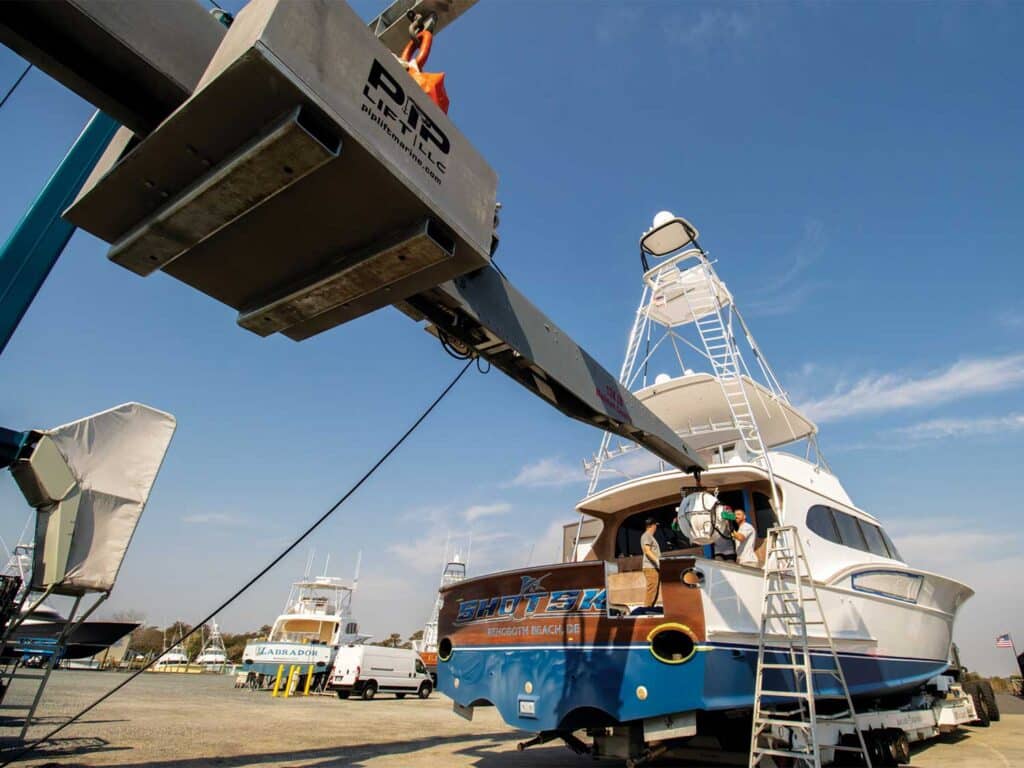
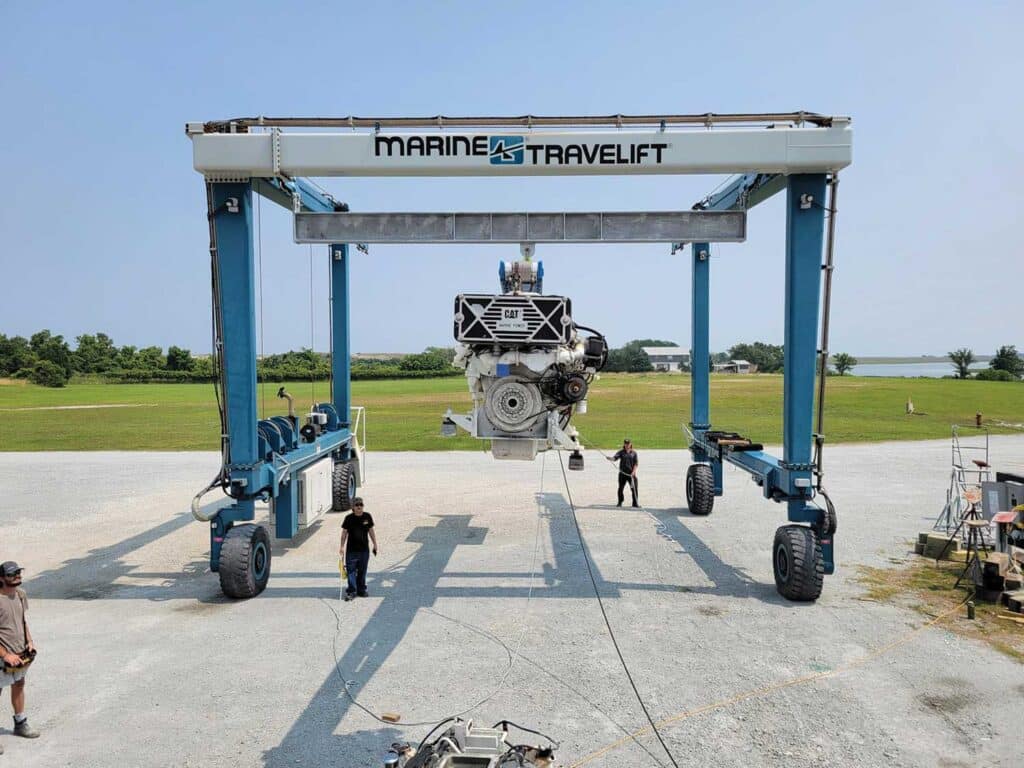
In layman’s terms, a PIP Lift is a remote-controlled, under-the-hook lifting device that can remove or install heavy systems on boats. It does the job of a traditional gantry and crane in a manner that reduces both labor cost and risk.
“Traditionally, it was three or four or more guys [to remove an engine], and you’d have gantries, you’d have a come-along, and you had to build frames in the boat,” Noveletsky says. And it was time-consuming. “Now we’re doing it with two guys, one on a Travelift and one with the PIP Lift, in about 14 minutes from the time you bring the PIP lift in to the time the motor is on the ground.”
The Installation Equation
“When we were putting the motors in [the Whiticar], I had a beam that I fabricated with a come-along and some counterweights, and we got the motor in, and then we messed up the roof of the boat because I forgot to take the counterweights down when I put the motor down,” Noveletsky says. He thought there had to be a better way to do this work.
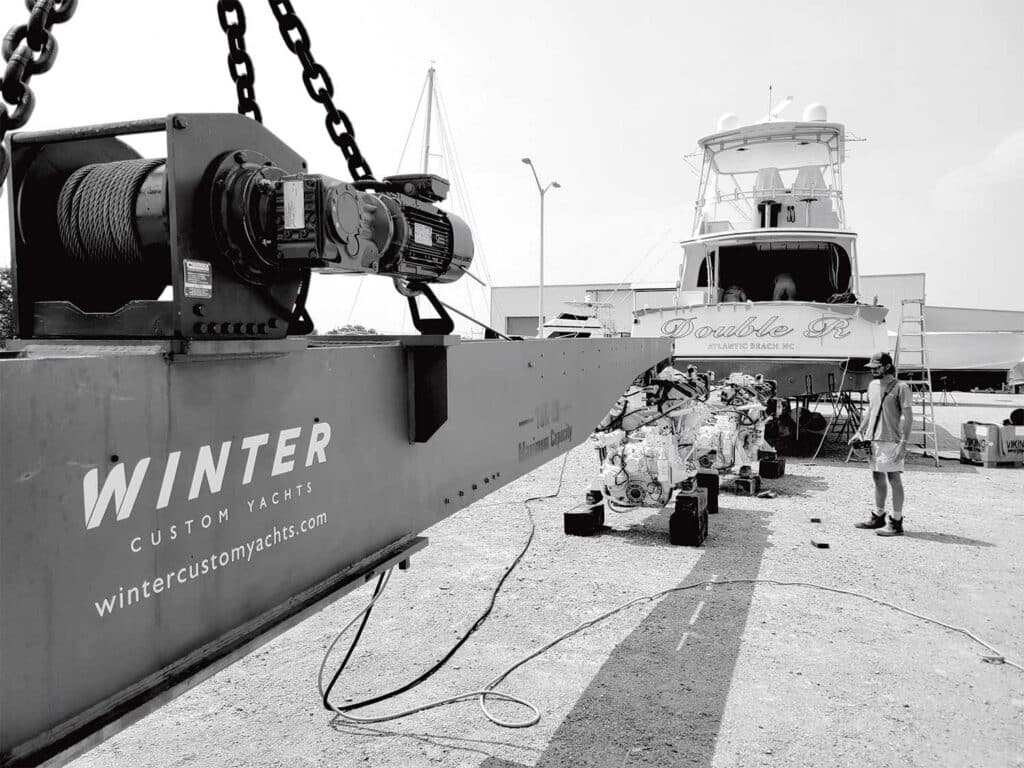
He reached out to his friend Tim Winters of Winter Custom Yachts for some advice. Winters told Noveletsky that he had an idea and sent over a drawing. Noveletsky thought that Winters’ idea had merit. “I brought it home, re-engineered it [and] came up with a concept, which is now PIP Lift,” Noveletsky says. “I showed it to Timmy, who said, ‘That’s great, run with it.’”
Several iterations and a fair bit of trial and error followed before form met function. In fact, it took nearly a year of investment, building, testing and tweaking to create the production version seen today.
Winters was interested and wanted one. The PIP Lift had to solve several challenges. Winters needed the lift to taper to 7 inches because he was having to remove oil pans with tight overhead tolerances. Height was also a key driver for the tech. Essentially, it needed to have bearlike strength and catlike agility.
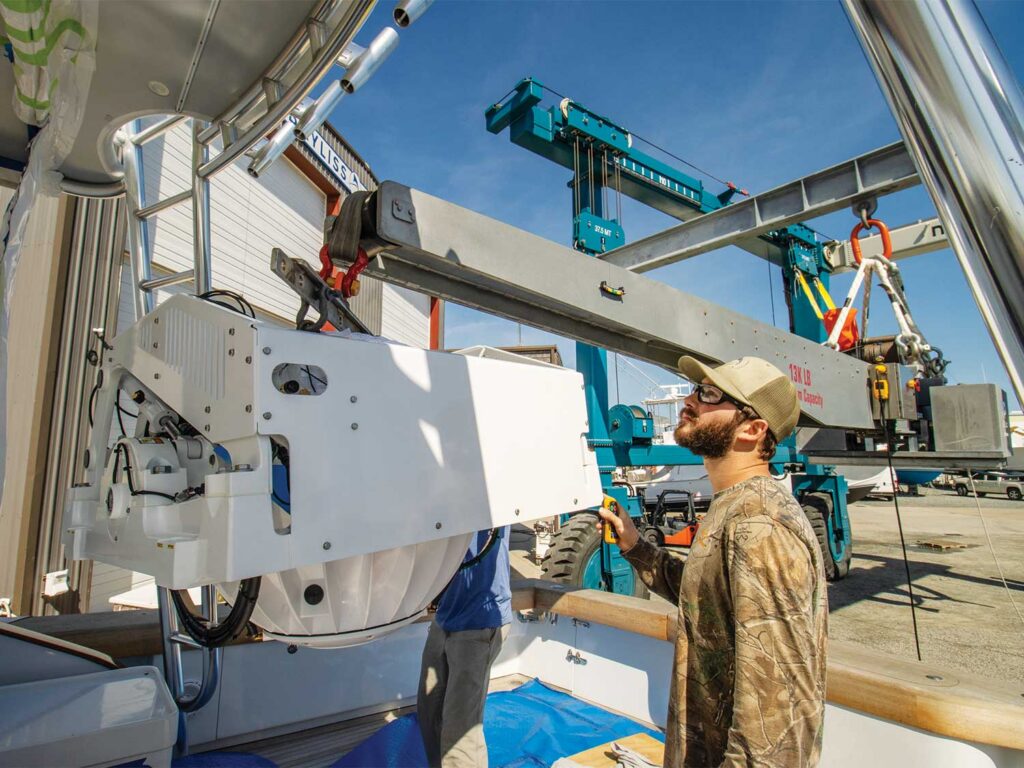
Noveletsky got the lift, which is built using only U.S.-manufactured steel, to the required 7-inch taper as well as to a 10,000-pound capacity. “Our initial lifts were 10,000 pounds at 7 inches, with 20 feet of reach,” Noveletsky says, noting that the use of U.S. steel is purposeful because it’s built to the strictest tolerances.
“[Lives are] in your hands when you’re fabricating it. And I don’t want to put my name on something that could hurt somebody,” he says.
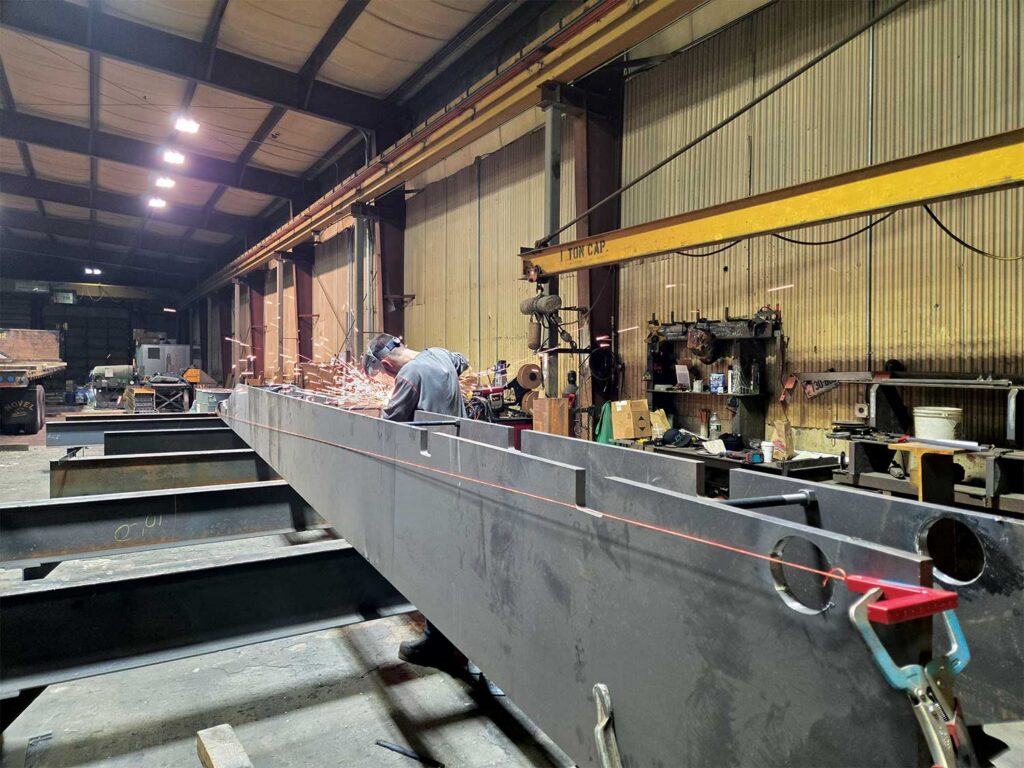
I recently had the chance to see a PIP Lift being manufactured. The process is as much art as it is schematics and science. Steel is a temperamental material that requires an artisan eye to get it to behave under the heat of a torch. PIP Lift has a dedicated production crew who know how to tame the tempestuous metal into submission.
One of the key concepts for the PIP Lift lies in the ability to control it remotely. “We want everybody away from the weights,” Noveletsky says with purpose. “We want everybody away from the motor. Safety is paramount. We want that to be our number one factor.” To that end, every PIP Lift self-balances at zero in the neutral position. No staff member should ever stand near the engine during installation or removal.
The remote also functions with just four buttons to either move an engine up or down or move the counterweights back and forth. “Simplicity is really key,” Noveletsky says.
Prepare for Liftoff
Noveletsky delivered the first lift, and his buddy Tim told him that this could be a real business. Noveletsky thought about it for a while and then fate intervened.
“I gave [Tim] his. And then I used one in the erection field and for steel fabrication to get stair stringers in and pieces into a building that we couldn’t do with a traditional crane because you had to get inside the building.”
Noveletsky realized there may be a market for his PIP Lift. Whether it was a boatbuilder or a service yard, time is money, and this is a piece of technology that could save dollars at both ends while reducing risk to the crew. At first blush, this appeared to be a clear win-win setup.
Feeling confident after building two working PIP Lifts, Noveletsky and his wife, Lexi, hopped in their car and headed to the hub of custom Carolina sport-fisher boatbuilding. The plan was to go door-to-door, seeing if anyone else would buy into their vision for easier, cost-saving engine-installation technology.
Noveletsky and Lexi wore a groove through the roads of North Carolina, sharing the idea and their success to date with anyone who would listen. “We went to North Carolina because that’s the heart of boatbuilding,” he says. “I just drove around to everybody, and people liked the idea, they liked the concept, but nobody really wanted one.”
Undeterred, the couple continued to pitch what they now felt was a game-changing technology. And then it happened.
Noveletsky shared the PIP Lift vision with Donnie Caison from Caison Yachts, who got it and liked it. And he cut a check to buy one. “Donnie said, ‘Great, how much?’” A check and a handshake later, PIP Lift was officially in business.
“Donnie seemed really excited,” Noveletsky reflects, adding that’s when he thought this really could be a business, not just a passion project. “So, there was mine, Tim’s and Donnie’s, and that’s where it all started,” he adds.
Hitting Stride
With his second client on board, it was time for PIP Lift to level up.
Noveletsky soon found another new client in Banks Boatworks. The company also developed a smaller PIP Lift, a 15-footer with a 5,000-pound capacity, with an eye toward the Northeast market. But it turned out that a much bigger lift would be needed. If you’ve been around the boating industry for the last decade or so, you know the boats aren’t getting smaller.
Bayliss Boatworks called and asked for a bigger version of the PIP Lift so the builder could hoist honking MTU diesels with the gears on them. “Our standard lift didn’t really fit the bill, so we went back to the drawing board, and we engineered and tested one even bigger,” Noveletsky says with a Cheshire cat grin. The company upped the ante on everything, from overall physical size to weight capacities as well as increased tolerances. The Super PIP, as it’s called, accommodates up to 13,000 pounds of big iron.
But the company founder wasn’t about to build a PIP Lift to a spec and send it off without knowing the exact limits of its capabilities. He fabricated a Super PIP and tested it beyond its current metrics by several thousand pounds. Once Noveletsky proved the Super PIP would work as hoped, he destroyed it. His company doesn’t believe in selling something that has been stress-tested to its limits. But once he knew the model worked, he built the first production Super PIP for Bayliss.
Jarrett Bay Boatworks soon ordered the second Super PIP.
Adoption and Expansion
Persistence and some early adopters have gotten PIP Lift to a place where the phone is now ringing the other way, and Noveletsky is all for it and more—much more. But what has changed since those long, early days driving through North Carolina’s boatbuilding hamlets?
It’s not any one thing, but a combination of several. “Safety is number one because everybody needs to go home at the end of the day,” Noveletsky says. “You’re not using the traditional gantries and come-alongs. So you’re keeping everybody safe.” Efficiency is also important. “A lot of boat owners have money, but they don’t have time.”
The efficiency quotient applies to boatbuilders and service yards too. “If you can turn a project around in a day that would have taken two days [or more], or a boatbuilder or boatyard can do it with two guys as opposed to six guys, you’re saving money and you’re saving time,” Noveletsky explains. “You’re keeping everybody away from harm while doing it faster and more efficiently.”
About a dozen PIP Lifts are now in use at boatbuilders and yards around the country. So, what’s next?
The short-term goal is to see a PIP Lift in every big yard on the East Coast.
Noveletsky says he’d love to be the next Marine Travelift, a ubiquitous piece of tech found in every shipyard. “I’d love to just see us as a standard piece of equipment in the yard,” he says, noting that expanding into the yacht world is also welcome.
“We can make a PIP Lift that picks up 15,000 or 20,000 pounds, or whatever the market needs,” Noveletsky says. “Our lifts reach 20 feet now, but if I needed to make one that reached 30 or 40 feet, I’m up for the challenge because that’s what we do.”
And the Whiticar? She’s got a fresh pair of 370 hp Cummins diesels. Oh, and she’s for sale.