Subscribe to Marlin magazine and get a year of highly collectible, keepsake editions – plus access to the digital edition and archives. Sign up for the free Marlin email newsletter.
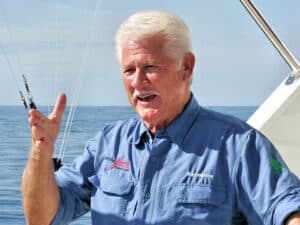
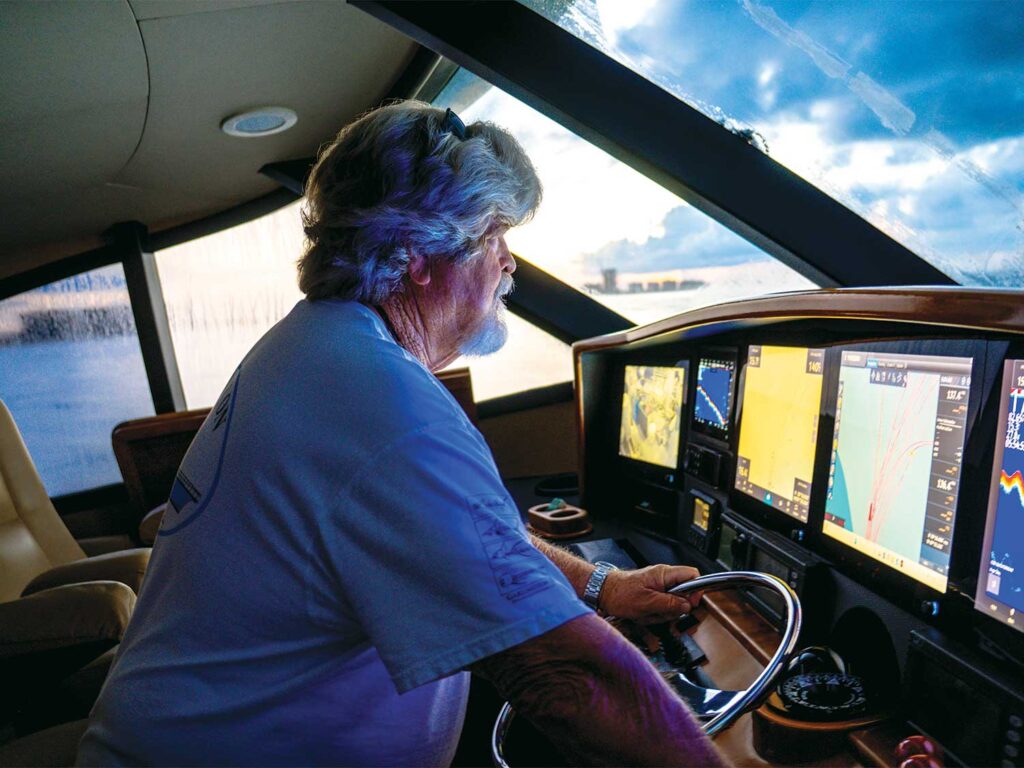
There are certain stories in sport fishing that don’t get told—they’re earned. They’re shaped over decades, forged in trust, loyalty, and the stubborn grit that only fishermen seem to understand. The renowned Dreamin’ On operation has one of those stories. For more than 20 years, the 78-foot Garlington has carried anglers across oceans, but its greatest chapter has little to do with the miles traveled or the marlin released. At the center of it all is Capt. Randy Hodgekiss—a man whose life on the water began long before the boat ever existed, and whose resolve would be tested in a way few could imagine.
Hodgekiss’ journey is defined not merely by where he has been, but by what he endured and how he returned. After the catastrophic loss of his leg in 2005, most would have expected his time at sea to end. Instead, it became the moment that revealed the depth of his character, the loyalty of those around him, and the remarkable resilience that allowed him to climb back into the tower—literally—and continue pursuing the life he loved.
This is not a story of a globe-trotting fishing program. This is a story about grit, loyalty, reinvention, and the refusal to let a single moment—no matter how devastating—define the rest of a life.
The Beginning
Thirteen-year-old Randy Hodgekiss first fell in love with offshore fishing when he and his uncle, Luther Creel, began leaving Rod and Reel Marina in Pensacola, Florida, aboard Little Mama, a beat-up 36-foot lapstrake Chris-Craft older than Hodgekiss himself. Back then, the technology was rudimentary: a paper chart, a simple compass, a directional radio antenna and a flasher sounder. That was it.
They pointed toward the Nipple, a subtle bump along the 100-fathom curve off Orange Beach, Alabama. Few boats fished offshore in 1963, and fewer still were hunting marlin. Hodgekiss learned by failing—rigging baits incorrectly, driving off course, fighting fish they had no business staying connected to. They broke lines, lost marlin that boats twice their size couldn’t have stopped, watched props chew through leaders, and on their best days, limped home sunburned but wiser.
Those early trips didn’t only make Hodgekiss a fisherman, but they also shaped the person he would become. They showed him the value of patience, improvisation, and staying calm in uncertainty. And they planted the seeds of something he didn’t yet realize—a life he would spend chasing horizons.
A Life at Sea
Through high school, Hodgekiss worked summers as a mate, absorbing everything he could from captains along the Gulf. In 1970, at age 20, he joined the Navy Reserves and served aboard the World War II destroyer William C. Lawe during the final nine months of the Vietnam War. When troops were withdrawn, he returned home ready for normalcy, which in Hodgekiss’ world meant being back on a boat.
He mated in tournaments from Alabama to South Florida, learning the culture and camaraderie that surround competitive fishing. He spent a season in Cozumel and earned his captain’s license in 1980. But like many young captains, he needed to work wherever he could. He ran supply boats in the Gulf oil fields on two-week rotations, built houses, poured concrete, even bartended at the Flora-Bama, one of the most iconic beach bars on the Gulf Coast.
“I worked all the time, doing whatever I could,” Hodgekiss says. “If I wasn’t fishing, I was doing something to make a buck so I could keep fishing.”
That mindset—steady, humble, hardworking—would ultimately catch the attention of three brothers with big plans.
The Brothers and the Boat
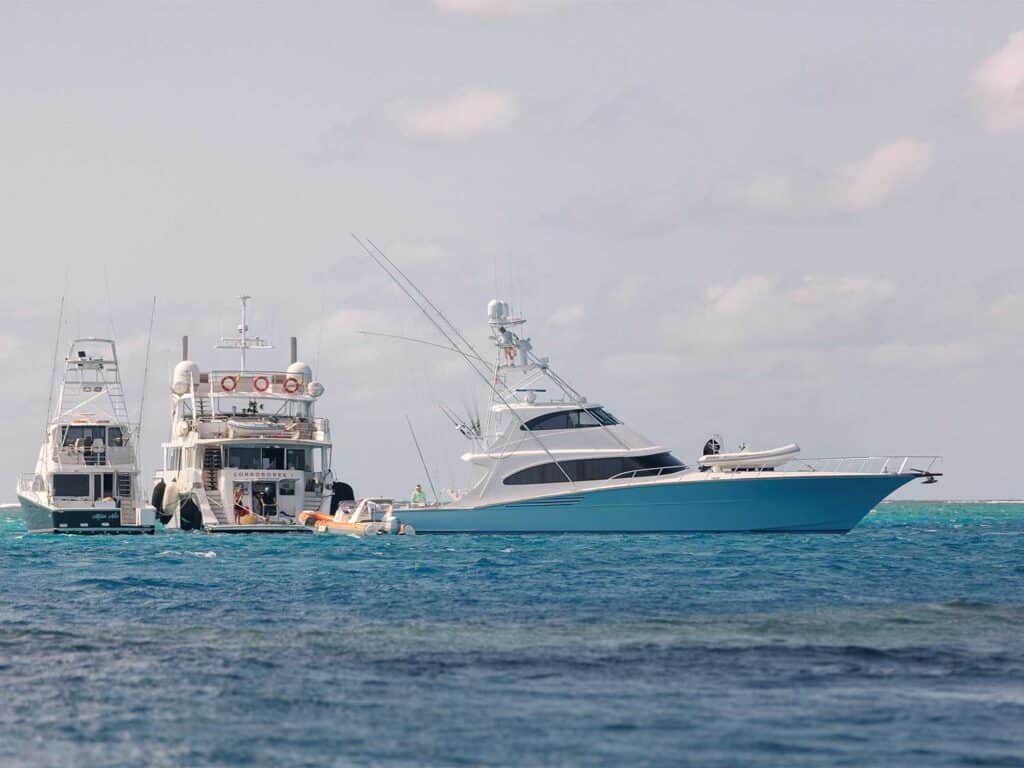
In 2002, Hodgekiss’ life changed course when he met the Keinath brothers: Warren, Steve and David. The trio had recently acquired a 78-foot Garlington built in New Zealand by Mullen Wing. They named her Dreamin’ On and intended the name literally.
“The boys bought the boat shortly after 9/11 and hired a captain who mostly fished the Gulf,” Hodgekiss says. “When he retired, they hired me—and they were ready to travel, to see and fish the best locations in the world, which was right up my alley!”
Costa Rica. Panama. Cabo. Bermuda. Season after season, the program expanded its footprint. Hodgekiss ran Dreamin’ On through the Panama Canal six times, learning the local seas, tides, currents, and personalities of each crew stationed there. The brothers fished hard, but they also explored, eating with local families, supporting communities, and learning the history of every place they visited.
Long runs, heavy weather, and fishing hours that stretched from dark to dark defined those early years. But Hodgekiss always says the same thing: “It was the stuff most people only dream about.”
Then, in 2005, everything nearly came to an end.
The Accident
On October 30, 2005, Hodgekiss and his wife, Becky, were on his motorcycle less than a mile from home when a distracted driver pulled directly into their lane.
“This car pulled into my lane of traffic,” Hodgekiss recalls. “I was trying to scoot around the car when he slammed into us. It was like deboning a chicken leg. Cut my damn leg off from the knee down.”
Becky’s femur shattered. Hodgekiss’ right leg was severed instantly. In the chaos and shock, small miracles unfolded. A police cruiser was already in the next lane. The first car to stop carried a husband and wife who worked in the ER.
“I’m sitting up, trying to squeeze my leg to stop all the blood loss, when paramedics arrived,” he says. “They put a tourniquet on and called for a helicopter. They landed in the street, knocked me out with something, loaded me up, and sent Becky in an ambulance.”
There was no possibility of reattachment. Two days later, Hodgekiss was released from the hospital.
“Three days after the accident, I was back on the boat,” he says. “I tried to climb the tower on crutches but couldn’t make it work. I thought my career had just ended.”
For the first time in his life, the sea felt out of reach.
Learning to Walk—and Fish—Again
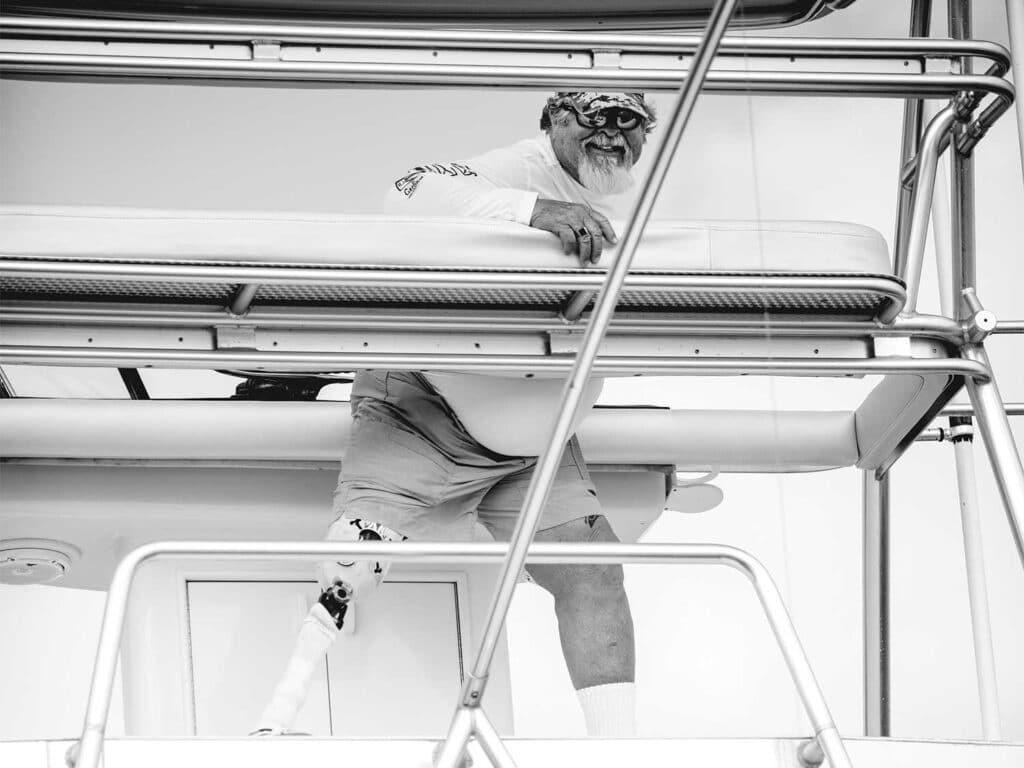
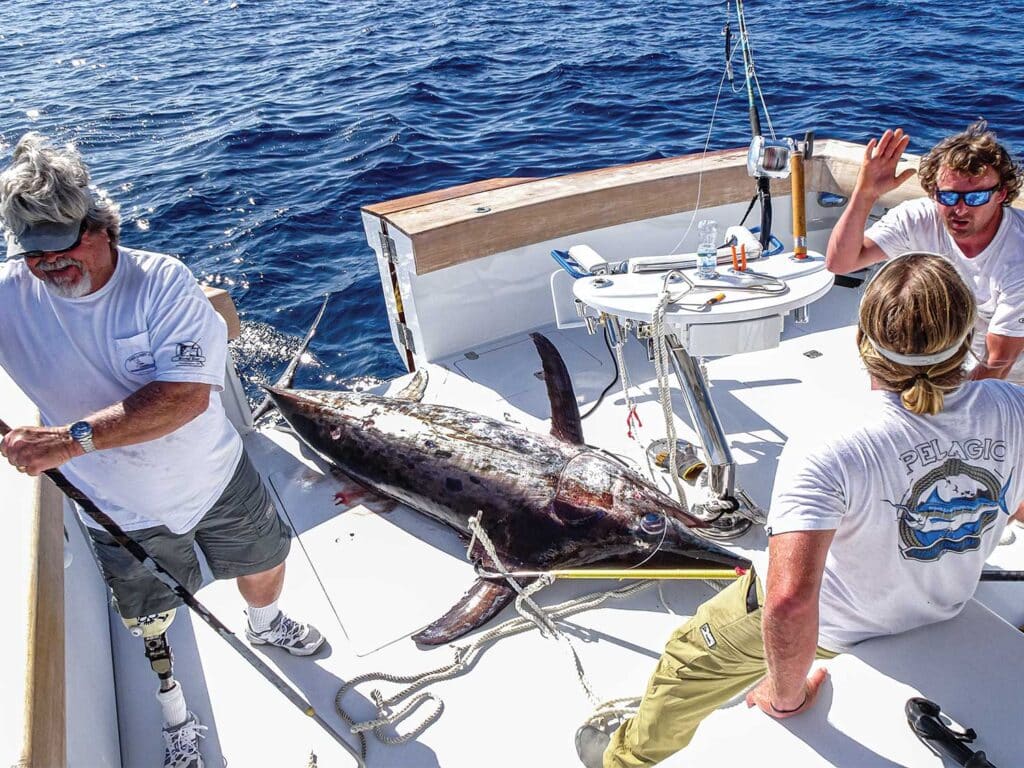
Weeks passed, but Hodgekiss’ amputated leg failed to heal. He contacted a friend and orthopedic surgeon, who scanned it and quickly scheduled a successful surgery to clear the infection. The next goal was finding a workable prosthetic limb. Hodgekiss discovered there were few options, none of which would allow him to climb ladders, grip narrow tower steps, or balance on a pitching cockpit deck in rough seas.
Then a friend told him about a man down the dock who made prosthetics using a 3D printer and CAD, years before the technology was widely adopted. Hodgekiss hobbled down to find him.
Rick Partain, a former helicopter medic in Vietnam, listened to Hodgekiss describe his job: the tower climbs, the long stretches at sea, the need for balance on wet decks.
“Rick was the first person who understood what I did for a living,” Hodgekiss says.
Two days later, Hodgekiss arrived early at Partain’s office in Gadsden, Alabama. By that afternoon, Partain had built a custom prosthetic from parts and pieces—free of charge.
“I walked out of his office that afternoon,” Hodgekiss says.
He drove straight to Dreamin’ On, climbed from the salon to the bridge, then to the tower. Only one minor adjustment was needed.
While Hodgekiss was recovering, the Keinath brothers made a decision that still chokes him up when he talks about it: They suspended all operations. They did not hire a replacement captain. They did not explore options. They simply waited.
That loyalty became the backbone of everything that followed.
The Pacific Odyssey
In 2010, Dreamin’ On shipped to Tahiti to begin a 14-month, 5,000-mile voyage through the South Pacific—a journey that would become the centerpiece of the program’s legacy.
They fished their way through Cook Island, Nui Atoll, Fiji, Vanuatu, the Solomons, Papua New Guinea and, eventually, Australia. Finding fuel was a challenge everywhere. Fitting a 78-footer into tiny docks required patience, creativity and sometimes impossible angles.
Along the way, the crew funded classrooms, donated school supplies, and built friendships with people in remote communities. Hodgekiss’ new leg became a fascination—sometimes even a source of fear among locals who had never seen metal prosthetics. For amputees using tree branches or PVC pipe as makeshift limbs, seeing Hodgekiss climb the tower brought hope.
They weathered cyclones, navigated coral-studded passes, and even survived a tsunami that sucked all the water from beneath the boat, dropping her into the mud before flooding back in minutes later.
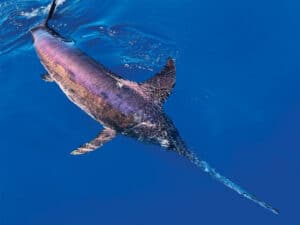
Near the end of the odyssey, on the Great Barrier Reef, they released an 800- to 900-pound black marlin—the largest of Hodgekiss’ life at the time.
Two Granders
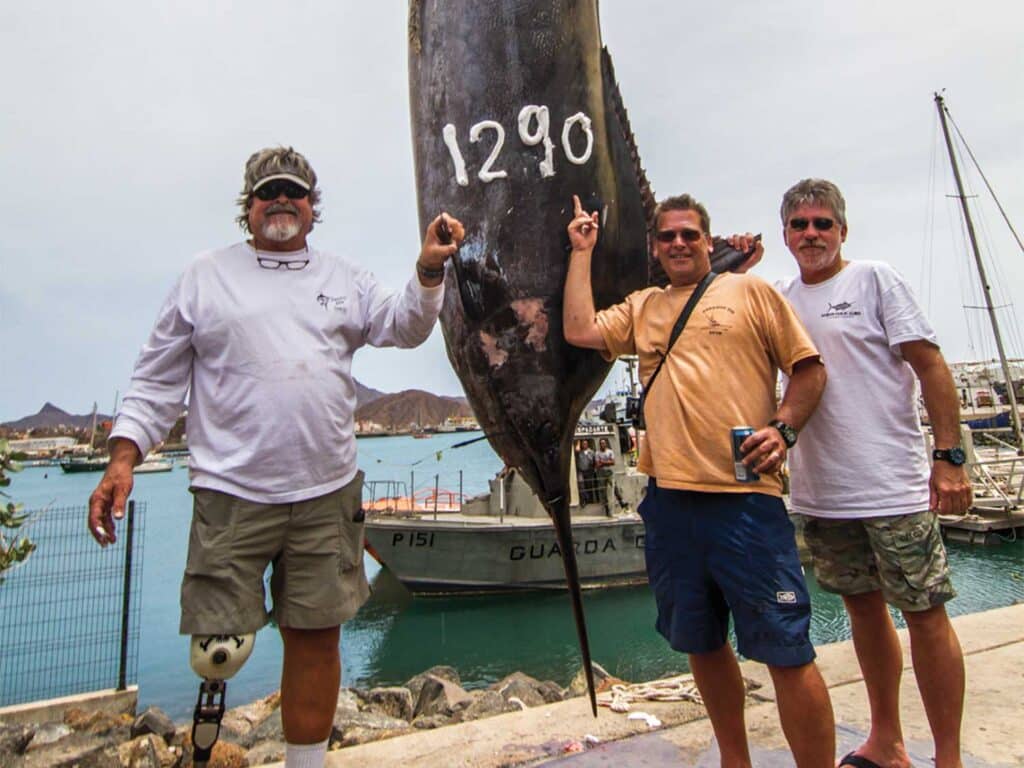
In 2016, Dreamin’ On shipped to the Canary Islands, and Hodgekiss ran her 800 nautical miles to Mindelo, Cape Verde. The Northwest Banks and seamounts there are his favorite places on the planet, and they had produced bigger marlin for the last two seasons.
“First thing off the bat, we catch a 300-pound blue,” Hodgekiss recalls. Later, a massive fish exploded on the center rigger.
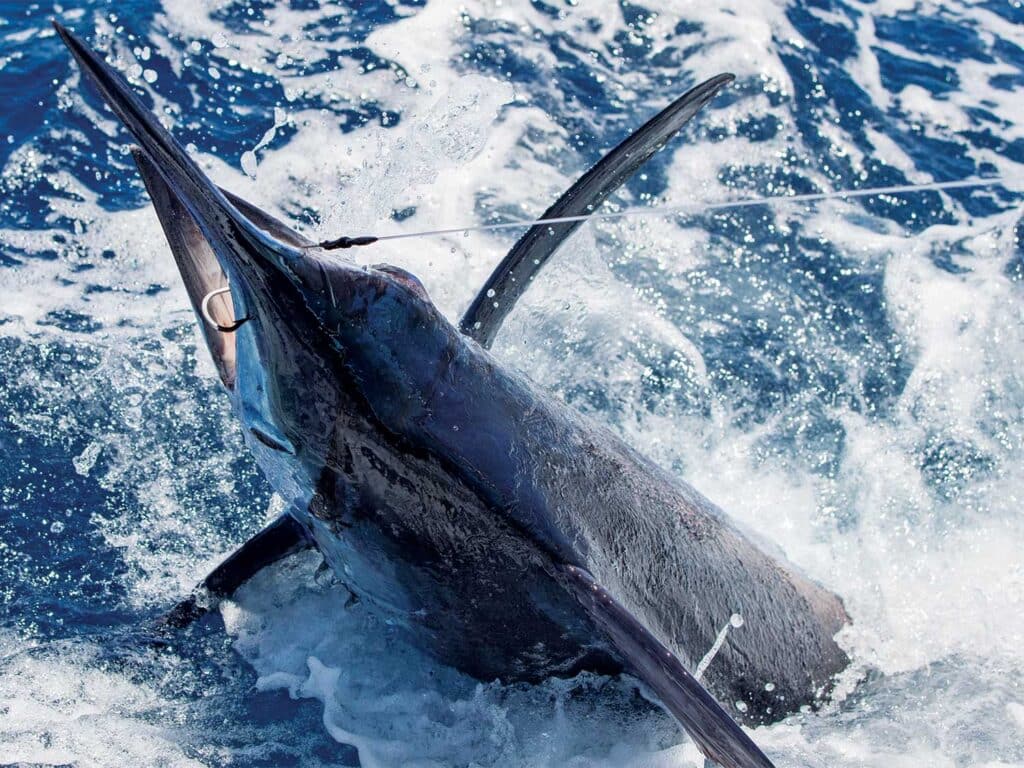
“She started jumping—one after another for at least 16 jumps,” he says. “We got her to the boat in about 35 minutes, and that’s when it got interesting.”
The wireman couldn’t hold her. She tore off, swam under the boat, and miraculously avoided the props. When they finally landed her, she filled the cockpit.
At Marina Mindelo, she weighed 1,290 pounds—the largest blue marlin ever weighed there at the time. Their first grander.
The second came less than a year later on Opal Reef in Australia. David and his lifelong friend Eric Gjerdingen, who had already caught several granders, were in the cockpit when the fish appeared.
“I tried to get David to take the rod, but he declined,” Hodgekiss says. “Eric began the fight. When he got it alongside the boat, the boys weren’t making a move. I shouted, ‘You boys better kill that fish, or you’re all fired!’”
The fish weighed 1,035 pounds—Gjerdingen’s eighth grander.
Over 23 years, the Dreamin’ On crew has killed fewer than a dozen marlin, releasing any fish whose size they could not confirm unanimously.
The Legacy Continues
Dreamin’ On’s tentative 2026 schedule includes shipping to the Canary Islands in March, then Cape Verde for the July 4 Blue Marlin World Cup, followed by Madeira and the Azores. Hodgekiss will celebrate his 76th birthday in January, but his enthusiasm remains unchanged.
“What’s next? Every day above ground is a good day,” he says. “I’m going to keep going as long as I can. You never know when the next bite might be the big one.”
For Hodgekiss, Warren, Steve and David, the dream has never been about luck. It has always been about loyalty, grit, and the unshakable belief that the next adventure could be the greatest one yet.