Subscribe to Marlin magazine and get a year of highly collectible, keepsake editions – plus access to the digital edition and archives. Sign up for the free Marlin email newsletter.
To bridle or not to bridle? That is the question. I spent most of my early years putting live baits directly on a hook and watched too many baits come back after a bite with the hook buried back in the bait. I started driving my hook under the chin and up through the nose. That seemed to help, but sometimes it seemed like too many fish still got away. Every fish I lost hurt me. There had to be a better way.
As the years went by, anglers realized that whether we were flat-lining or kite-fishing, flossing our live baits onto the hook was a better way to go. I look back now at the primitive way we used to create bridles on the back or nose of a goggle-eye and just shake my head. Our first bridles were actually floss-stitched two times sideways through the nose or back, then tied in the form of an X, and then we added a small loop above the X and tied off that loop again about a half-inch above the X. We would put the hook in the small loop that we created, twist it tight, and then put the hook under the X.
It worked, but it was pretty rough on the bait because of how hard we had to squeeze the bait and how long we had to hold it while we were stitching. We did discover, however, that it reduced the number of times that a hook was turned back into the bait and increased our hookup ratio because the full hook was exposed. This meant that we could actually go down a hook size in many cases. I’m not sure that the hook size really mattered in the end, but it certainly made us feel better to look at a smaller hook on our bridled bait.
Fishing in places like Australia, I quickly realized that Dacron or floss bridles were standard issue when heavy-tackle fishing with dead baits. One thing I did pay close attention to was how much was enough bridle and what was too much. Baits bridled with too much Dacron or floss were actually counterproductive because the fish wouldn’t shed the bait quickly after the hookup. The bait then became a hook remover. It’s hard in this article to describe what is too much and what is too little, but you get the idea. Ideally, there should be enough of a bridle to endure the bite, drop-back and hookup, but still allow the fish to shed the bait quickly after the hookup. That is generally controlled by the strength of the bridle or the depth of the stitch.
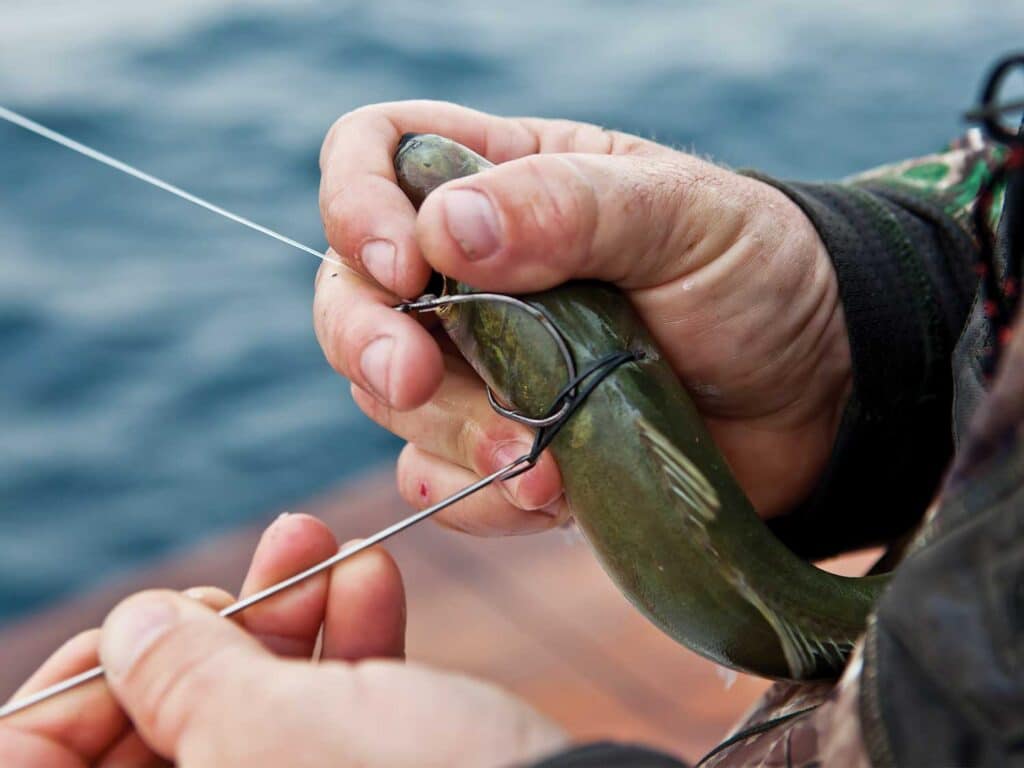
When it comes to live-bait fishing, we will start by talking about bridling smaller, hand-size baits. Bridling live tuna and large dead baits requires a totally different set of tools, which I will discuss in a following article. For live-bait fishing, I prefer synthetic bands, but floss loops and no bridles do have their place. When fishing for kingfish and wahoo, a floss loop or simply hooking the bait directly on the hook is superior to a synthetic band. The one flaw of a synthetic band is that a sharp tooth can cut the band and cause the hook to detach from the bait. A floss loop or putting the hook directly into the bait is a better choice for toothy critters.

One of my goals when making synthetic bridle bands for R&R Tackle was to accomplish what I just described from my time in Australia. I wanted to build a band that would be strong enough to hold onto the bait until just after hooking the fish, but would detach from the hook when the fish makes its first jump. In order to accomplish that, we paid attention to the thickness of the band, the width of the band and, most importantly, the diameter of the circle.
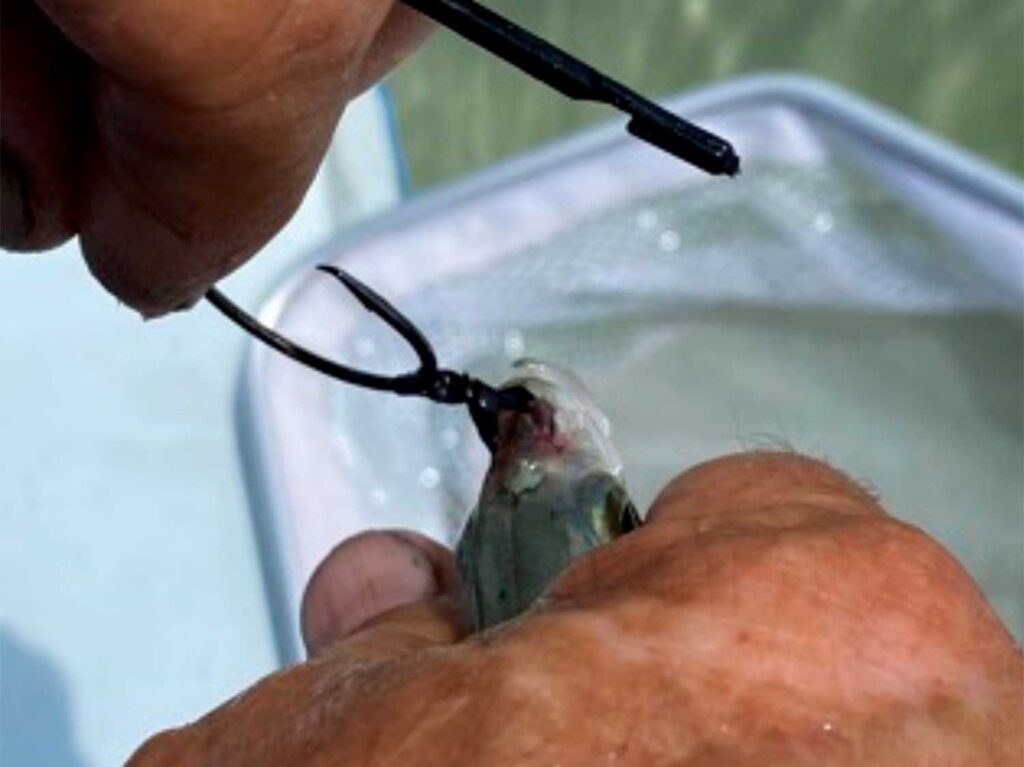
The goal when using a synthetic band or floss loop is to use a loop large enough that there is a small amount of slack when you put the band or loop back on the hook. This allows you to twist the hook, typically one, two or three times, to take up that slack and then feed the hook under the twisted band. One thing I’m adamant about is not over-tensioning the band or loop by twisting it too much. Whenever we do that, I notice that the soft tissue in the back of the bait gets squeezed over time, which can cause the band to pull out of the bait on certain strikes. If a billfish, tuna or mahi bites aggressively on a tightly banded bait, that might be enough to detach the hook and band from the bait. No bueno!

Remember, you’ve got wave action, surging baits, and people winding and dropping back baits, which tends to compromise the tissue attaching the hook to the bait. One way to test if you’re doing it right is to pay attention to what that hole in the back of the bait looks like after 20 or 30 minutes of fishing. If the band is hanging on by a thread of skin, you might want to put the needle a little deeper into the bait next time or twist the band a little less before you put the hook under it. This will take pressure off that soft tissue, improving the hookup ratio (fewer pickoffs). Basically, there’s no reason to over-tension the band or floss loop. It’s also counterproductive because it causes the hook to be slightly more rigid during the hookup, which I think reduces your hookup ratio. Anything that I can do to increase my catch ratio by a couple percent matters, especially in tournaments.
Our small synthetic band is approximately a half-inch in diameter. I use this to nose- or eye-bridle baits like pilchards, herring, sardines, ballyhoo and goggle-eyes. The only modification I make with the small bands is to double them up if I’m skipping a trolled bait like a flying fish off the kite. That’s simply due to how much impact is placed on the band with that bait skipping across the water at 5 or 6 knots for a long period of time.

Our large bands are approximately 1.5 inches in diameter and are better for bridling in the back of a hand-size bait or the eye sockets of a bigger bait. Again, one exception would be that if I bridle through the eye sockets of a bigger bait, I would probably double up the larger bands. The purpose of the larger band when back-bridling a hand-size bait is that you are able to poke the needle deeper below the back to hold onto more tissue. Of course, be careful not to go too deep and put the needle through the bait’s spine. I like to be a little bit above the spine, never below.
The last question is: clear bands or black bands? I find the black bands are easier to see when they fall on the deck. Also, I’m not sure that a sailfish ever rejects a bait because of the black band. The hook is generally black and has a lot more profile than the band, but there is nothing wrong with the clear band, especially if you have young eyes.
I’m not going to say that there’s an absolute right or wrong way to bridle, but this is just the way that I’ve seen the best results. And to answer the question we started out with, whether to bridle or not to bridle? From what I can see, bridling is worth it.
Bridling Tips, Step by Step
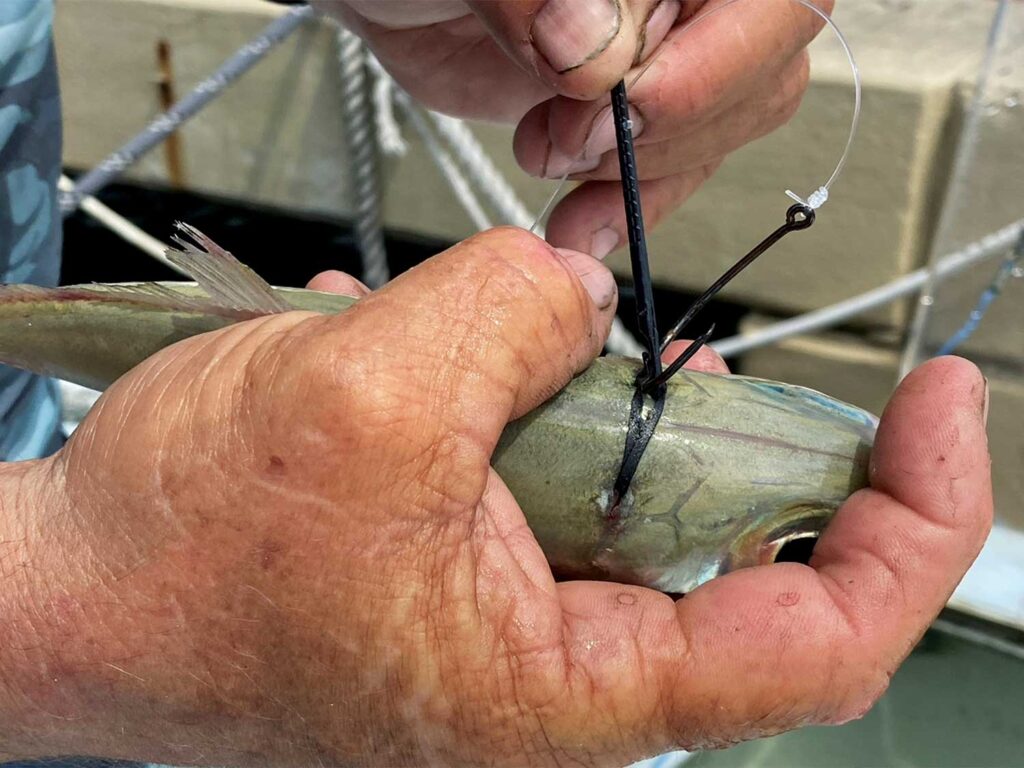
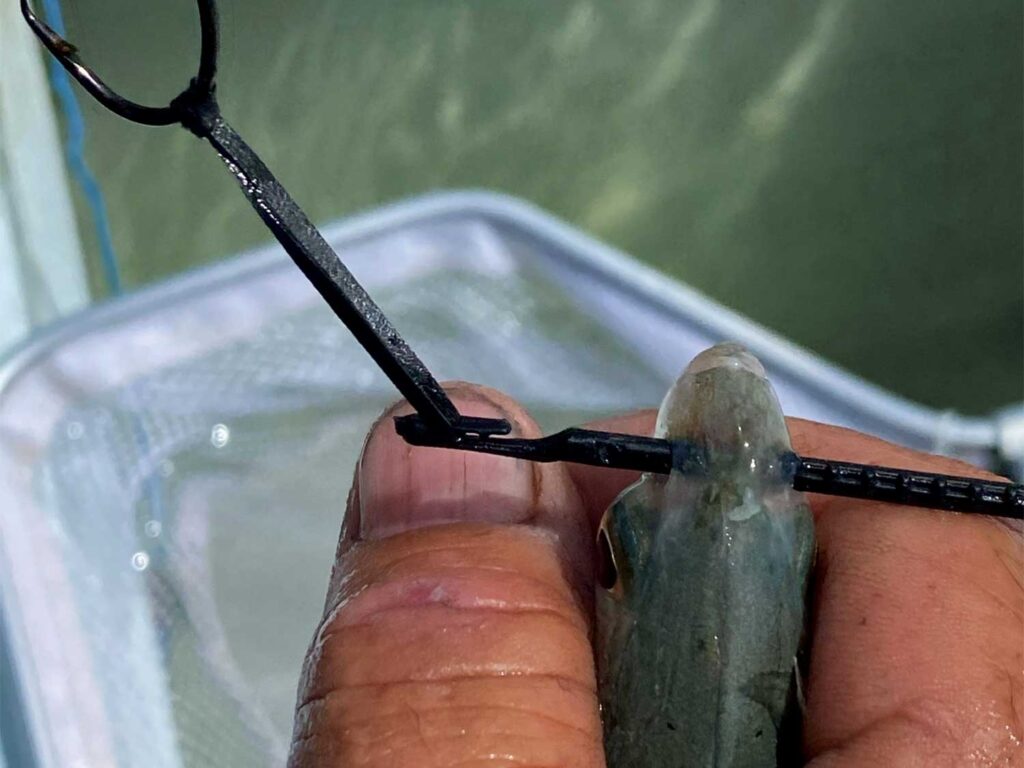
When bridling a live bait, the goal is secure tension without crushing delicate tissue. Insert the band or floss just deep enough to grab solid structure, leaving a touch of slack so the hook can be twisted one to three times. Avoid over-tensioning—too much pressure compresses the back, weakens the stitch over time, and can cause the band to pull free during aggressive strikes or surging wave action. A properly balanced bridle keeps the bait lively and dramatically reduces pull-outs.
Step 1

Step 2

Step 3

Step 4
Step 5

Step 6
Step 7

Step 8