
Subscribe to Marlin magazine and get a year of highly collectible, keepsake editions – plus access to the digital edition and archives. Sign up for the free Marlin email newsletter.
Some records arrive with fanfare. Others surface quietly, in fog so thick, you can barely see past the bow. And every so often, a record comes together in a way no one could script, pairing decades of experience with beginner’s luck, and patience with raw endurance—all in a fishery still revealing just how much it has changed.
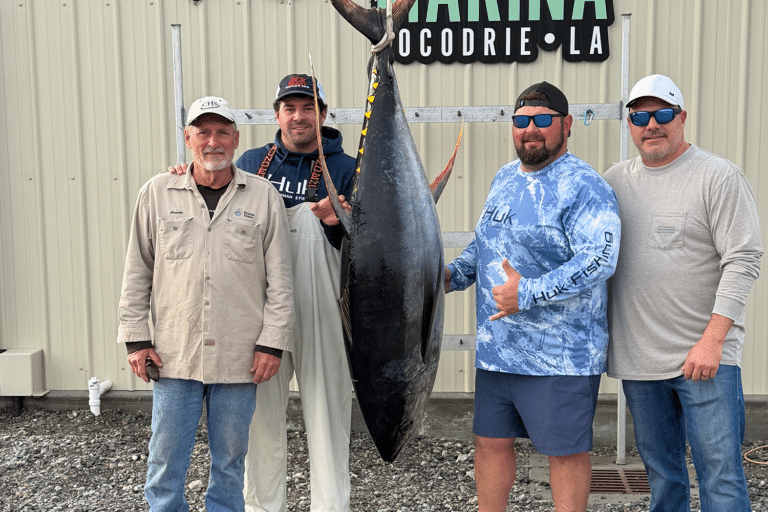
That was the case off Virginia Beach this January, when High Hopes, captained by Capt. David Wright, returned to Rudee Inlet towing an Atlantic bluefin tuna that would ultimately tip the scales at 832 pounds—a new Virginia state record.
At the other end of the rod was 23-year-old Mike Rogerson, a project engineer from Virginia Beach who had never fought a fish remotely close to that size—and nearly hadn’t been on the trip at all.
“I didn’t even know I was going until the day before,” Rogerson says. “A co-worker had a couple of cancellations and needed to fill the charter. I definitely wasn’t turning that down.”
For Wright, the day was the culmination of nearly five decades on the water. He has run charters out of Virginia Beach since 1978 and now operates his third boat under the High Hopes name. His path into the industry began early: cleaning fish as a kid, and working headboats and sport-fishing vessels before he was old enough to drive.
“I’m the only one left of my generation,” Wright says with a laugh. “That’s why I call myself a dinosaur.”
At 68 years old, Wright still runs trips regularly, though the fishery he operates in today barely resembles the one he grew up with. Striped bass are gone. Inshore fishing has become more about entertainment trips. Offshore runs are longer and conditions more unpredictable.
But bluefin tuna—once scarce—have returned in force.

“Three years ago, they showed up in bigger numbers than I’ve ever seen,” Wright says. “And now, not only are there more fish, they’re bigger. I think these fish are larger than last year’s. That’s my opinion—but it’s an informed one.”
The morning of the record fish began with uncertainty. Dense fog blanketed the coast, visibility limited to a few boat lengths. Wright admits he wasn’t confident about where to start.
“I told the guys I flipped a coin,” he says. “It was still spinning over my head. Eventually, it landed north.”
Running roughly 20 miles northeast of Rudee Inlet toward the Eastern Shore, High Hopes put lines in around 7 a.m., trolling ballyhoo at 6.5 knots. For over an hour, nothing happened.
Then, just after 9 a.m., the flat line was annihilated.
“At first, it didn’t even look real,” Wright recalls. “It sounded like a whale. I honestly thought something else was going on—it was that violent.”
Rogerson was the one who ended up clipped in.
“I think Capt. Wright wanted the younger endurance guy on it,” Rogerson says. “I’m not going to toot my own horn, but I got lucky.”
The fight stretched to an hour and a half, much of it in just 48 feet of water—an unusual advantage with fish of this caliber.
“It was a stalemate,” Wright says. “He’d take line, we’d gain it back. We saw braid backing forever. He just wouldn’t give up.”
Rogerson barely noticed the time.

“I had no concept of it,” he says. “The adrenaline took over. If the fish wanted to run, I let it run. When it came toward the boat, I reeled like crazy.”
Eventually, the tuna surfaced belly up. A hand gaff ended the fight.
With the fish on the deck, speculation gave way to disbelief. The previous state record had already fallen twice in the preceding 24 hours. But as they took measurements, it became clear this fish was different.
“The length was similar,” Rogerson says. “But the girth was way bigger. That’s when everyone started looking at each other.”
Their thoughts were confirmed roughly two hours later when the crane hoisted the fish and the certified scale read in the 830s.
“That was even more exciting than the bite,” Rogerson admits. “That’s when the party started.”
For Wright, the record is meaningful—but what matters more is what it represents.
He believes today’s bluefins off Virginia are part of a larger, interconnected Atlantic stock—fish that might cross oceans, return to the same feeding grounds, and continue to grow.
“They have a GPS,” Wright says. “They’ll come back to where they’ve been successful before.”
And perhaps, it’s proof that the “old dinosaur” still has some spunk left in him.
As for Rogerson, the experience has reshaped his view of fishing entirely.
“Capt. Wright joked with me—said now’s the time to switch to golf,” he says. “But I don’t think I’m done yet. Once I get full motor function in my right arm and hand again, I’ll be ready to go again.”
Some records are measured in pounds and inches. Others are measured in moments shared between generations, sealed in adrenaline, and unforgettable for everyone involved.