Subscribe to Marlin magazine and get a year of highly collectible, keepsake editions – plus access to the digital edition and archives. Sign up for the free Marlin email newsletter.
Many consider Florida the hub of modern-day sport fishing, with its two coasts and a bevy of inshore and offshore species to pursue. However, it is perhaps a lesser-known fact that most of the big-game tackle innovations and techniques popular today were invented and perfected in early fishing competitions in California, dating back over 125 years.
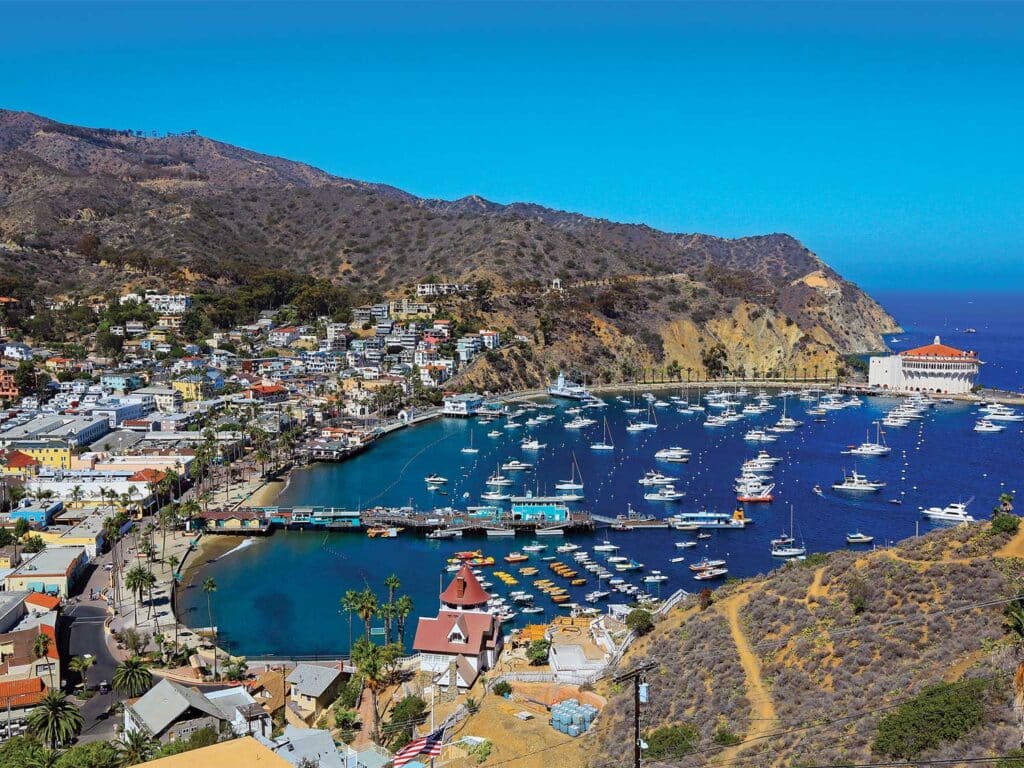
On June 15, 1898, Charles Frederick Holder founded the Avalon Tuna Club on Catalina Island, 22 miles off Southern California. Early members included notable figures such as Zane Grey, Bing Crosby, Charlie Chaplin, Stan Laurel, Hal Roach, Cecil B. DeMille, Herbert Humphrey and Gen. George S. Patton, who skillfully fished with linen lines of various strand counts to establish line classes and compete for club prestige. This spirited competition spurred tackle innovations that shaped modern sport fishing. Tuna Club members and other local anglers pioneered fighting chairs, outriggers, flying gaffs, kite-fishing, bait rigging, fish teasing, star-drag systems, live-bait systems and short stand-up rods.
In the early days, fishermen in Southern California targeted striped marlin, swordfish, and bluefin, yellowfin and bigeye tuna, along with mako and thresher sharks, and inshore species like yellowtail, white seabass, halibut and giant black seabass. More than a century later, these same waters remain a world-class playground for anglers. Yet Southern California’s story isn’t just history—it’s still being written. In recent years, a remarkable resurgence of offshore opportunities, highlighted by prolific runs of bluefin tuna, has transformed the region into one of the most exciting big-game fisheries on the planet. The birthplace of sport-fishing innovation now also stands as a premier destination for modern offshore adventure.

Pelagic Playground
When examining a detailed oceanographic chart or using a program like Navionics, you’ll see that much of the California coastline serves as a prime example of complex underwater structure, featuring steep drop-offs, deep submerged canyons, offshore banks and ridges.
These features drive upwelling currents that mix nutrient-rich waters, fueling the historic abundance of forage species like sardines, anchovies, saury and mackerel. It is this rich diversity that drives the seasonal visits of pelagic species, allowing anglers in Southern California to relive our rich fishing heritage.

Bluefin Tuna
The fish that really put big-game sport fishing on the map here in California was the bluefin tuna. In the late 1800s and early 1900s, these massive predators could be seen “leaping” in pursuit of California’s sizable flying fish. Early anglers learned quickly how to approach them and eventually perfected the presentation of a bait with a kite, but the tackle of those times was rarely up for the fight that ensued. This prompted these pioneers to come up with reels with greater line capacity and more sophisticated drag systems, as well as rods to handle the task. Once these innovations became a reality, so did the success of catching other large species found in local waters, such as swordfish, mako sharks, and even the giant black seabass that inhabit the coastal zones.
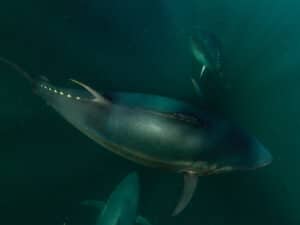
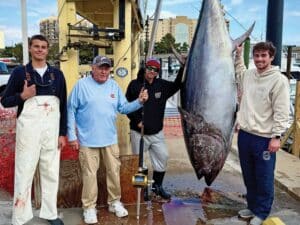
Large bluefin tuna dissipated and disappeared for decades, then made a brief and isolated appearance in the early 1980s. In recent years, much to the delight of California’s anglers, it seems these fish have again returned to the Golden State.
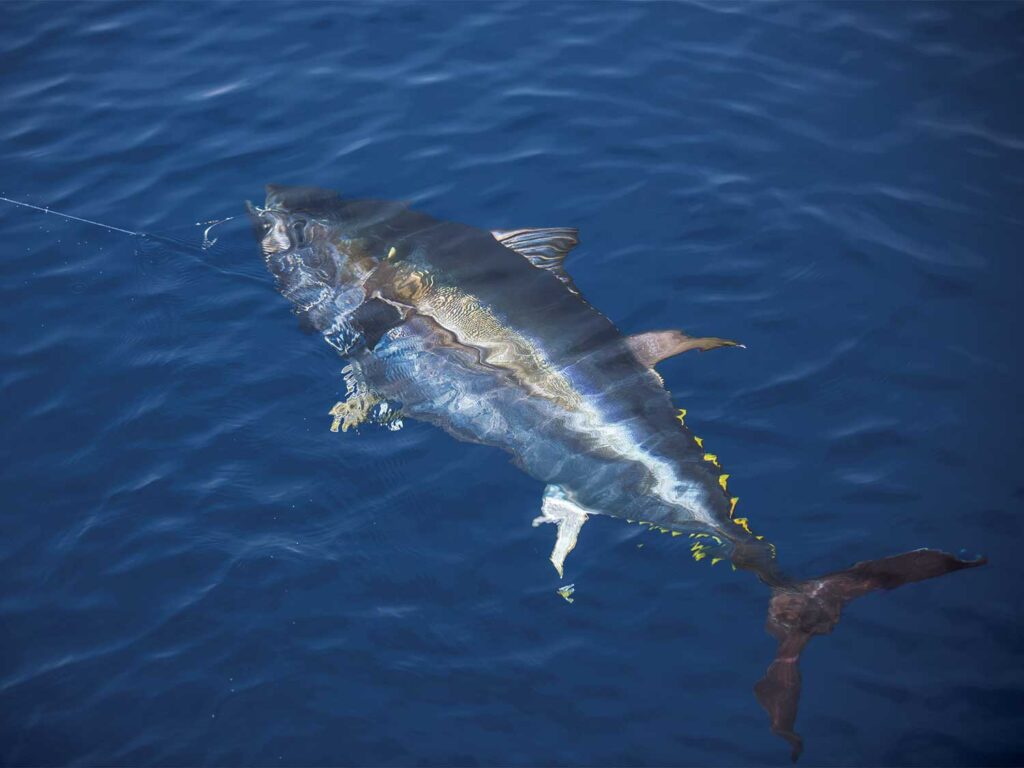
Interestingly, the large bluefins ranging from 100 to 300 pounds that recently reappeared have yet to leave again. Is this evidence of a spawning aggregation? Scientists all agree that it isn’t. In fact, these Pacific bluefin tuna, much like their Atlantic cousins, will only breed in specific areas of the world. The eastern Pacific Ocean isn’t one of them. These fish would literally have to migrate all the way to the Sea of Japan and waters off Taiwan to release an egg, so why their continued abundance off California? All indicators suggest the area’s bait, including finfish, market squid and red pelagic tuna crabs, have kept their interest.
From this revived fishery, a steep learning curve has emerged, with Southern California anglers experimenting with tackle and pioneering innovations to meet the demands of giant bluefins. The game is constantly evolving: throwing oversize poppers into daytime foamers, fast-trolling hard baits far back in the wake, rigging dead flying fish for kite deployment, or dropping heavy jigs into 200- to 400-foot marks in the dark of night. Each technique has driven new gear adaptations—heavy-duty, baitcaster-style combos, specialized deep-jigging setups, heavy kite rigs and stealthier trolling systems—all tailored to fool these selective, powerful predators. The fun lies in discovering what one of these seemingly finicky eaters will decide to crush next, and in the process, anglers are redefining modern offshore tackle.
Striped Marlin
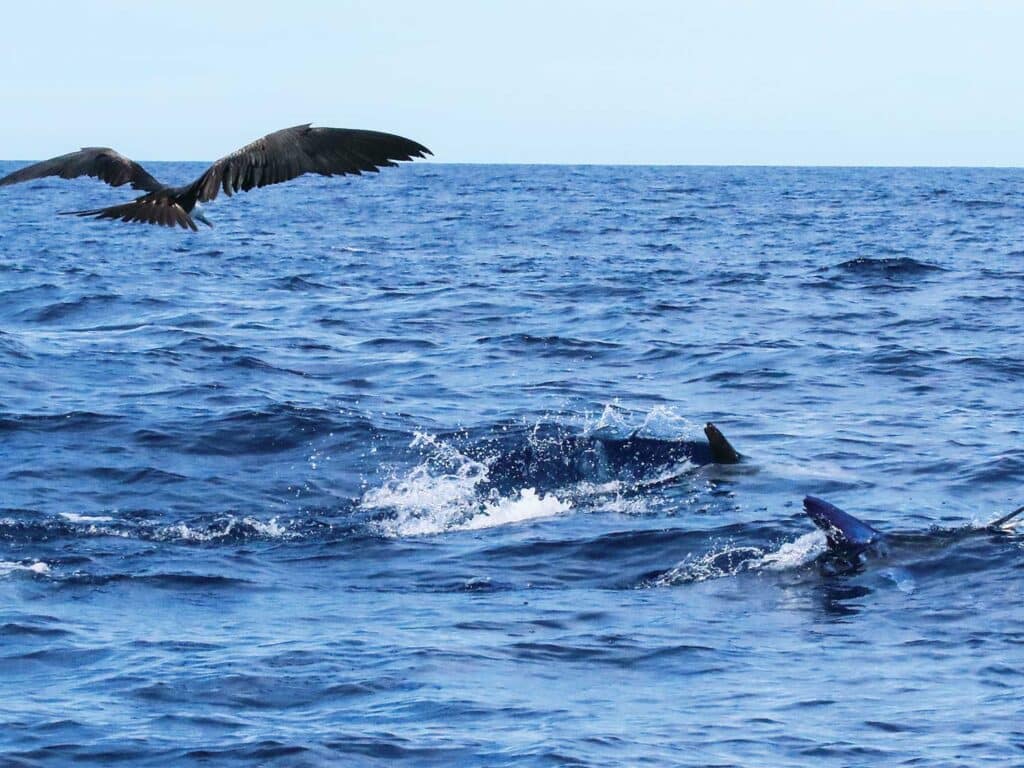
Southern California has just one marlin species to chase: the striped marlin. Acrobatic and elusive, they appear seasonally—typically between July and October, though sightings can begin as early as June. It’s a short, temperamental window that fluctuates with ocean conditions. Warm-water El Niño years tend to boost numbers, while cooler La Niña cycles push fish farther offshore.
Unlike Baja’s prolific striped marlin fishery, Southern California’s population doesn’t migrate up the coast. Tagging work by scientists, such as Dr. Michael Domeier, Dr. Chugey Sepulveda, Dr. Barbara Block, and others with the National Marine Fisheries Service, has shown most of these fish come from Hawaiian waters—roughly 2,700 miles west—instead of Cabo San Lucas. Early spaghetti tags hinted at the pattern, but it was satellite pop-up tags that confirmed striped marlin here generally travel east-west rather than north-south.
Despite the geographic differences, the style of fishing mirrors what we see in Baja. Success means keeping eyes forward and scanning for tailers, sleepers and feeders rather than waiting for fish to appear in the spread. Once spotted, the bow becomes center stage. Anglers scramble forward, supported by a rail that keeps them in the boat as they grab a live Pacific mackerel from an unorthodox bow bait tank, pin it through the nose, and lob it toward the fish with precision and hope.
Hooking and fighting a marlin in this setting is a thrill every offshore angler should experience. There’s nothing quite like casting to a tailer—heart pounding, waiting for the bite and the subsequent explosive run—then walking the fish down the rail to release it at the stern. Most SoCal stripeys average between 90 and 150 pounds, but the occasional 200-plus-pounder does show. In 1994, aboard my 25-foot Wellcraft, Baja Bandido, Capt. Mike Arujo, Bob Fruge and I won the California Classic Marlin Tournament with a 200.5-pounder—a fish found under a screeching tern at high tide on the 14 Mile Bank.
Luck helped that day, but anglers like IGFA Tommy Gifford Award-winners Capt. Steve Lassley, Capt. Pete Grosbeck and Mike “The Beak” Hurt routinely elevate the game. They leverage oceanic data—temperature breaks, chlorophyll charts and structure—to locate bait and fish. The advent of side-scanning sonar has only enhanced this hunt. I wrote the first Marlin magazine article on sonar use for striped marlin, and Lassley, a master sonar operator and former commercial swordfisherman, was my go-to source.
That was 20 years ago. Long before it was common among marlin crews, San Diego long-range captains used side-scan sonar to locate tuna. Today, it’s a standard part of the marlin playbook. For a fish that spends more time near the surface than any of its cousins, the technology has changed everything.
What hasn’t changed is the challenge. And that’s what makes it so special.
Swordfish
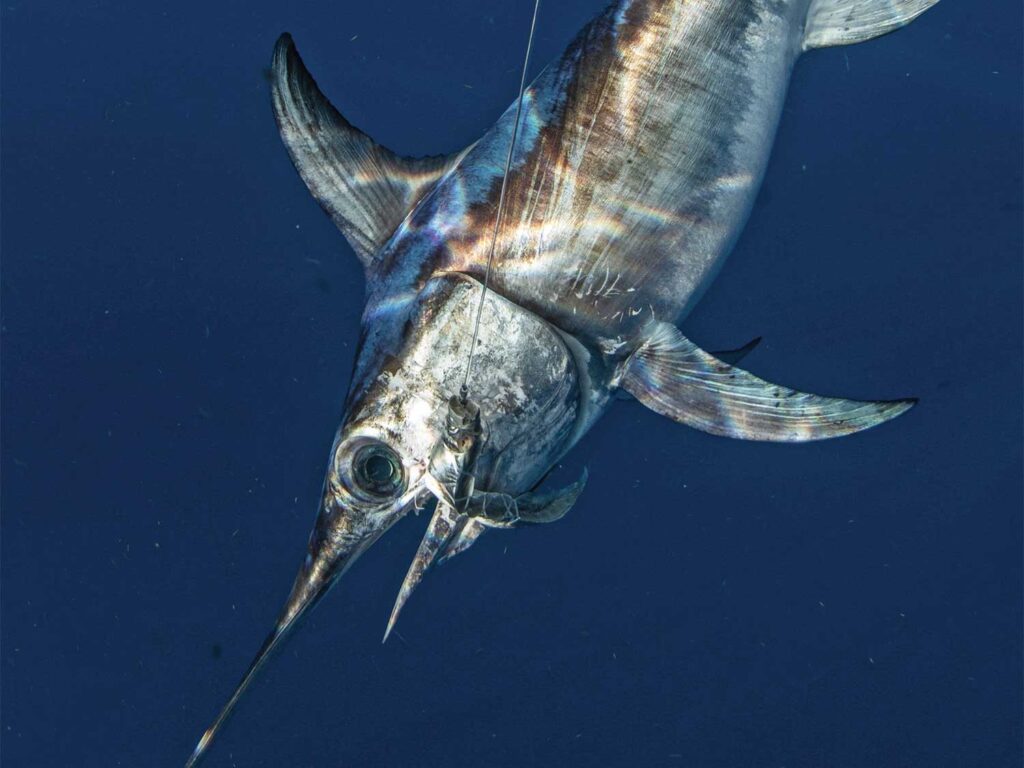
California is blessed with a truly marvelous swordfish fishery. The fish are plentiful, big and, from a sport-fishing perspective, undertargeted. Unlike the techniques practiced in Florida and other parts of the world, where anglers fish for swordfish at night using a spread of baits from the surface down to several hundred feet, Southern California’s traditional swordfish fishery was fashioned after techniques used by commercial “stick boats.” Although it’s rarer in other parts of the world, California swords spend copious amounts of time sunning at the surface to help them digest their latest meal. Commercial stick boats take advantage of this surface time by spearing fish from a long plank.
Recreational anglers take a similar approach, but instead of using a spear, they toss a bait on the swordfish’s head in hopes of coaxing a strike. More California swordfish have been caught in this manner on the surface than almost anywhere else in the world. Of course, with the deep daytime fishery invented off Venezuela and perfected off Florida and the Gulf, Californians have also gravitated to this technique, but with the welcome advantage that fish can be caught at 800 to 1,000 feet, as opposed to 1,500 to 2,000 feet. Another advantage of the California swordfish fishery is that the fish are typically much bigger than those caught along the East Coast or in the Gulf.
The SoCal Long-Range Experience
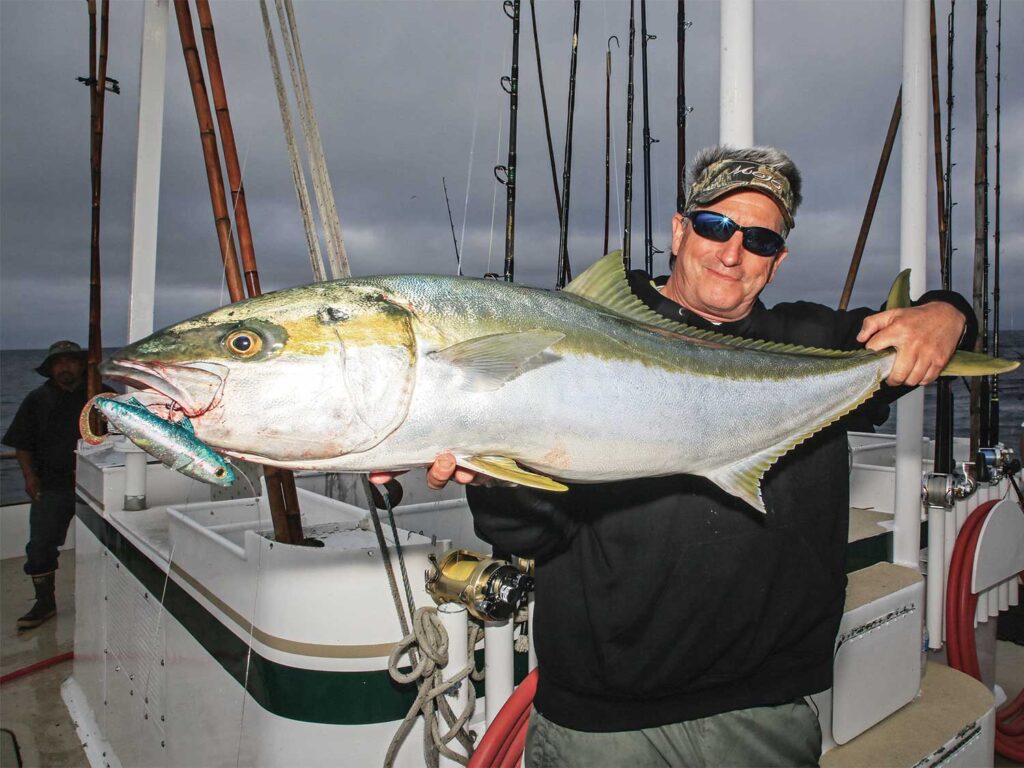
When discussing offshore fishing in California waters, it would be a crime not to mention a few of the other species that help keep rods bent and drags burning. Most notable are the “flotsam family” of gamefish: the California yellowtail (hamachi in sushi bars), dorado (dolphin in East Coast fishing circles) and yellowfin tuna. Typically found with flotsam, such as large kelp paddies that have broken away from rocky shorelines and hold high concentrations of bait, these species are the staple of the long-ago-established commercial “jack pole” and purse-seine fisheries that have operated out of San Diego and San Pedro since before World War II. These three fish are also the main focus of the famous long-range fishing fleets out of San Diego that go on multiday trips (up to 16 days), often hundreds of miles south of Baja. It has been a mainstay of the California fishing experience to go on one of these boats, such as Royal Polaris, Polaris Supreme, Excel, Intrepid and Red Rooster. They offer anglers the opportunity to live on the high seas for extended periods and to observe as well as participate in this amazing fishery.

Final Thoughts
Southern California’s waters are where much of the sport’s DNA was coded. From the pioneering days of the Avalon Tuna Club—where early anglers invented the very gear and techniques we still rely on—to today’s thriving offshore scene, this coast has shaped big-game fishing like few places on Earth. Modern SoCal anglers enjoy access to a staggering range of premier species: giant bluefin tuna, broadbill swordfish that bask on the surface, seasonal striped marlin, and a supporting cast of yellowfin, dorado and yellowtail.
The region also boasts a vibrant tournament circuit, much of it rooted in the tradition of long-standing fishing clubs that remain pillars of the local culture, fostering camaraderie, competition and community. It’s a living, breathing fishery that marries more than a century of innovation with world-class opportunity, all within striking distance of a vibrant coastline. For anglers who value history, diversity and the thrill of the chase, Southern California isn’t just a chapter in sport-fishing heritage—it’s a bucket-list destination that demands a place near the top.