Subscribe to Marlin magazine and get a year of highly collectible, keepsake editions – plus access to the digital edition and archives. Sign up for the free Marlin email newsletter.
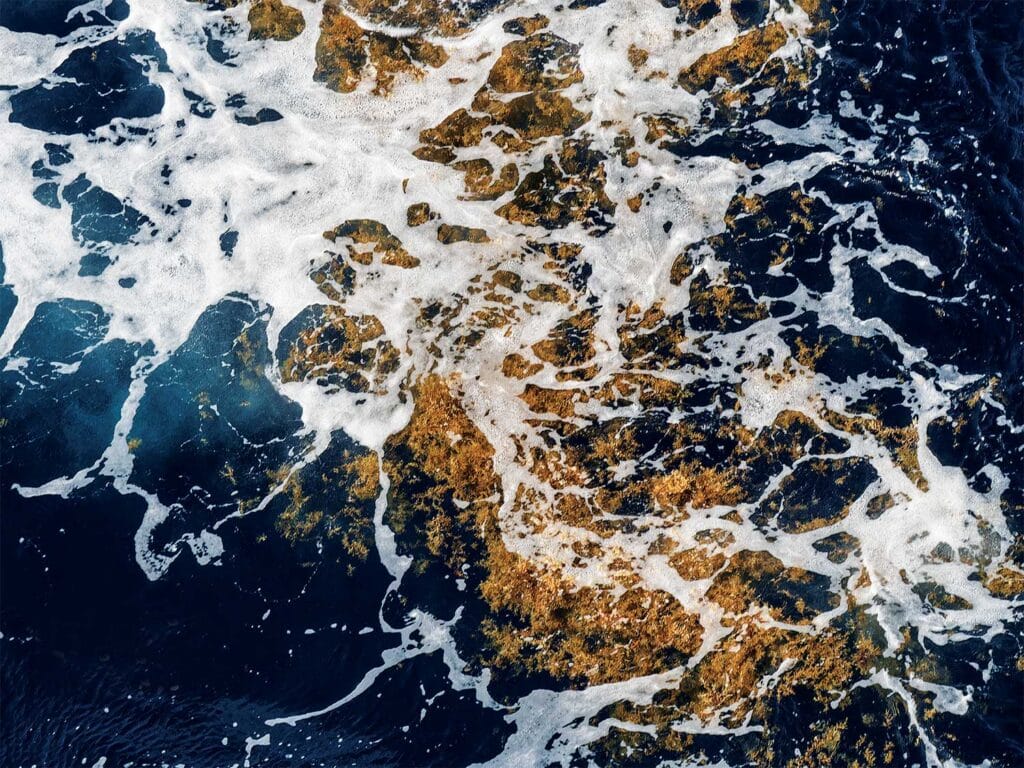
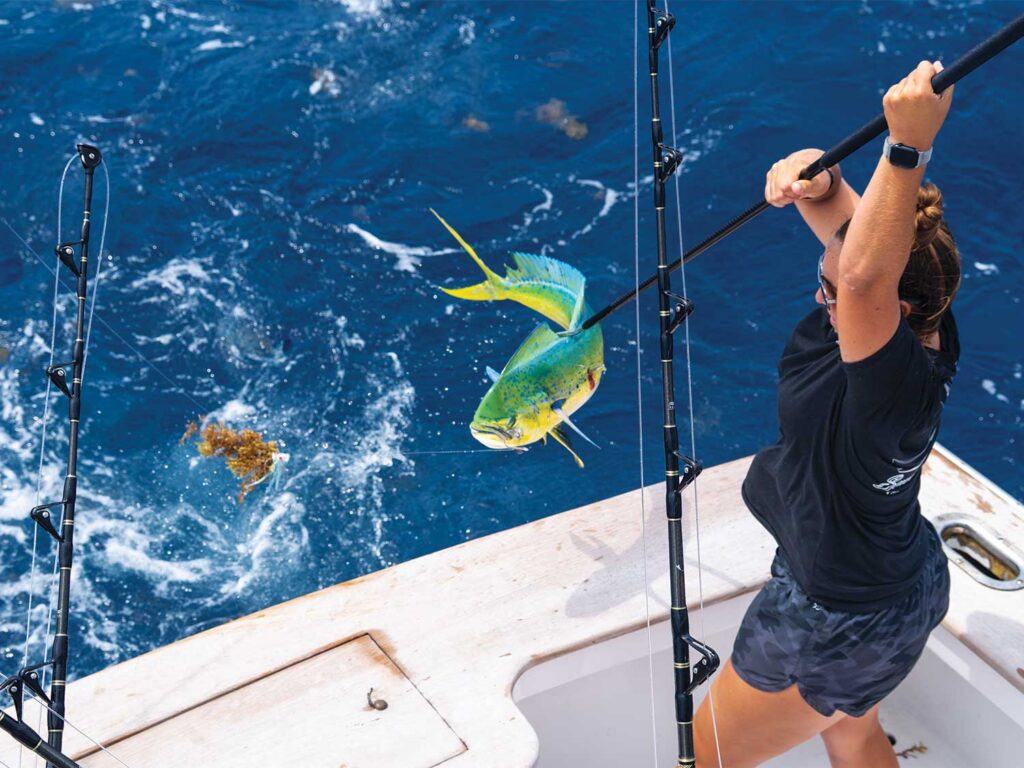
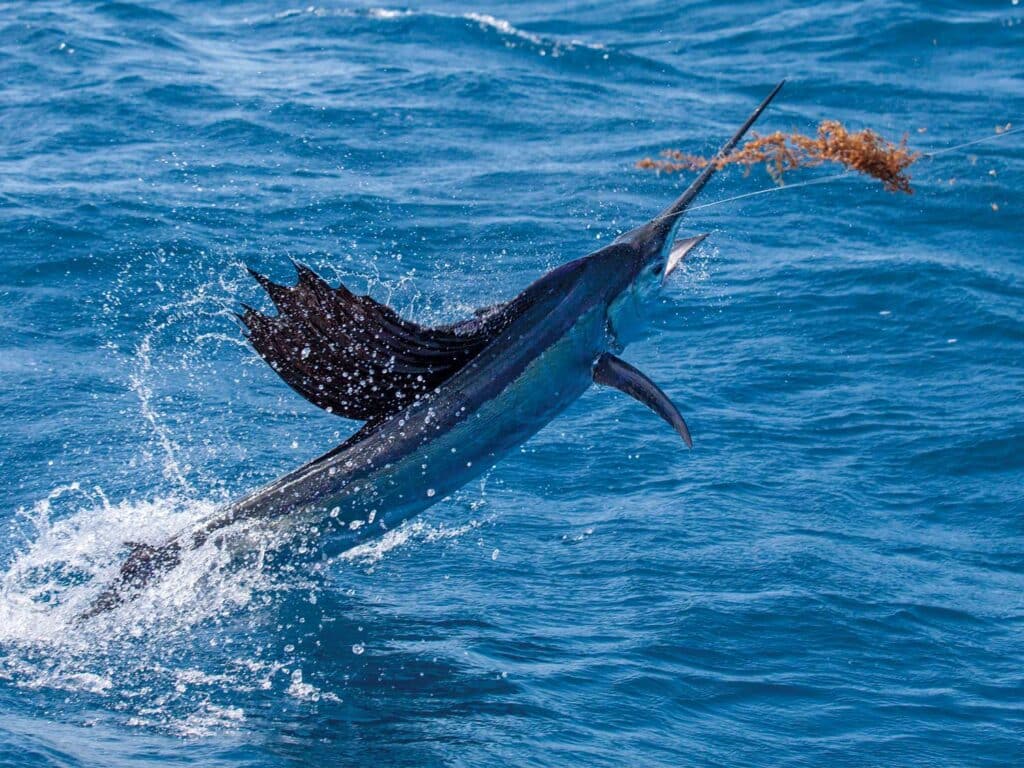
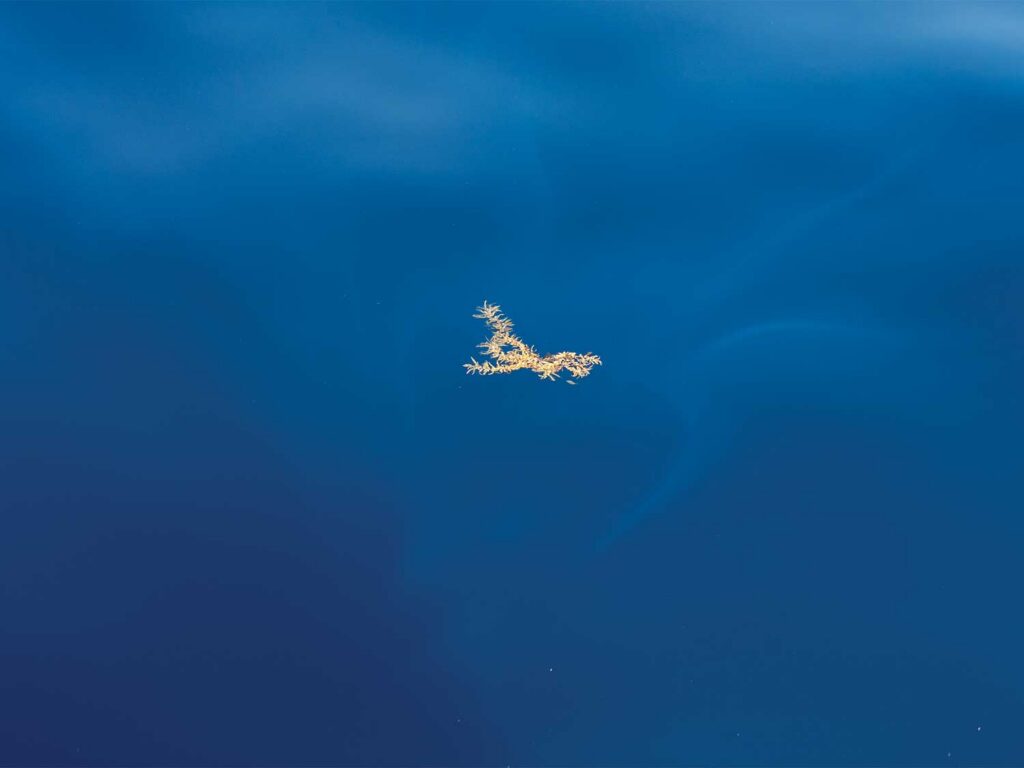
If you grew up fishing anywhere along the western Atlantic, Gulf of Mexico or throughout the Caribbean, a relationship with sargassum is nearly as fundamental as learning to tie a Bimini twist or rig a ballyhoo. You learn early on that the floating weed is both friend and foe, a blessing and a curse. On the right day, when the water is clean and the breeze pushes golden mats into tight, healthy lines, sargassum becomes its own remarkable ecosystem, alive with baitfish, crustaceans, juvenile gamefish and the predators that shadow them. But when it’s scattered, windblown and disorganized, the same weed becomes a torment. It fouls baits, clings to dredges, trips up teasers, and leaves crews muttering obscenities into their mics as they pluck grass instead of watching the spread.
Still, in recent years, there seems to be an increase in both the volume and frequency with which we encounter sargassum. Although the topic came to me through personal and anecdotal evidence, there seems to be more sargassum than anyone remembers seeing before. A growing number of captains, anglers, scientists, resort operators and coastal communities are voicing the same concern. What once felt like a seasonal nuisance has evolved into a recurring, basin-wide phenomenon—one that now shapes tourism, fisheries and navigation far beyond the cockpit of a sport-fisherman.
Curious about what exactly is happening and how it intersects with big-game fishing, I began looking into the issue. It quickly became clear that the story is far more complex than most offshore anglers might realize. But what does that mean for us?
Bad Weed
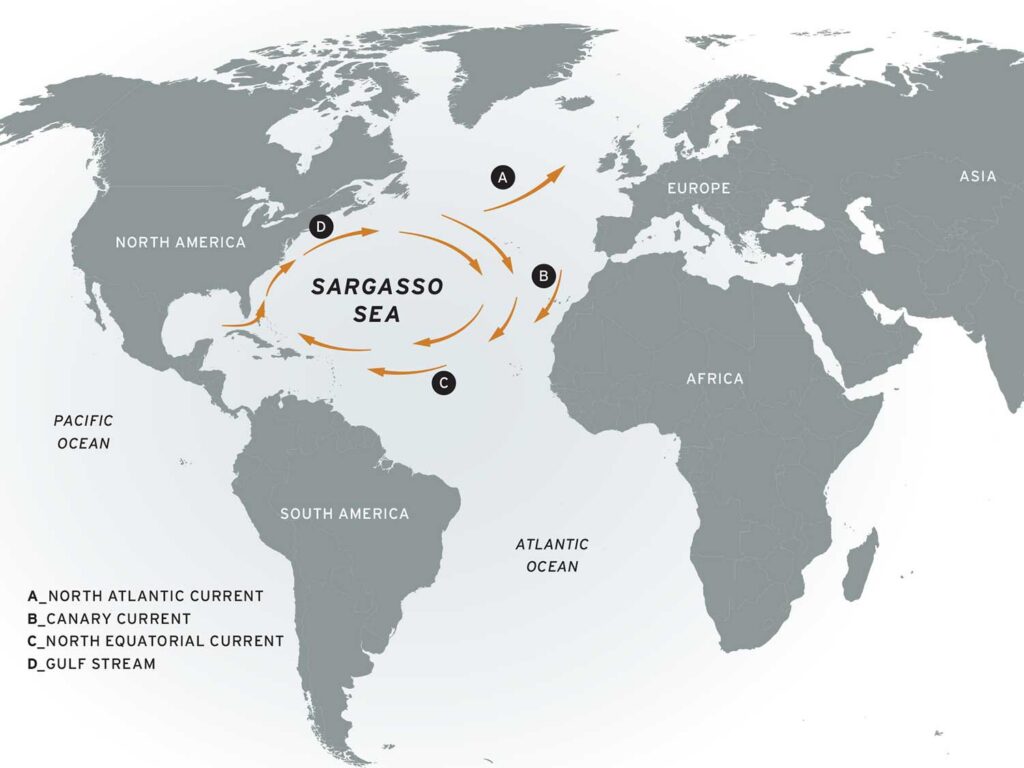
Before diving into why sargassum seems so abundant today, it’s worth remembering that the weed itself is nothing new. When interviewing him for this piece, Capt. Karl Anderson astutely pointed out that Christopher Columbus even referenced thick rafts of it in his transatlantic logs. For centuries, sargassum has thrived in the Sargasso Sea, a massive gyre east of the U.S. defined not by land but by currents. Here, the free-floating algae reproduce vegetatively and drift with the wind and currents, offering shelter and structure to countless marine organisms.
But beginning around 2011, something shifted. That year marked the emergence of what oceanographers now call the Great Atlantic Sargassum Belt, a seasonally persistent band of algae stretching from West Africa across the Atlantic to the Caribbean Sea and Gulf of Mexico. During heavy bloom years, satellites show it reaching more than 5,000 miles, sometimes covering an area larger than the continental U.S. Since then, the sheer frequency and scale of these events have increased dramatically.
And although increases of sargassum have been the bane of many crewmen’s existence, those moans go mostly unheard. Rather, it is the impacts the influx of weed is having on local economies that is prompting groups like NOAA to take action.
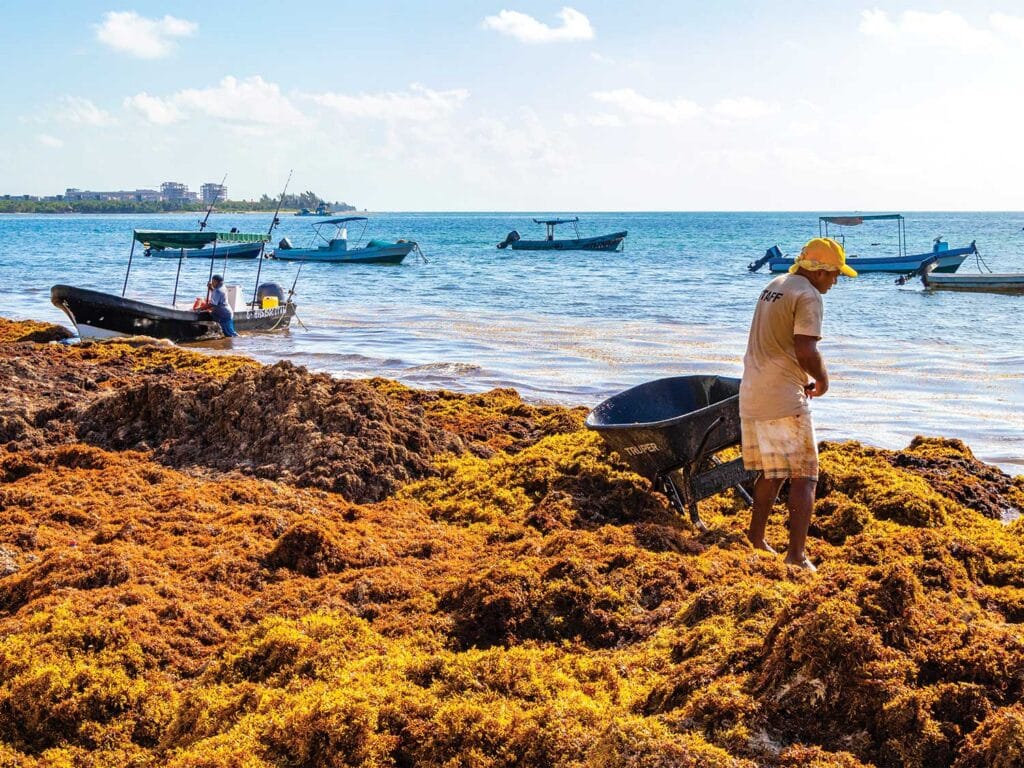
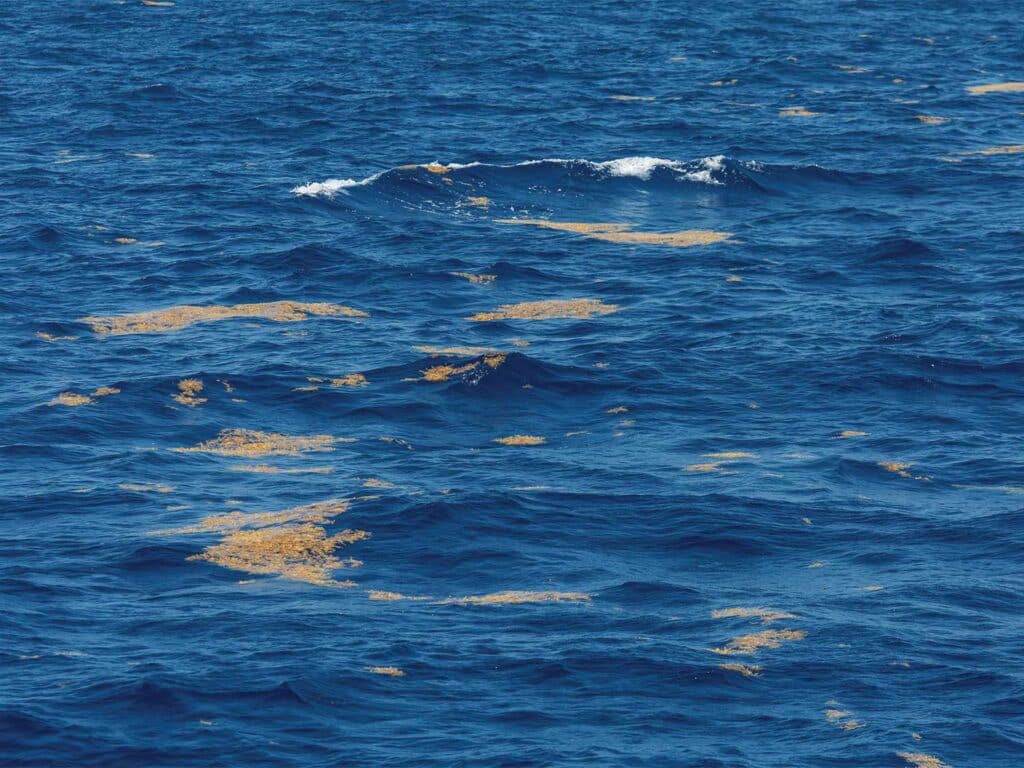
When persistent winds and currents push massive mats ashore, areas throughout the Caribbean, Gulf of Mexico and eastern U.S. can be buried in several feet of rotting vegetation. The cleanup costs millions. Tourism grinds to a halt. If you’ve ever gone to the beach when sargassum is in full force, you know this all too well.
And nearshore ecosystems—seagrass meadows, coral flats, juvenile fish nurseries—can suffocate beneath the weight of accumulated biomass. Decomposition releases hydrogen sulfide, a gas that irritates the lungs and corrodes infrastructure. In bays and lagoons, mats block light, reduce circulation, and strip oxygen from the water column.
Why the Influx?
With this information, the next logical question is: What causes these heavy blooms? According to a report published by NOAA following a May 2025 workshop on sargassum knowledge gaps and management, the short answer is this: Sargassum blooms when it gets fertilized, and lately, the Atlantic is feeding it more than ever.
It should come as no surprise that scientists have found that the weed grows faster in nutrient-rich coastal waters, and long-term sampling shows that sargassum now contains far more nitrogen than it did decades ago.
That spike in nutrients likely comes from a mix of sources—river outflow like the Amazon, coastal runoff, and even Saharan dust blowing across the ocean. At the same time, phosphorus levels have dropped, but sargassum has a workaround: It uses chemical mechanisms to pull phosphorus from other forms in the water.
Add warming seas, shifting currents, and possibly help from microbes living on the weed, and you get a plant that grows faster, spreads farther, and sticks around longer. In plain terms, the Atlantic is giving sargassum everything it needs to thrive—and the weed is making the most of it.
When I asked Dr. Peter Gaube, senior principal oceanographer at the University of Washington’s Applied Physics Lab and an avid angler, about why the blooms have increased, he mentioned that there are likely several factors and missing information. Hence, the NOAA workshop held earlier this year to address the knowledge gaps.
“There’s information out there, but nothing that says, ‘Here is the one singular cause,’” Gaube explains. “The oceans are changing quickly, and this may just be another sign of that change.”
Gaube notes that while many people assume more sargassum must mean more growth, it could also reflect how currents are redistributing the weed.
“It definitely seems like we are seeing more mass, but how are the changes in currents affecting how the sargassum is pushed toward shore? That’s a fascinating question.”
These uncertainties align with what NOAA researchers have pointed out: While sargassum is a natural and essential part of the Atlantic ecosystem, the scale and regularity of blooms over the past decade are unlike anything previously documented.
Forecasting the Future
Perhaps the most fascinating development isn’t about why the weed is blooming, but how we may soon be able to track it.
Gaube says the scientific community is currently focused on improving the ability to detect, map and eventually forecast sargassum from space.
Right now, identifying sargassum via satellite is difficult. Instruments like MODIS can detect chlorophyll signatures, but not reliably enough to distinguish sargassum from other floating biomass. That’s beginning to change.
“There’s a new satellite called PACE that measures the full light spectrum,” Gaube explains. “That gives us a lot more information. We’re now working on algorithms that can say, with confidence, this is sargassum.”
Once the mapping is accurate, forecasting becomes possible.
“If we can see where a big chunk of sargassum is today,” Gaube says, “we can use surface-drift models—the same kind used for oil slicks—to predict where it will be in two weeks.”
But Gaube is quick to note that the ocean surface is extraordinarily difficult to model. The small-scale processes that bunch sargassum into fishy weed lines—fronts, filaments, Langmuir cells—occur on subkilometer scales that current models can’t resolve.
“We’re not great at predicting those details yet,” he says. “But the next few years are going to bring major improvements.”
For the first time, fishermen may eventually receive sargassum forecasts alongside sea-surface-temperature charts and chlorophyll imagery.
What It Means for Anglers
For big-game crews, the response hasn’t been retreating or finding solutions to the weed—most that I spoke with view it as just part of the game. Sure, no one likes it, and techniques may shift slightly in weedier situations, but at the end of the day, the captain’s consensus is clear: If the fish are in the weeds, so are the baits.
Capt. Corey Gillespie runs the 70-foot Titan Lunatico and has fished some of the weedier waters in the Atlantic, including St. Thomas and Bermuda. He says weed alone rarely dictates whether he stays in an area.
“If the conditions are right and there happens to be weed, we’re not leaving productive water,” he says. “We just tell the crew to get their gloves on—it’s time to pull hay.”
Anderson agrees with Gillespie’s sentiment, emphasizing that weed has always been part of the game, even if the scale has changed.
“Sure, there might be more of it around with blooms or whatever, but shaggin’ grass is just part of it. You adapt, you adjust, and you keep going,” he says. “That’s offshore fishing.”
Despite the “just fish through it” mentality that permeated through my various interviews, there were some practical tips offered.
When fishing areas with heavy weed, crews will often increase the strength of the line on their dredge reels to provide a stronger base to cut through the sargassum. Gillespie also mentioned that he will sometimes lift his dredges out of the water in areas with heavy weed, only redeploying them once he has marked a fish on the sonar.
The final straw if the weed is just too thick and your crew has run out of patience? “Just pull in all the baits, run only teasers, and pitch baits to fish when they come up,” Anderson adds for a final bit of wisdom on the topic.
Living With It
In the end, the consensus—from scientists, resource managers and captains alike—is that sargassum isn’t fading from the western Atlantic story anytime soon. If anything, the opposite is true. NOAA’s expanding task-force efforts, new multi-agency mitigation initiatives, and rapid advancements in satellite detection and forecasting all underscore a simple reality: The scale of these blooms demands long-term attention, study and adaptation.
But for offshore anglers, the takeaway is far less complicated. No matter how sophisticated the models become or how urgently coastal communities work to soften the weed’s impact, life in the cockpit will still mean shaggin’ grass, clearing lines, and hunting bites along those shifting golden edges. The ocean is changing—fast. But for fishermen, learning to work with the weed rather than wish it away will remain part of the job description for years to come.
Weed 101
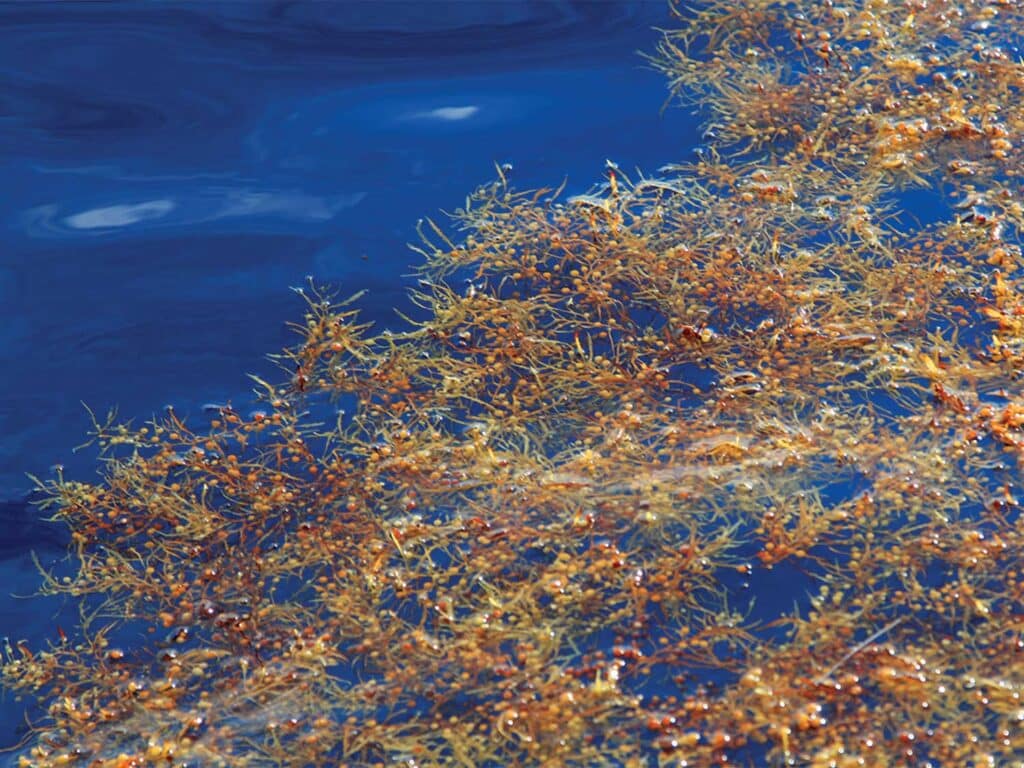
Sargassum is a free-floating brown algae sustained by tiny gas bladders that keep it buoyant at the surface. Unlike most seaweed, it never needs to attach to the seafloor. Instead, it drifts through the Atlantic, forming mats that serve as nurseries for fish, invertebrates and endangered sea turtles. NOAA designates it as essential fish habitat.
Offshore, it’s an oasis of life. Inshore, it can smother ecosystems, block light, and create hypoxic conditions. When it decomposes, it produces hydrogen sulfide, irritating lungs and damaging infrastructure.
This dual role—vital offshore, harmful ashore—makes sargassum both a cornerstone of the Atlantic ecosystem and one of the region’s most vexing management challenges.
Evolution of Weed Lines
Anglers often attribute weed lines to “easterly trade winds” or “steady summer conditions,” but according to Dr. Peter Gaube, the mechanics behind their formation are much more intricate.
“When you blow wind over the ocean, stuff doesn’t just drift downwind,” he explains. “It rotates pretty quickly.”
Surface sargassum is affected by wind, but also by currents, eddies, and a host of small-scale processes that ocean models can’t yet fully resolve.
One of the most influential mechanisms, Gaube says, involves Langmuir cells—the wind-driven vertical circulations responsible for those long, ruler-straight “windrows” many anglers have seen streaking across calm seas. These cells create convergences at the surface where floating material, including sargassum, naturally aggregates into tight lines.
“Gentle, steady winds can bunch up the weeds into filaments,” Gaube says. “But when you get a strong wind event, all of that falls apart. You’re suddenly adding so much energy to the ocean surface that those nice convergences disappear.”
That’s why a perfect weed line can dissolve into a scattered mess seemingly overnight.