Subscribe to Marlin magazine and get a year of highly collectible, keepsake editions – plus access to the digital edition and archives. Sign up for the free Marlin email newsletter.
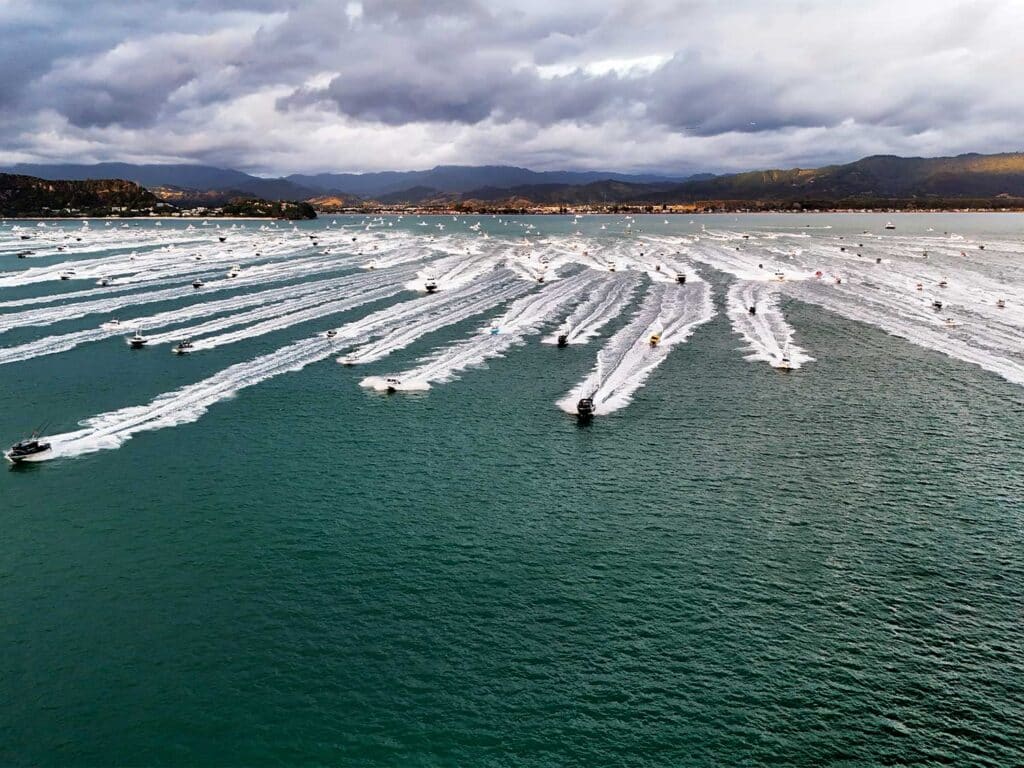
New Zealand is famous for its big fish, but here’s the twist most of the globe has missed: It’s also home to the world’s largest billfish tournament—measured not by purse, but by number of teams. The Kubota Billfish Classic has quietly surged past some of the sport’s most storied events, drawing a jaw-dropping 470 boats in 2025. For context, the mighty White Marlin Open hosted 449 boats in 2005, the Big Rock Blue Marlin Tournament fielded a record 302 boats in 2024, and the Bisbee’s Black & Blue drew 185 boats in 2005—massive by any standard, but still short of Kubota’s trailer-boat armada.
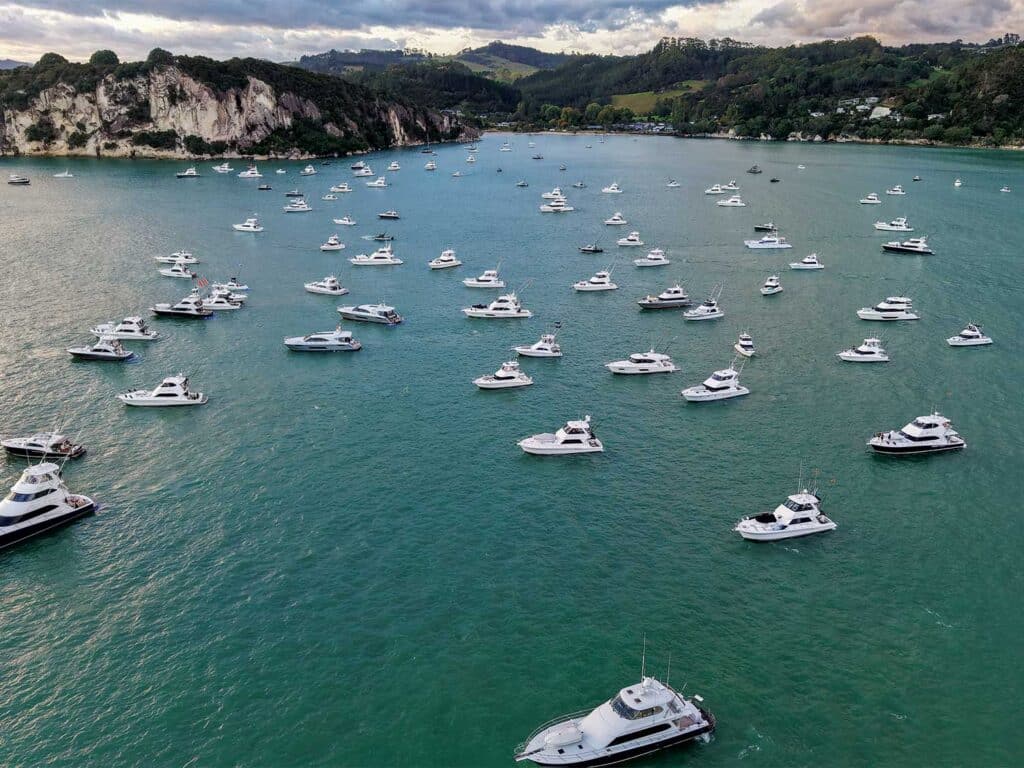
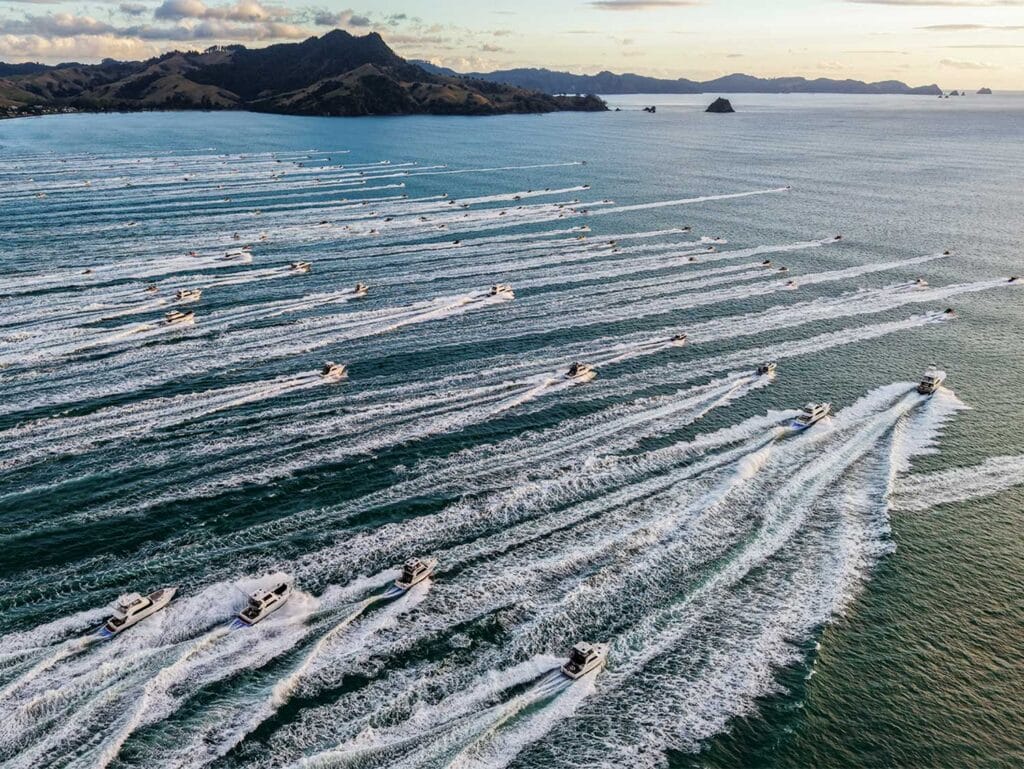
Whitianga, a small, sun-splashed township on the North Island’s eastern seaboard, becomes a floating carnival each March as the Classic takes over the bay and everything around it. In 2024, the fleet reached 420 boats; in 2025, it leapt again to 470. The harbor and adjacent waterways stretched to accommodate them. This isn’t a parade of gleaming, nine-figure battlewagons (though a few roll in to strut their stuff). It’s predominantly a small-boat, trailer-boat brigade: hard-charging Kiwi crews launched at dawn, utes backed down the ramps, chilly bins packed, lures sharpened, and families piling aboard. Although the event is the largest billfish tournament fleet on Earth, the vibe is more community meetup than superyacht cotillion.
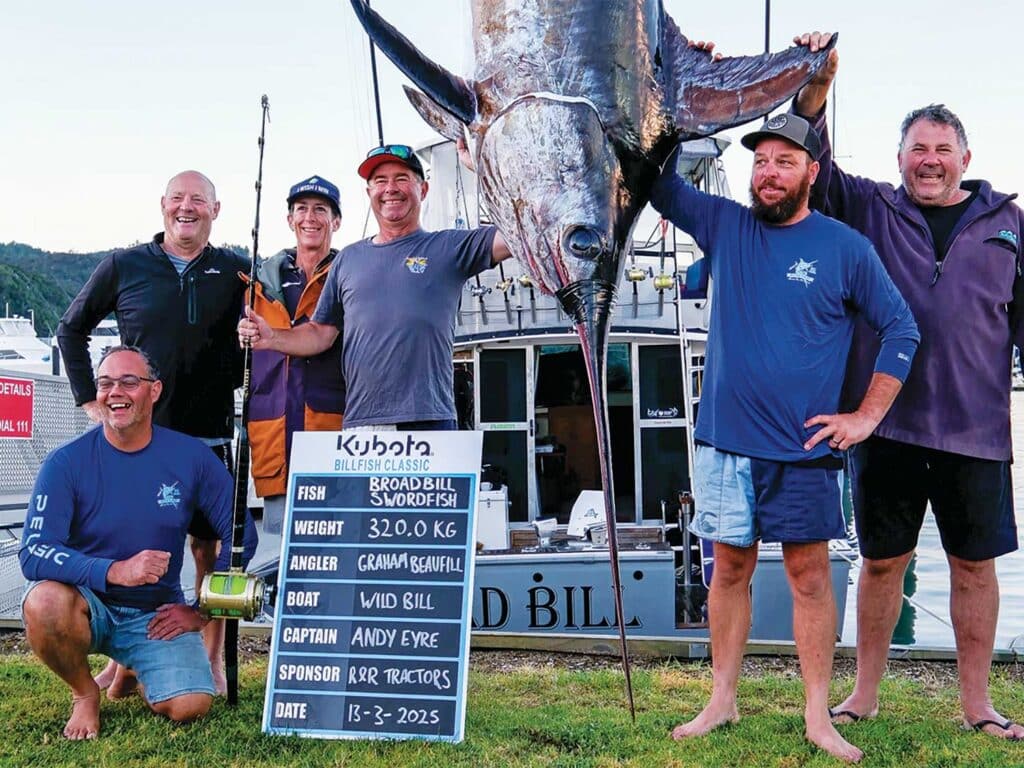
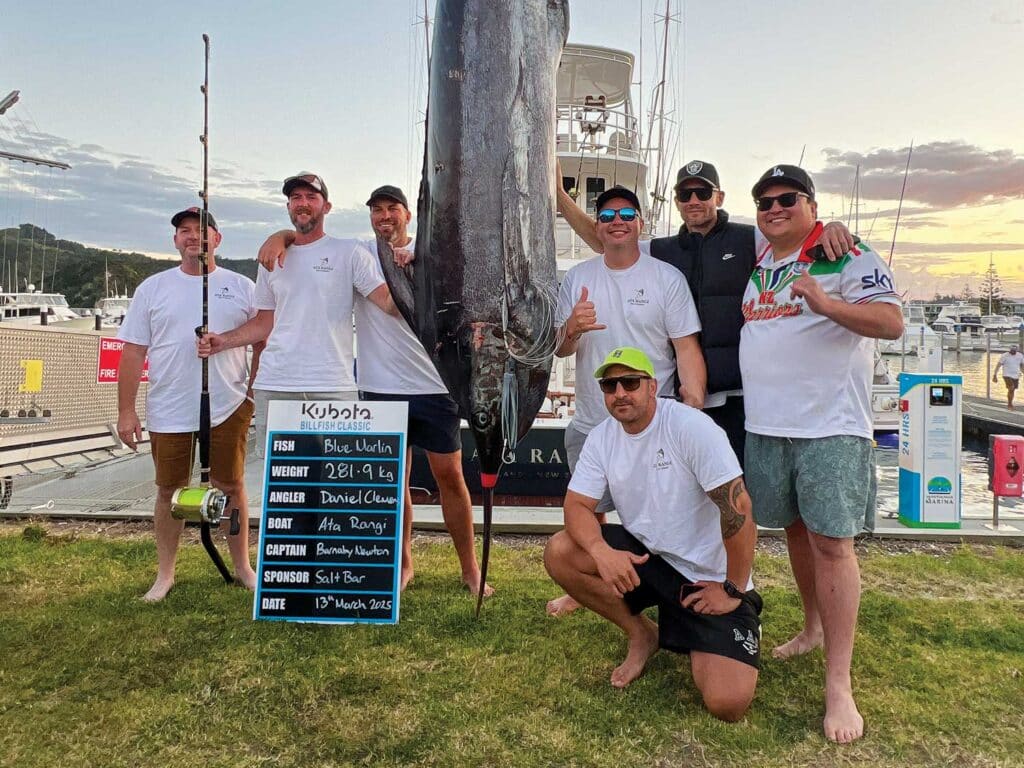
On the water, 2025 delivered a spectacle. Records fell in multiple categories. The crew aboard Wild Bill hauled a 320 kg (705.4-pound) broadbill swordfish, a tournament record and the heaviest ever weighed at the Mercury Bay station. Ata Rangi added a 281.9 kg (621.4-pound) blue marlin, while Te Hana posted a 129.8 kg (286.1-pound) bigeye tuna. A rare wahoo turned up for Miss Piper, causing a proper stir, and a 22.3 kg (49.2-pound) yellowtail kingfish for Sambucca showed just how varied the local action can be.

That species diversity is the Classic’s secret sauce. It’s not one-fish, one-track. Swordfish, blue marlin, tuna, mahimahi, kingfish, and even the odd wahoo all create paths to the stage. More species means more ways to win, more tactical approaches, and more anglers who see a place for themselves, whether they’re deep-dropping at night, trolling lures off the edge, or working inshore contour lines for kingies in the afternoon blow.
And the town leans all the way in. With $1.7 million in New Zealand dollars (just shy of $1 million in USD) in prizes, the Classic can credibly claim the mantle of New Zealand’s richest sporting event, edging out the New Zealand Golf Open. But beyond the headline number is the ripple effect that defines Whitianga’s big week. Tournament director Capt. Tom Maxwell estimates the 2025 Classic injected NZ$9 million to NZ$10 million (more than $5 million) into the local economy across a two-week window. Rooms were booked out months ahead, cafes hummed, tackle shops emptied of favorites, and the marina rang with that unmistakable morning chorus of outboards.
“The Classic has captured the imagination of a wide range of Kiwi and overseas anglers, so much so that the event was maxed out nine months before a single lure or bait hit the water,” Maxwell says.
The event’s growth curve is pure Kiwi ingenuity. That first year, the entry fee was NZ$500 ($146) per boat, with NZ$20,000 ($11,707) awarded for the heaviest billfish, and a total prize pool of NZ$100,000 ($58,456). It’s nearly doubled in scale year after year. In 2024, 420 boats cracked a prize pot north of NZ$1 million ($583,967); in 2025, the Classic set a world-record fleet with 470 participating boats and a NZ$1.7 million (more than $1 million) pool. The prize table is classic Kubota—not just cash, but serious kit: Kubota tractors, ATVs, generators, and even a Stabicraft 1550 trailer boat and Kubota Sidekick package. And the “last man standing” entry draw for a Kubota package worth NZ$125,000 ($73,750) is a proper crowd-pleaser. Over four days, five Kubota tractors were given away. Only in New Zealand would that cause as much buzz as a grander.
“I have tried to take the best elements of our domestic and international contests to create something different by Kiwi standards,” Maxwell says “One of the best things we did was having a livestream of the weigh station on social media, letting those who could not attend be part of the action and stay abreast of the results. I guess we played on their FOMO emotions, and judging by the attendance at the weigh station and online feedback, we struck the right chords.”
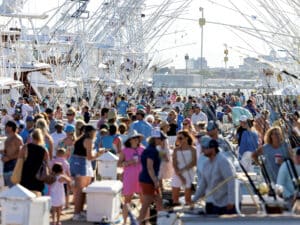
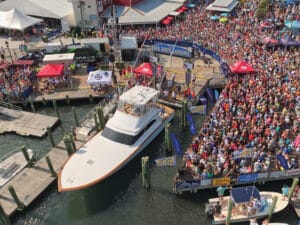
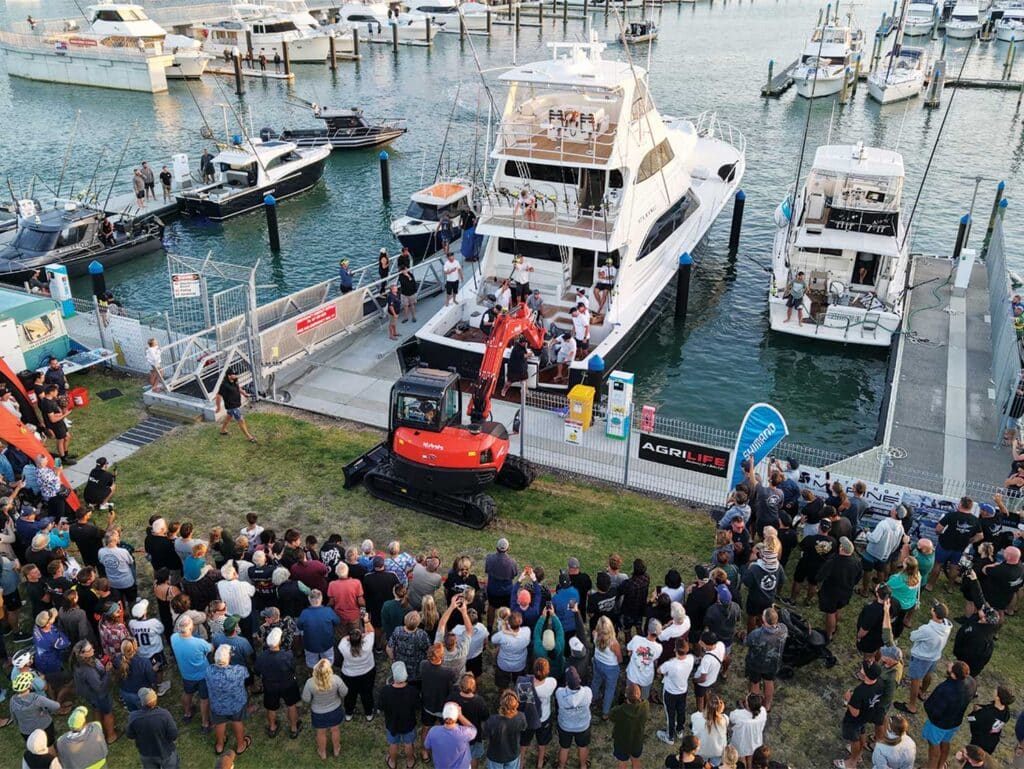
The livestream worked because the Whitianga scene is already electric. On Day 1, several thousand people lined the cliffs and wharves around Mercury Bay for the shotgun start. When the estimated arrival times were pushed to radio and online, the temporary bleachers filled. The weigh station turned into a festival grandstand. Kids queued for ice cream, grandparents compared leaderboards, and every spectacular hoist at the gantry set off a fresh ripple of cheers. It’s the sort of genuine, ground-up enthusiasm that many big-money tournaments would pay to bottle.
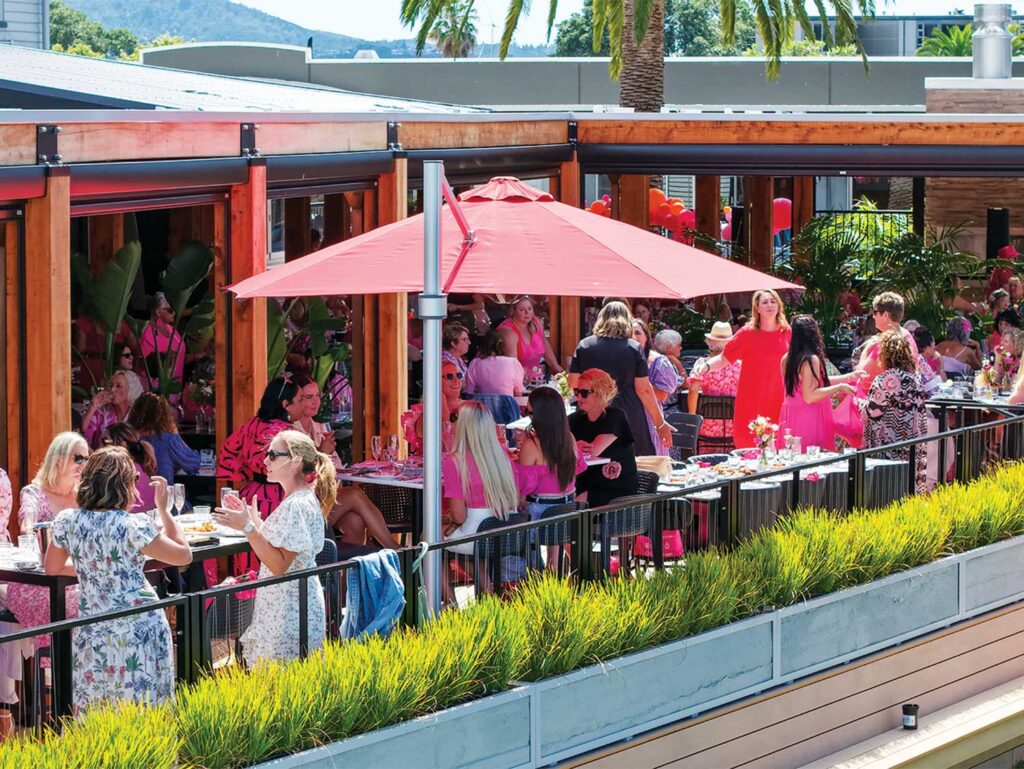
Maxwell continues: “The carnival atmosphere generated in the community extends beyond the event. Whitianga as a destination gets a great deal of positive publicity from the tournament. The wider Coromandel region has a lot to offer visitors, numbers of which are boosted over the event and beyond.”
The Classic’s community footprint is undeniable, with more than NZ$50,000 ($29,292) raised and donated across local charities and organizations. Beneficiaries included the Whitianga Coastguard, Mercury Bay Game Fishing Club, Mercury Bay Rugby and Sports Club, and the Whitianga Fire Brigade. Additional support extended to breast-cancer research, children’s hospitals and food banks, ensuring the event’s impact reached far beyond the docks.
Anyone who has fished the other big Mercury Bay events will appreciate the logistics involved in running a tournament with four times as many boats as the typical event. Berths are the pinch point. “We are fortunate to have the support of the Marina Society and the Whitianga Waterways. Every berth, mooring and anchorage is fully utilized for the event,” Maxwell explains. The fact that it works at all is a testament to local buy-in—and no small amount of Kiwi problem-solving.
The conservation story is just as strong. Across four days, 127 billfish were captured, with all but eight tagged and released. That’s a 94 percent tagging rate under strict IGFA rules. Each tagged fish went into the draw for that NZ$125,000 Stabicraft 1550 and Kubota Sidekick package, turning ethical practice into a shot at a life-changing prize.
Maxwell, a longtime Mercury Bay charter captain with several local business interests, says other New Zealand clubs have approached him about spinning up similar events in their waters. “The Whitianga contest has certainly laid down a certain standard that would be hard to replicate elsewhere,” he says.
It’s not hard to see why. The Classic lands during the shoulder of the summer tourist season, giving retailers and hospitality operators a final, vital surge heading into winter. Bleachers fill, ramps jam, and the town hums with anglers and crew swapping stories at the local pub about chasing swordies in the dark and that infamous mystery bite that never quite stuck.
As for 2026, Maxwell is looking to refine, not completely reinvent the proverbial wheel. He will continue to fine-tune the tournament based on feedback from the participants and advertisers. “We have most things right, thanks to the cooperation of all concerned, including the locals who can see the benefit the Kubota Billfish Classic brings to the wider community,” he says.
The truth is that the biggest billfish tournament in the world, by team count, doesn’t come out of Cabo, Kona or the Carolina banks. It roars out of Whitianga, where a sea of trailer boats—backed by a town that cooks, volunteers, donates and cheers—has built something the rest of the world is only just starting to notice.
Made Possible by a World-Class Fishery
For nearly a century, overseas anglers have been drawn to New Zealand’s waters in pursuit of record-setting catches of striped marlin, broadbill swordfish and yellowtail kingfish. In the 1920s, legendary American author and angler Zane Grey made several pilgrimages Down Under, immortalizing the extraordinary fishery in his books—most famously Angler’s Eldorado—and in countless articles. Remarkably, one of Grey’s boats, Otehei, still plies the Bay of Islands 100 years later. A glance through the latest IGFA World Record Game Fishes publication reaffirms the strength and diversity of the New Zealand fishery.

Striped Marlin
The current all-tackle record of 224.1 kg (494 pounds) was set in 1986 by Bill Boniface, fishing out of Tutukaka. Of the 23 conventional-tackle world records for striped marlin, an astounding 18 were caught in New Zealand waters. The Jacobsen family—Guy, Eryn and Kylie—feature prominently, accounting for eight of those marks, many with the noted Capt. John Batterton at the helm. New Zealand also claims three junior/small-fry records and one fly-tackle record.
Broadbill Swordfish
While the all-tackle record of 536.2 kg (1,182 pounds) belongs to Chile, New Zealand has produced 10 men’s and women’s line-class world records. Again, Eryn and Guy Jacobsen are at the forefront. Among the most notable is Jim Gigger’s 404.4 kg (891.5-pound) swordfish, landed on 37 kg tackle at Cape Karikari in 2012 aboard Capt. John Gregory’s renowned charter boat, Primetime. That catch, made during what was meant to be a routine reconnaissance trip, unexpectedly set a new world benchmark.
Yellowtail Kingfish
New Zealand also dominates the Southern yellowtail kingfish record book. The all-tackle record of 52 kg (114 pounds, 10 ounces) is shared by two Kiwi anglers: Mike Godfrey (1984, Tauranga) and David Lugton (1987, White Island). Lugton’s fish was landed on 15 kg tackle. Of the 22 line-class records for the species, all but one were caught in New Zealand waters. The lone outlier is the women’s 1 kg line-class record, set at Bellambi, New South Wales, Australia. Among the most impressive ultralight feats is Gavin Spaabaek’s 15.2 kg (33.5-pound) kingfish on just 1 kg line, landed at Whangaparaoa in the Hauraki Gulf.