Subscribe to Marlin magazine and get a year of highly collectible, keepsake editions – plus access to the digital edition and archives. Sign up for the free Marlin email newsletter.
Ever since legendary captain Tommy Gifford had the idea to get a larger spread and refine the “drop-back,” and subsequently implemented his “outrigger” idea, the refinements and benefits have snowballed. Gifford started with bamboo poles attached to the boat with an articulated fitting at the base, a lay-down arm on the bridge, and a rope going forward to hold it from collapsing aft on the bite. Glass eyes were used to run the rigger lines through, with clothespin-style clips to hold the fishing line.
Through companies like Lee’s in Miami, the poles morphed into fiberglass with cast-metal mounting and layout systems. With the need for more strength for larger baits and longer poles for larger boats, aluminum poles with spreaders and aircraft cables to stiffen them became the standard. The first early sets by Rybovich and then Lee’s had more-refined hardware and integrated the backbar to replace the rope going forward. They also featured an articulated lay-down arm to get more spread and integrated eye bolts to run lines through.
Then along came the genius of Micky Rupp, who in 1980 founded his company Rupp Marine in Port Salerno, Florida. An avid offshore angler and innovator, Rupp used his machinery expertise to break down the outrigger systems and dramatically improve them through stronger, lighter-weight poles with replaceable sections. He integrated replaceable components, such as individual spreader arms, spreader arm tips, and cables with swaged fittings on the ends, and a more easily adjustable system to install on the myriad production and custom boats from 35 to 55 feet being produced at the time.
Today, those systems have once again morphed into larger, longer, stronger systems to fit the 65- to 95-foot sport-fishing boats of today. These larger boats and boats with enclosed bridges with longer poles are impractical to lift by hand. The solution was a hydraulic system developed to deploy and raise the riggers. We also have seen a great deal of development in outrigger clips with companies like AFTCO offering its Roller-Troller, the infamous Black’s clip, R&R Tackle with its articulating clip, and gear that gives you the ability to deal with multiple lines from Gemlux for single-, two- and three-line rigger line blocks with locks to eliminate line creep. All these solutions offer benefits that have solidified the need for quality outrigger components to do a better, more efficient job on the water.

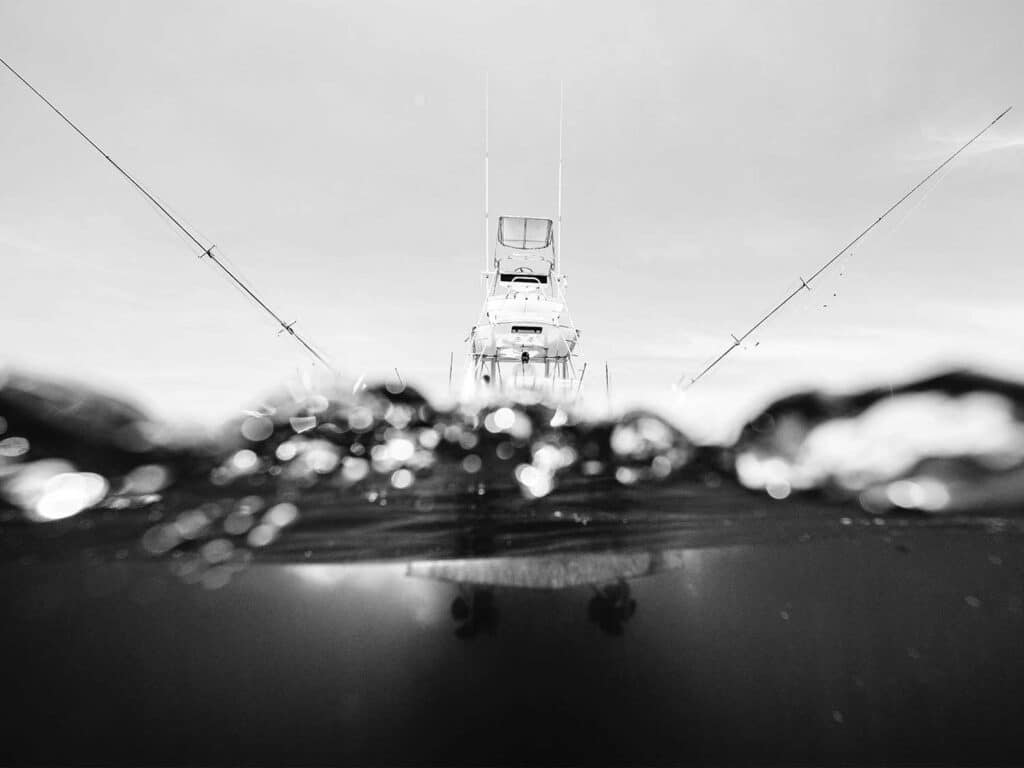
These rigger systems have proven themselves invaluable for years, but through technological advances in materials and components, we have once again seen a return to the single-pole, no-spreader outrigger. It was only a matter of time for the stiffness and lightweight qualities of carbon fiber to be utilized. It started on center-consoles, and a few crafty individuals who had a working knowledge of carbon fiber fabricated their own on custom boats. Now the carbon-fiber, single-pole, no-spreader outrigger is coming of age, and Gemlux offers these spreaderless solutions with its Gulfstream Outriggers to those who see the benefits.
Globe-trotting and record-setting Kiwi captain John Batterton feels that the simplicity, stiffness and lower maintenance are all benefits of the carbon-fiber system. The Gemlux Gulfstreams have no spreaders or stays and come in three diameters (2, 2⅜ and 3 inches) and in any length from 26 to 61 feet. Obviously, the longer the pole, the more diameter you’ll need at the base. They feature anodized aluminum hardware and have prebuilt attachment points for teasers and dredges, or they offer hardware the captain can apply where he or she wants them.
The Rupp carbon Bigg Riggs come in lengths from 28 to 55 feet in two-, three-, four- and a new five-spreader configuration. Capt. Nick Bovelle on the 77-foot Merritt Catch has a set of four-spreader carbon Bigg Riggs with the PowerRigger hydraulic system and has nothing but praise for them. Having fished Cape Verde and the Azores for the past two seasons and traveled over 10,000 nautical miles on his bottom this season alone while fishing in very rough conditions, he is wholly impressed with their resilience, toughness and reduced maintenance. On one occasion he dipped a rigger and felt sure an aluminum rigger would have collapsed, whereas the carbon fiber held fast.
Like anything, it will take time for these technologies to get mainstreamed. The look is different, as they come in black or white, which are not the norm. The more boats that integrate this technology, the more rapidly it will advance the standard of performance and easier maintenance, helping crews focus on fishing and keeping the boat tight. It’s a long way from a bamboo or cane pole, but the idea behind these outriggers was as sound then as it is practical today. Even though they utilize space-age technology blended with time-honored components, outrigger systems are arguably the most taken-for-granted and overlooked component on boats today.