Subscribe to Marlin magazine and get a year of highly collectible, keepsake editions – plus access to the digital edition and archives. Sign up for the free Marlin email newsletter.
How did you spend your fall? Pumpkin patches and college football? Mullet runs and tuna fishing? Not me. This fall, I spent a good part of my early Q4 nerding out and getting a crash course on some of the newest technology to enter the marine and boating world.
Each year, between the months of September and November, there are three significant events in the marine and boating world where the latest and greatest are unveiled. First is the National Marine Electronic Association (NMEA) Conference, which took place in September in West Palm Beach, Florida. Just a few weeks later was the International BoatBuilders’ Exhibition & Conference (IBEX), which was held in Tampa, Florida, and is North America’s largest technical trade event for marine industry professionals. Completing the triumvirate is the renowned Fort Lauderdale International Boat Show (FLIBS), the granddaddy of them all.
I had been going to these shows for more than a decade, catching up with old friends and enjoying the festivities and early cocktail hours. But never had I gone in with the specific mission of identifying the most innovative new products for the big-game enthusiast.
After completing the marine-product Triple Crown and sitting down to compile this list—sorting through countless business cards, promotional material and notes—two overarching things resonated with me: the immense volume of new products entering the market, and the incredible pace at which marine technology is advancing. If you thought AI was just limited to ChatGPT, think again. It’s already becoming established in the marine navigation and forecasting realms.
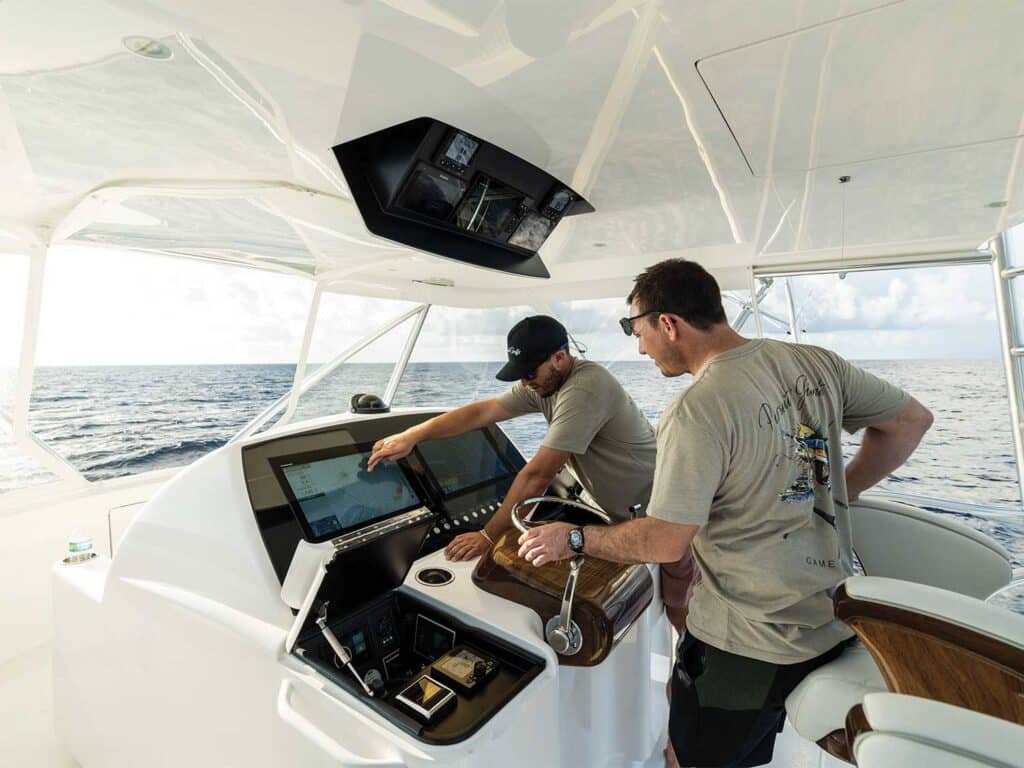
From clever, practical solutions to age-old onboard problems to groundbreaking advances in electronics, propulsion and comfort, these are the products that caught my attention. While perhaps not as grandiose or sexy as the latest and greatest AI tool, each one is thoughtfully designed to either solve a problem or make your time on the water more enjoyable—and both in some cases.
CAT Marine C2.2B Genset
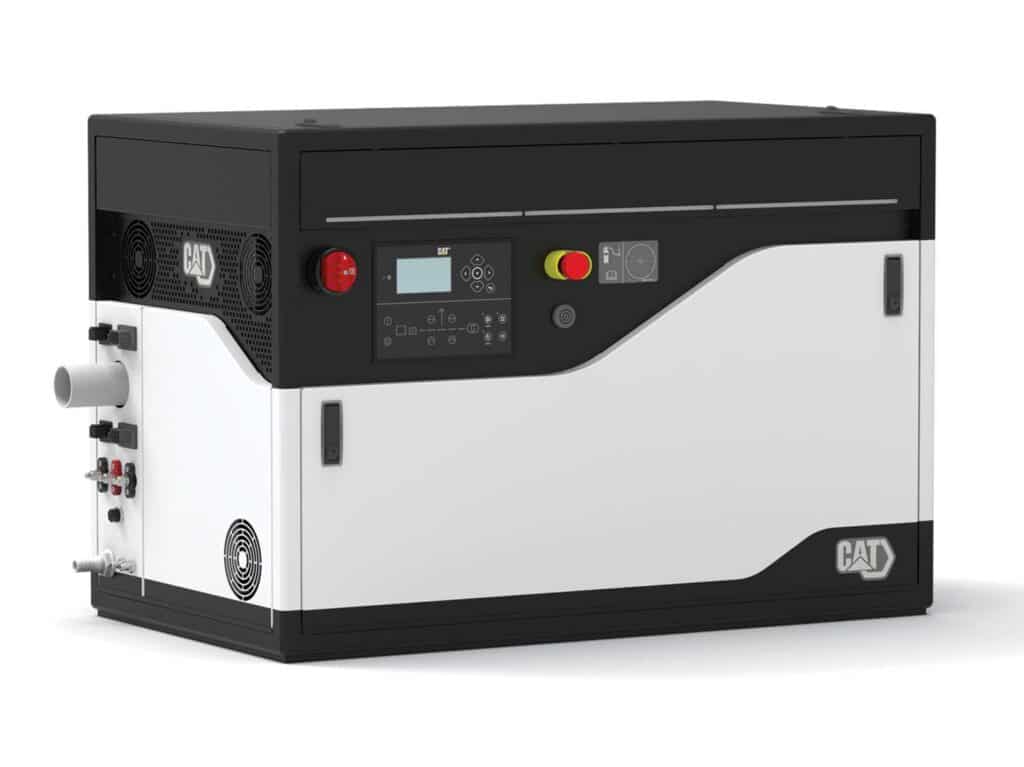
CAT Marine’s return to the small-vessel market was long overdue, and the new C2.2B genset shows the company didn’t ease its way back in. Launched at FLIBS, it’s CAT’s smallest sound-enclosed generator ever. With four power ranges from 16 ekW to 26 ekW, the genset’s compact size optimizes engine-room space for amenities of the vessel owner’s choice.
Designed to deliver reliable, compact, efficient auxiliary power, the C2.2B integrates cleanly with additional gensets, battery systems and helm displays, and its standard paralleling functionality lets crews run on one or both units seamlessly. The advanced control system adds real intelligence with AC monitoring, digital AVR, alarm/shutdown logic and smooth load-sharing.
But the star of the show is still the LED status strip, a brilliantly simple indicator that gives an instant read from anywhere in the engine room: white for normal, amber for a warning, red for a fault. No screens, no fuss. Backed by CAT’s global dealer network, the C2.2B is small, quiet, fuel-efficient, and engineered to run hard without complicating your life—a sharp, modern comeback from one of the most trusted brands in marine power.
Airmar UltraWide Chirp Transducer
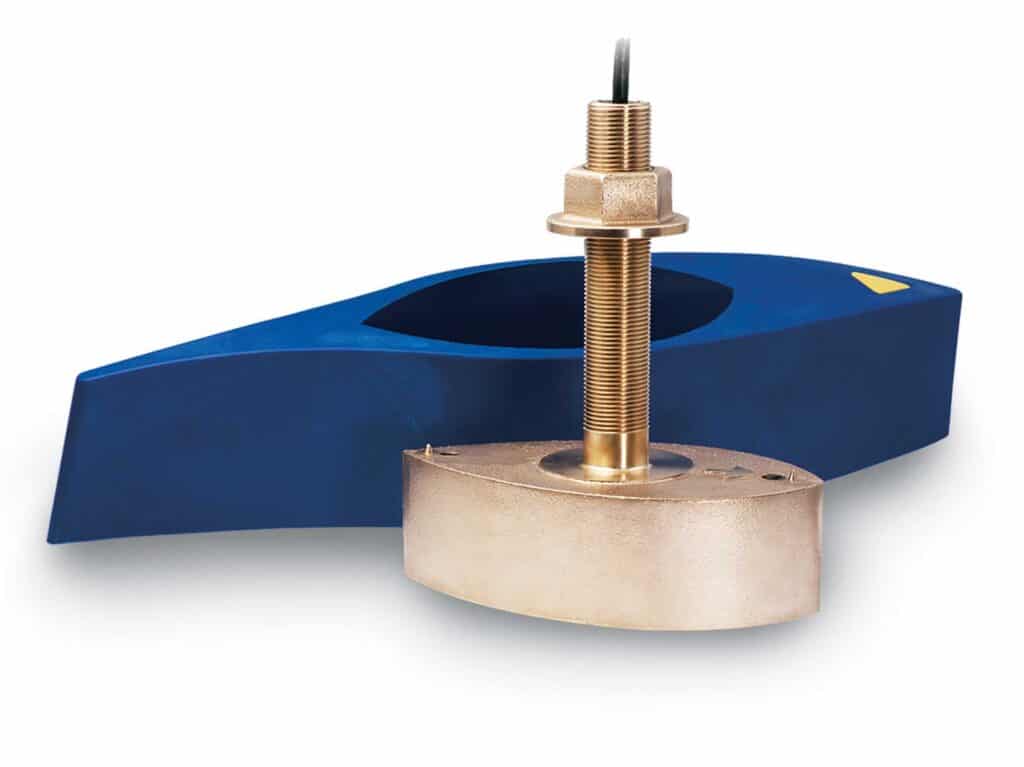
Airmar has long been a quiet powerhouse in the marine electronics world, but its newest ultrawide chirp additions—the B275MWHW and TM275MWHW, if you really want to get specific—feel like a jump forward in real-world fish-finding. Introduced at the NMEA Conference, each 1 kW transducer features Airmar’s concave ceramic array, giving anglers a massive 73-degree medium-frequency beam and a 25-degree high-frequency beam. That’s not just more data; it’s a fundamentally different perspective of the water column.
For big-game anglers, pairing one of these with your existing sonar completes the picture. Instead of scanning a narrow cone, you cover a broad swath of the midwater column, where pelagics roam and feed. It’s the difference between seeing “something beneath the boat” and understanding the full environment—bait schools sliding off to the side, predators roaming the rips, subtle thermoclines you’d normally miss.
Thinking about upgrading electronics down the road? Airmar’s Mix and Match system is a smart bonus. One transducer can pair with a wide range of major display brands simply by swapping the short adapter cable—no haulout, no reinstall. And because Airmar engineered these to integrate cleanly with Furuno, Raymarine and Humminbird chirp systems, most crews can upgrade without rerigging the helm.
ElectroSea DryGenie
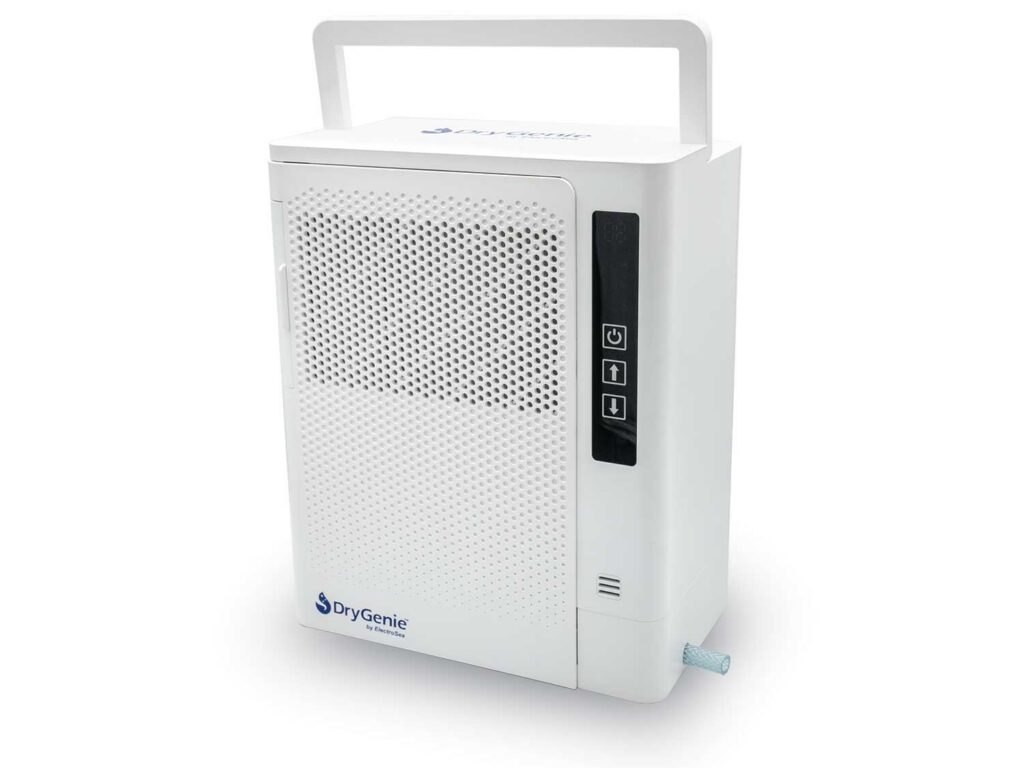
ElectroSea built its reputation by solving the unglamorous but absolutely necessary problems aboard, and the DryGenie fits right into that lane. Not every new product needs to be a moon shot; some are just clever, practical answers to things boaters battle every single day. Moisture is one of them.
Unveiled at the 2025 Fort Lauderdale International Boat Show, the DryGenie tackles humidity head-on, pulling up to 3 liters of water per day, which is roughly triple what similarly sized units manage. It’s engineered specifically for boats, factoring in tight installation spaces, constant vibration, fluctuating temps, and the harshness that comes with running offshore.
With smart controls and quiet performance, the DryGenie keeps cabins fresher, woodwork safer and electronics happier. It’s the kind of “small” innovation that makes a noticeable difference, especially on sport-fishing boats that see brutal humidity, wet gear, and occasional long sits without AC. It’s practical, smart and refreshingly straightforward.
Dometic CSX Marine Cooling Unit
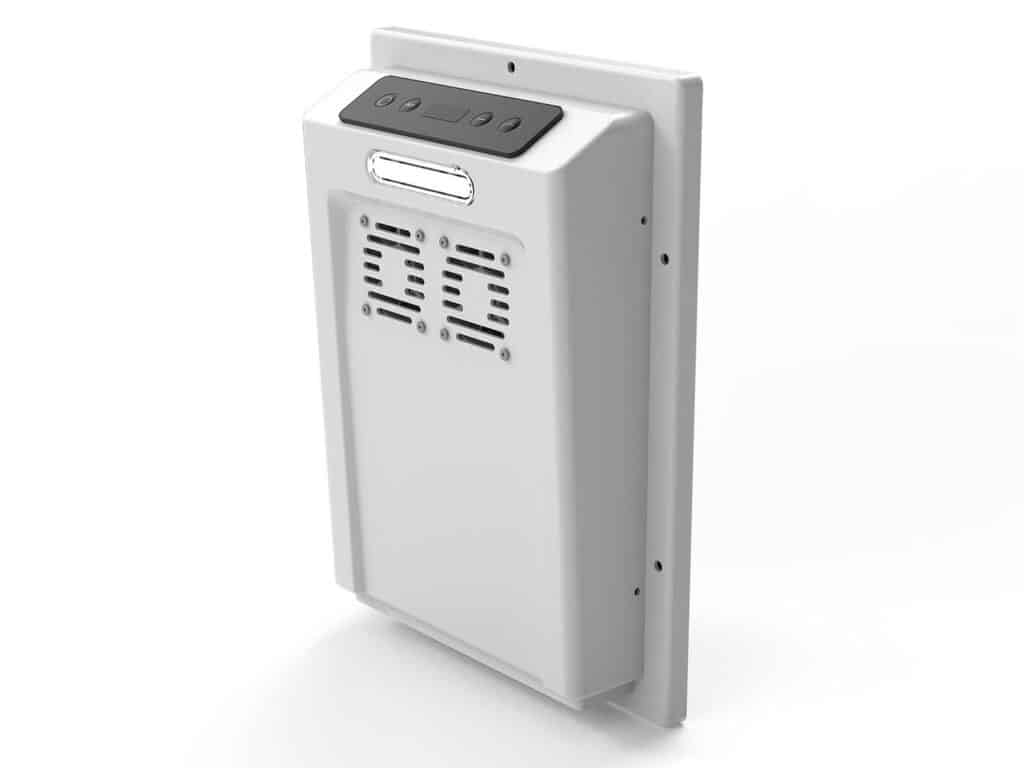
Dometic’s new CSX Series might just be one of the coolest products (pun intended) to hit the market recently, and the NMMA seems to agree, awarding it a 2025 Innovation Award. For big-game anglers, the appeal is obvious: The CSX transforms any pre-insulated compartment into a full-function refrigerator or freezer. Think about all the unused or oddly shaped spaces on a sport-fisher—now they can become bait storage, a provisions cold-hold or a dedicated fish box.
The CSX is self-contained, available from 60L to 400L, and installs without remote compressors or complicated rigging. Power draw is impressively low—up to 15 percent less than previous models—thanks to a high-efficiency compressor, smart digital controls and a fan-cooled evaporator. It also runs on a low-GWP refrigerant, keeping things more environmentally friendly.
For traveling boats, tournament programs, and crews who always seem to need more cold storage, the CSX provides a flexible, modular option without tearing up the boat. Practical, efficient and genuinely useful, it’s a well-deserved award-winner.
Em-trak X100 VHF
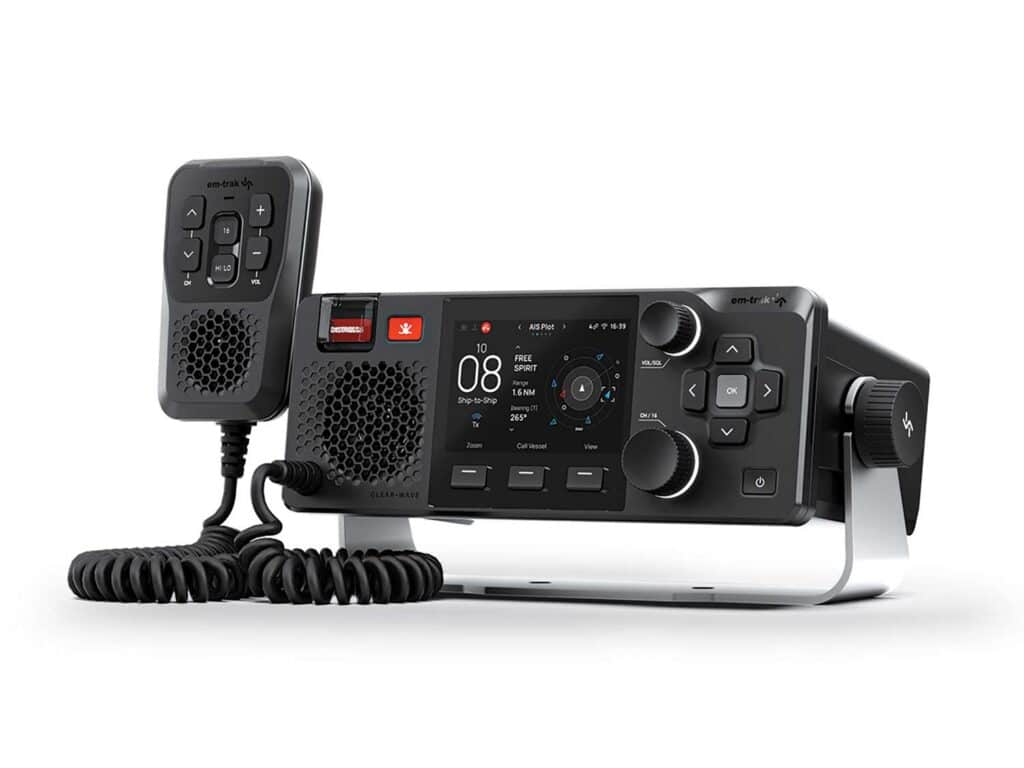
The Em-trak X100 feels like the point where VHF finally joins the rest of the modern world. And for someone who still likes a traditional VHF, that’s exciting news. A big part of that is Connect-X, which turns your smartphone or smartwatch into a fully functional wireless command mic. You can make VHF calls, monitor AIS targets, get nav alerts, and move freely around the boat, such as from the tuna tubes to the bridge without running back to the helm to call it in.
For tournament crews or kite-spread teams, the private intercom function is a huge bonus. Multiple phones and watches can link together for seamless communication without yelling over the cockpit.
Add in the integrated Class B AIS, DSC, GPS and zero-loss antenna splitter, and the X100 becomes one of the most versatile comms tools available. Em-trak is known globally for rugged AIS systems, and this feels like the natural evolution: a modern interface, bulletproof hardware and truly useful onboard connectivity.
Frigibar Polar Cap II
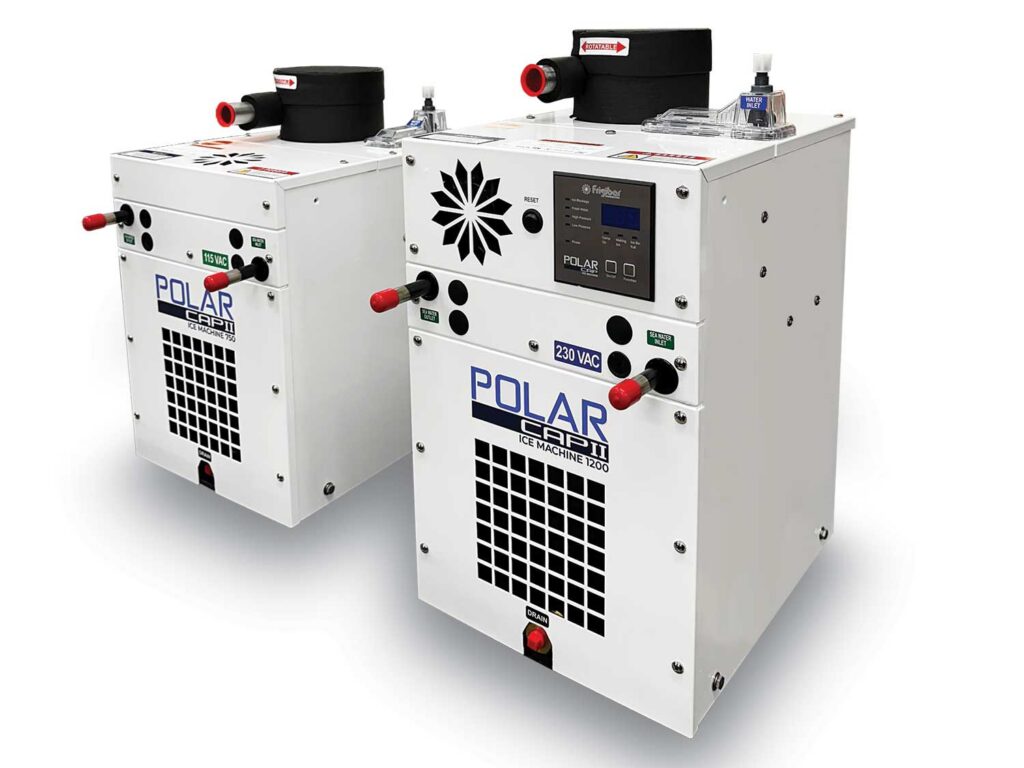
The Frigibar Polar Cap II was one of the standout products I came across at IBEX this year—and it didn’t just catch my eye on the show floor. Longtime Marlin contributor Capt. Karl Anderson, who just wrapped up a gorgeous new Merritt build, spoke highly of it as well. When a guy with Karl’s experience and miles gives a piece of equipment a thumbs-up, you tend to pay attention.
Built for serious fishing programs, the Polar Cap II and its XL version produce an impressive 750 to 1,200 pounds of ice per day, with the ability to deliver ice up to 30 feet away. That kind of output is a big deal for crews who run hard and go through ice fast. The system is housed in powder-coated aluminum with titanium condenser coils—a combination made to survive the saltwater world—and the commercial-grade auger keeps production steady even on hot, demanding days.
What really separates this machine from competitors is its rotatable output mechanism, allowing installs from three sides or from the base, giving crews and builders far more flexibility. And despite its capability, it boasts the most compact footprint in the category, up to an inch shorter and 3 inches narrower than the smallest competing models.
Fast, durable, compact and smartly engineered, the Polar Cap II feels tailor-made for modern center-consoles and sport-fishing boats. It’s a sharp upgrade for anyone who treats ice as mission-critical.
Garmin GPSMap 9000xsv
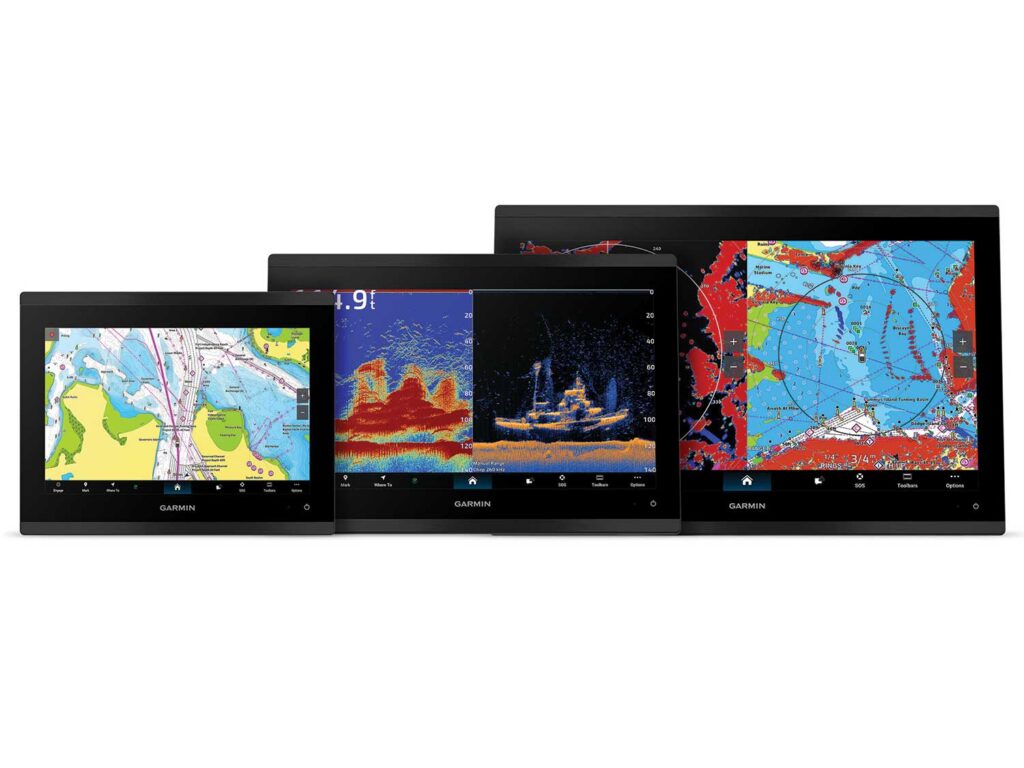
Garmin’s GPSMap 9000xsv brings top-shelf technology and sonar capabilities to more compact sizes, perfect for center-consoles, express boats, and crews who want serious electronics without rearranging the helm. Offered in 10, 13 and 17 inches, the displays deliver gorgeous 4K resolution (on the two larger models), which makes charts, sonar returns and even onboard entertainment crisp and easy to read.
Under the hood, Garmin packed its most advanced sonar, complete with integrated xCHIRP, UHD scanning sonar and RapidReturn, which doubles the update rate for a more fluid picture when running or marking bait. Add in 5 GHz Wi-Fi, full BlueNet networking and OneHelm digital switching, and these units act like the boat’s nerve center.
Garmin continues to win NMEA Manufacturer of the Year honors for a reason. The 9000xsv is intuitive, powerful, and built for anglers who want maximum capability in a manageable footprint.
FishCast by Simrad
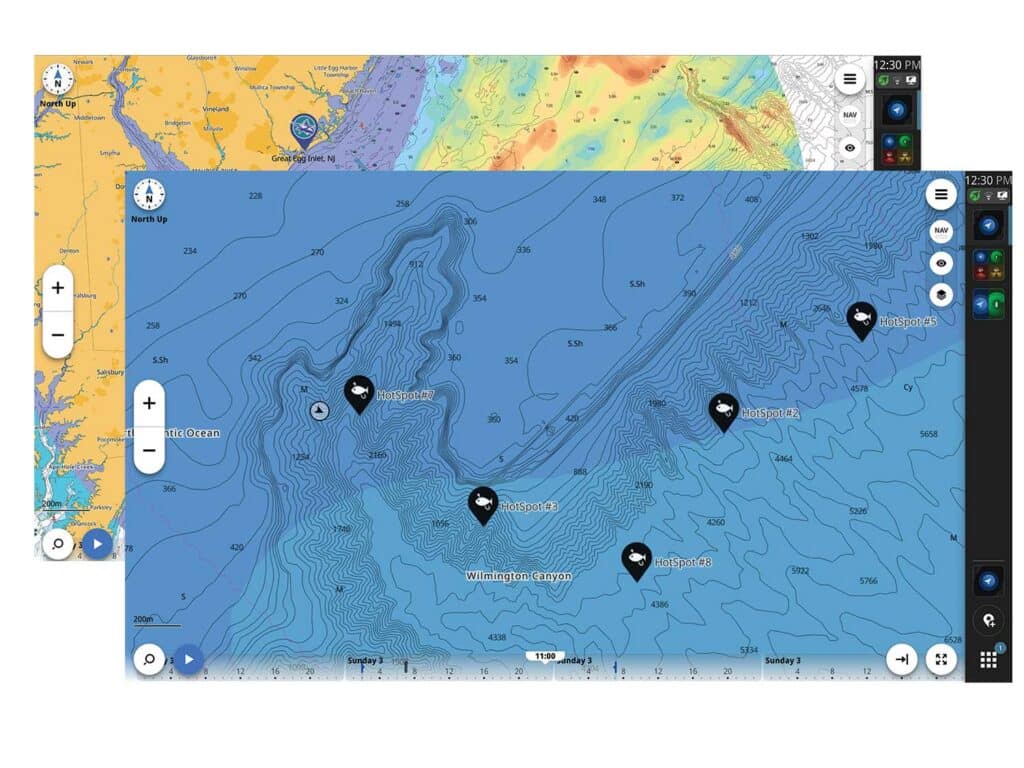
FishCast represents one of the clearest examples of how AI is becoming woven into the everyday tools of offshore fishing. Built into select Simrad displays as a chart overlay, FishCast combines ROFFS’ decades of historical catch data with Fathom Science’s AI-powered ocean modeling to highlight where pelagics are most likely to feed.
Instead of flipping between apps, satellite charts and screenshots, everything appears directly on your helm display: real-time and forecast SST, chlorophyll, color breaks, currents and ROFFS hotspot history, all distilled into high-probability fishing zones.
You can look ahead hours or days, set a custom search radius, and generate ranked areas to target before ever leaving the slip. For crews who want to maximize their time offshore, especially tournament teams, this level of intelligent forecasting is incredibly valuable.
FishCast isn’t gimmicky; it’s the next logical step in data-driven fishing, bringing pro-grade analysis to anyone running a Simrad NSX or NSS4.
Sharrow by VEEM Inboard Propellers
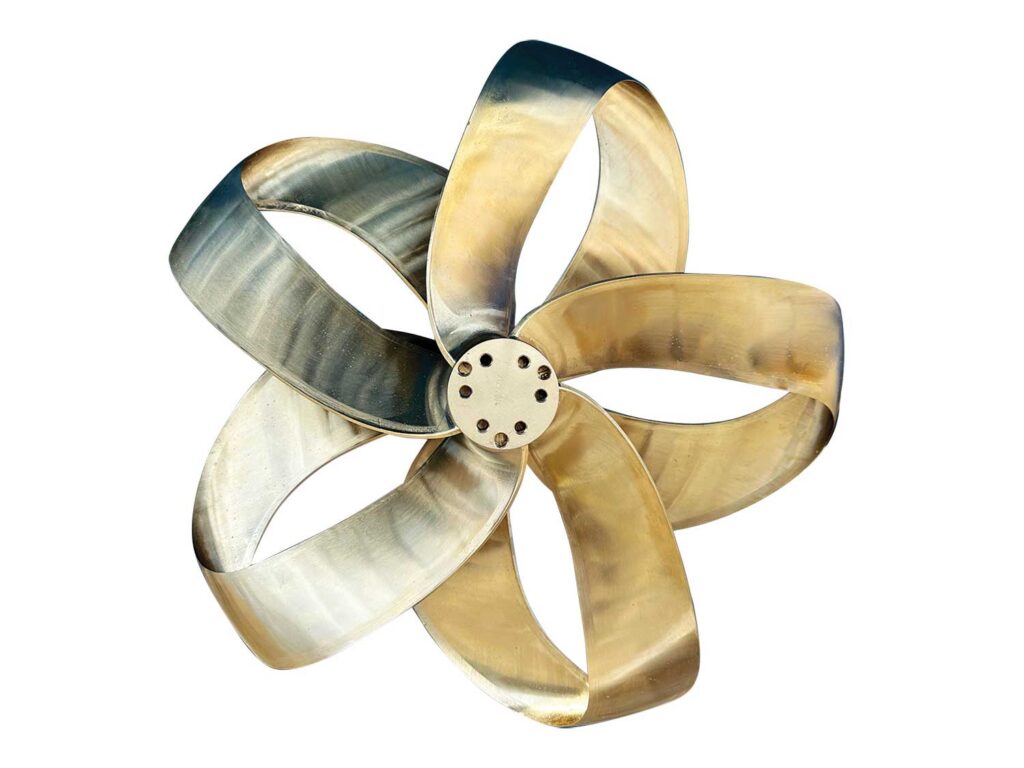
Possibly the most talked-about new product in propulsion, Sharrow’s loop-blade design exploded onto the outboard scene—and now its partnership with VEEM is turning heads in the inboard world too. VEEM brings decades of high-end manufacturing experience, while Sharrow contributes the patented geometry that reduces cavitation, increases lift, and dramatically improves low-speed handling.
On VEEM’s 64-foot Viking test boat, the results were noticeable: smoother acceleration, better reverse authority, improved fuel economy and a quieter ride overall. For big-game boats that see everything from long-range runs to precise docking maneuvers, those gains matter.
This inboard adaptation feels like the beginning of a new era in propeller design, one where efficiency and comfort improve without overhauling the powertrain. If dock talk is any indicator, Sharrow by VEEM is just getting started.
Tohmei ARG Stabilizer
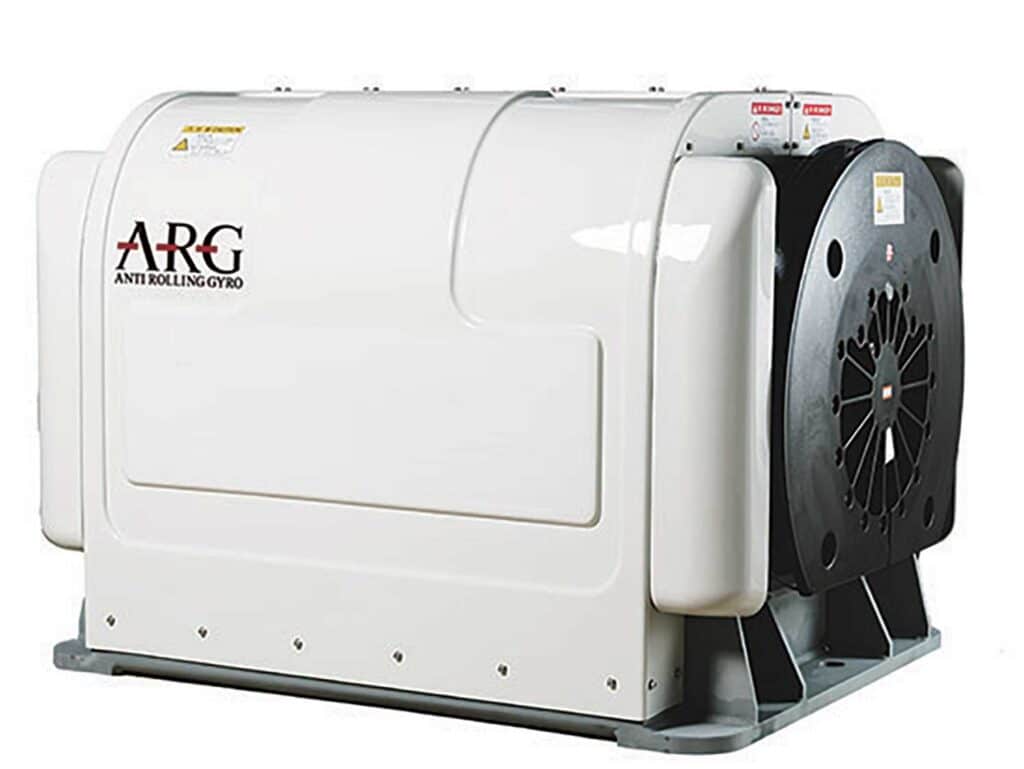
I first learned about Tohmei’s Anti-Roll Gyro (ARG) products at FLIBS after meeting Mr. Koji, an avid Japanese angler and businessman who represents Yellowfin and several other top American brands in Japan. He spoke highly of the company’s 30-plus years of gyro experience, which was news to me, given how new the brand feels in the North American sport-fishing scene. But globally, and especially in commercial sectors, Tohmei has been a trusted name for decades. Now, with a growing dealer network and a U.S. office in Fort Lauderdale, Florida, the brand is making a push into our market.
In talking about the product with Koji, the ARG stands out for one major reason: heat management. While most gyro systems generate substantial heat and rely on complex cooling circuits, Tohmei takes a different approach. The spinning flywheel creates airflow within the unit, allowing it to cool itself internally. That means fewer systems and fewer headaches from heat generation. In short, it’s a new cool-running, low-maintenance gyro option earning attention quickly in the sport-fishing world.